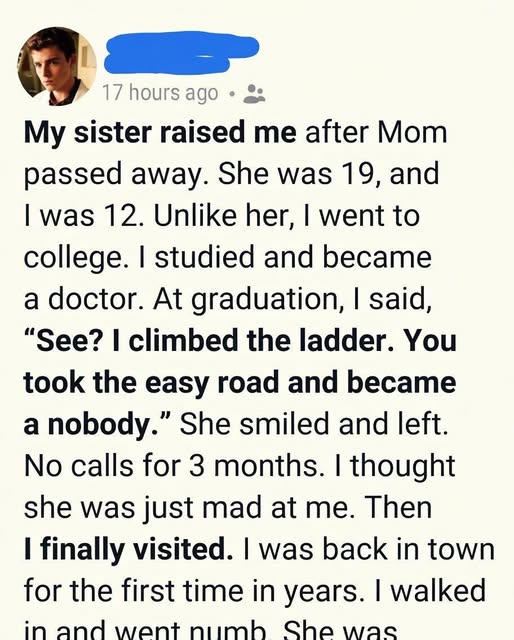
There are moments that feel small when they happen—words spoken quickly, judgments made with confidence, beliefs held so tightly they seem unquestionable. Yet those same moments can quietly echo through everything that follows. I didn’t understand that the day I stood in my graduation gown, surrounded by applause and certainty, convinced that everything I had achieved was mine alone. In that moment, I divided the world into simple categories: those who worked hard and succeeded, and those who didn’t. I placed myself at the top of that equation—and my sister somewhere far beneath it.
When I spoke, my words were sharp, dismissive, and careless in a way only pride can justify. For a brief second, I felt powerful, as if I had defined my worth out loud. But the silence that followed carried something far heavier than any argument. She didn’t fight back. She didn’t correct me. She simply looked at me with that familiar, tired kindness—smiled in a way that held no anger—and walked away. At the time, I told myself it meant nothing. Later, I would understand it meant everything.
In the months that followed, I built a life that looked exactly as I had imagined. Work filled my days, success filled the spaces in between, and from the outside, everything appeared complete. But there were quiet moments—unexpected, persistent—when I would reach for my phone to call her, only to stop myself. Instead of confronting the distance, I justified it. I told myself she needed time, that she was strong, that things would eventually return to normal. What I refused to admit was far simpler: I had hurt her in a way I didn’t yet understand.
When I finally went back home, it wasn’t because I had found clarity—it was because something inside me no longer felt right. The house looked the same, the streets unchanged, but the air carried an absence I couldn’t ignore. I called her name once, then again. No answer. The silence was different now—deeper, heavier, final in a way I wasn’t prepared for. Then I saw the note.
Her handwriting was steady, familiar. She wrote that she was tired—not the kind of tired sleep could fix, but the kind that comes from years of giving everything without pause. She said she didn’t blame me. That hurt more than anger ever could. She explained that my words hadn’t just stung—they had revealed something she could no longer ignore: that everything she had sacrificed had become invisible, even to me. She hadn’t left out of resentment. She had left to finally find something for herself.
At the end, she wrote that she was proud of me. That she always had been. And that she hoped one day I would understand—not to feel guilt, but to truly see.
I read that letter over and over, as if repetition might change it, as if somewhere between the lines there might be a way to fix what I had broken. But there wasn’t. What came instead was something slower, heavier—a realization that settled into every part of me. I began to see what I had never allowed myself to notice before. The long nights she must have endured. The opportunities she had quietly given up. The way she carried responsibilities I never questioned because they were always handled before I could see them.
The life I had claimed as my own achievement had never been mine alone. It had been built—carefully, quietly—by someone who asked for nothing in return except to be seen.
In the days that followed, I searched for her. Through old contacts, familiar places, anything that might lead me back. But the deeper search wasn’t outside—it was within. I began to understand how easily we overlook quiet strength, how often we measure worth by what is visible while ignoring everything that isn’t. My definition of success began to change. Not disappear—but deepen. Expand. Become something that included gratitude, awareness, and humility.
I started carrying her letter with me. Reading it when I needed to remember—not just what I had lost, but what I still had the chance to become. The way I spoke to people changed. The way I listened changed even more. I began to recognize that the strongest love is often the least visible—the kind that builds a life for someone else without ever asking to be acknowledged.
I don’t know where she is now. That uncertainty doesn’t fade—it simply becomes something you learn to carry. What remains is the lesson she left behind. That some words cannot be taken back. That some gratitude arrives too late to be spoken directly. But also, that even in regret, there is responsibility.
If I ever see her again, I know what I will say. Not perfectly. Not in a way that erases the past. But honestly, from a place that didn’t exist before.
And if I never do—then the life I live will have to become the apology.
Because sometimes, love doesn’t disappear when it’s unseen. It waits. Quietly. Until you finally learn how to recognize it.