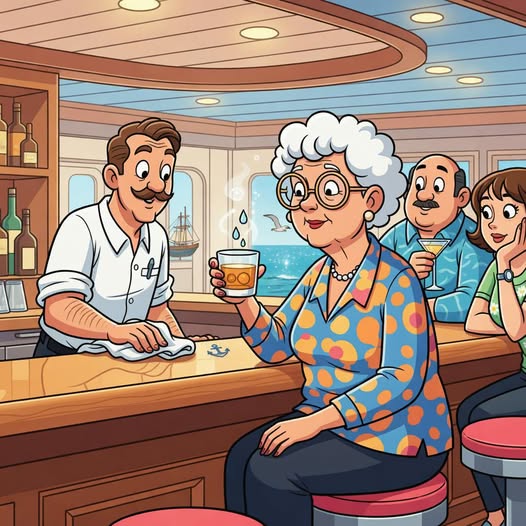
The old woman let out a soft giggle—light, almost playful, as if it belonged to another time—and lifted her glass in a small, private toast. The bartender, already polishing a perfectly clean glass, leaned in just a little closer, curiosity quietly taking over. Around them, the cruise ship bar hummed with life—low music, clinking glasses, conversations drifting in and out—but something about her presence seemed to draw the noise inward, as if her words might matter more than the evening itself.
She looked down at the amber liquid and smiled. “I’m not really drinking for the taste anymore,” she said gently. The bartender hesitated, unsure whether to respond, but she continued before he could. “At my age, habits aren’t about what they seem. They’re about who you were when they began… and who you refuse to forget.”
She took a slow sip—not savoring the flavor, but the moment—and placed the glass carefully back on the bar. “Eighty years is a long time,” she said. “Long enough to forget things you swore you never would… and remember things you sometimes wish you could.” Her eyes drifted far beyond the room. “I used to hate Scotch,” she admitted with a quiet laugh. “Too strong, too serious. I was a champagne girl once—loud, bright, always laughing. But life…” She paused. “Life changes your taste.”
Her finger tapped lightly against the rim of the glass. “The two drops of water,” she said, “they’re not for the drink. They’re for him.”
The bartender straightened slightly, listening now with full attention.
“He taught me,” she continued. “Said good Scotch doesn’t need much—just a couple drops to open it up, let it breathe… let it tell its story.” She smiled softly. “He used to say people were the same.”
She leaned back, letting the memory unfold. “I was twenty-two when we met. Traveling alone, thinking I knew everything. He was at a bar—just like this one—arguing about something unimportant, probably with far too much confidence.” She chuckled. “I thought he was unbearable. By the end of the night, I knew I’d marry him.”
The couple nearby leaned in, caught in the quiet gravity of her voice.
“He ordered a Scotch,” she said. “And when it arrived, he added two drops of water with such care, like it mattered more than anything. I asked him why, and he said, ‘Because even the strongest things deserve a little gentleness.’”
Her hand rested around the glass, not gripping it, but holding it like something familiar.
“We had a good life,” she said softly. “Not perfect—never perfect—but good. We argued about nonsense, laughed about everything else, and never went to bed angry. That was his rule. ‘Life’s too short,’ he’d say.” She paused, her expression shifting—not to sadness, but to something deeper. “Funny how right he was.”
The room had grown still now.
“He got sick in our sixties,” she continued. “One of those illnesses that doesn’t wait, doesn’t ask. It just… takes.” She met the bartender’s eyes, calm and steady. “On his last good day, we had a drink together. Scotch, of course. His hands were shaking, but he still added those two drops of water.”
She smiled faintly. “I asked him if it really mattered anymore. He said, ‘It always matters. The small things are what make the big things bearable.’”
For a moment, no one spoke.
“After he passed, I stopped drinking altogether,” she went on. “It felt wrong. Like continuing a conversation alone.” She looked down at her reflection in the glass. “Then one day, on his birthday, I poured one. Just one. Sat by the window… and added two drops of water.”
Her voice softened, but didn’t break. “And for the first time since he was gone… it didn’t feel like he had left. It felt like he had just stepped out for a moment.”
The bartender exhaled quietly, unaware he had been holding his breath.
“So you see,” she said, lifting the glass again, “it’s never been about the Scotch.”
She held it there for a second, as if honoring something unseen.
“It’s about remembering that love doesn’t disappear. It just changes shape. Becomes quieter… softer.” She smiled. “Like two drops of water in something strong.”
She took a small sip and set the glass down with a gentle clink.
The bartender finally spoke, his voice no longer casual. “That’s the most beautiful reason I’ve ever heard.”
She waved her hand lightly. “Oh, it’s not beautiful,” she said. “It’s just true.”
Beside her, a stranger reached out and squeezed her hand. Another lifted his glass in a silent toast. She returned the gesture, her eyes steady—not filled with tears, but with something stronger.
And as the ship moved quietly through the dark, endless sea, her small ritual continued—two drops of memory, holding together a lifetime of love in the simplest, most enduring way.