The night everything began to unravel didn’t feel dramatic. It was quiet—heavy with the kind of exhaustion that builds slowly, unnoticed, until it settles deep in your bones. I stood alone in the kitchen, long past midnight, staring at the faint glow of the clock, wondering how something as solid as a life could begin to fracture without making a sound. By then, my husband Caleb had already filed for divorce. His explanation was simple, controlled, convincing. We had grown apart. I was overwhelmed. Emotional. Unstable. He, on the other hand, was calm, steady—the reliable parent. At first, I was too drained to challenge that version of reality. I didn’t yet understand how carefully those words were being arranged to shape what would come next.
Our daughter Harper was ten. Old enough to feel tension, too young to fully understand it. I didn’t realize she had been carrying something heavy in silence. While I struggled with paperwork, court dates, and the slow unraveling of everything familiar, she was learning how to navigate fear without language for it. The legal process moved quickly. Caleb’s attorney spoke with certainty, building a narrative that painted me as unstable and him as the foundation holding everything together. Sitting there, I felt invisible—like my life was being rewritten without my voice. The truth I carried—quiet fear, shifting moods, the tension I had learned to anticipate—didn’t feel like something I could prove. And in that room, proof was everything.
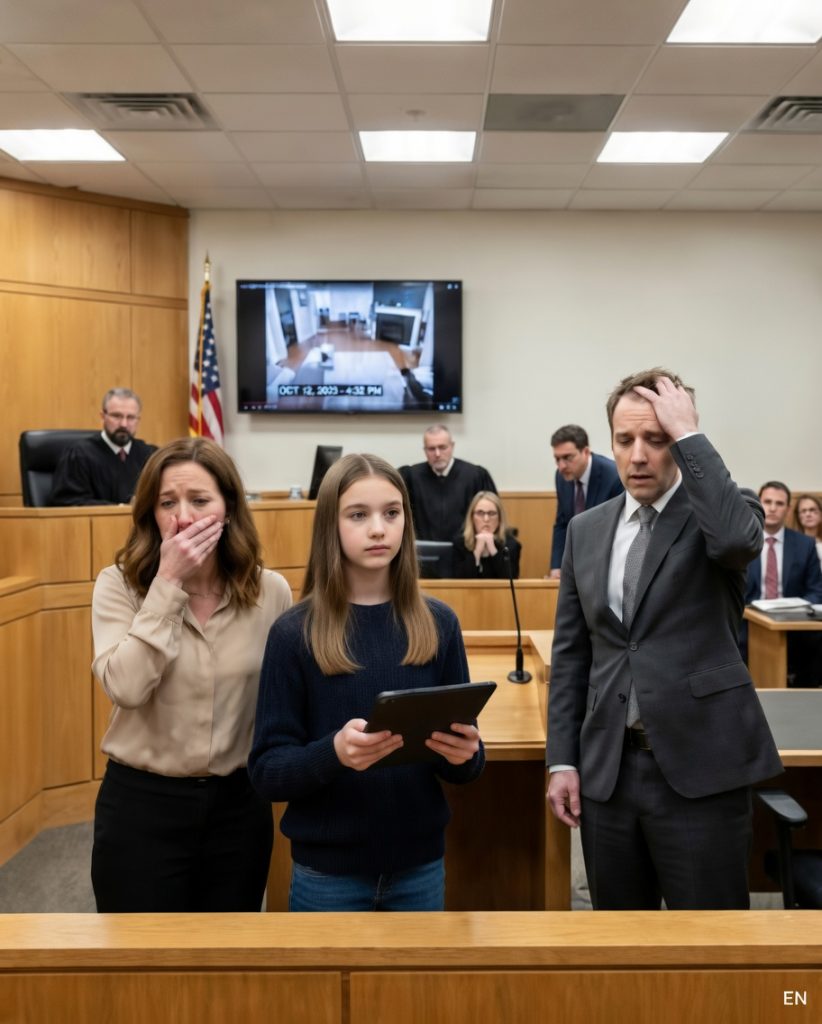
Harper sat beside me, unusually still. When the judge asked if there was anything more to add, I shook my head. I thought the moment had passed. Then Harper stood up. Her chair scraped softly against the floor, and in a voice that trembled but did not break, she asked, “Your Honor, can I show you something Mommy doesn’t know?” The room stilled. The judge leaned forward, his tone gentle as he asked if she felt safe speaking. She nodded. I felt my heart race, my instinct to protect her battling with the understanding that this moment mattered. So I stayed quiet.
She pulled a small tablet from her pocket, holding it carefully, like it carried something fragile. The video began. A timestamp. Our kitchen. And then—his voice. Not calm. Not controlled. It was sharp, angry, unfiltered. He wasn’t speaking to me. He was speaking to her. Telling her to stop crying. Telling her she caused stress. Warning her not to tell me. Her voice followed—small, scared, asking for me. Then the sound of something breaking. In that moment, the version of reality presented in court shattered completely. I hadn’t known about that night, but I recognized the tone. I had lived with it.
When the video ended, silence filled the room. Not the quiet of uncertainty—but the kind that comes when truth settles heavily and undeniably. The judge’s expression shifted. The narrative had changed, not because I argued louder, but because my child spoke. When asked why she recorded it, Harper said she was afraid she might forget—and if she forgot, maybe it wouldn’t feel real. But she couldn’t forget.
That day didn’t end with a final decision, but everything had already shifted. In the weeks that followed, the court ordered evaluations, supervision, and safeguards. The language in the courtroom changed. Where there had once been confidence, there was now concern. I was granted primary custody—not as a victory, but as protection. Walking out of the courthouse, Harper held my hand tightly, her small fingers finally relaxing after holding so much for so long. She apologized for not telling me sooner. I knelt in front of her and told her what mattered most: she had been brave. Fear doesn’t cancel courage. Silence doesn’t mean acceptance.
Life didn’t become easy overnight. Healing never works that way. There were long conversations, therapy sessions, and moments where guilt tried to take hold. But I learned something important—blaming myself would not protect her. Listening to her would. Slowly, she began to change. She slept through the night again. She laughed more. The tension that once lived in her shoulders began to fade. And I changed too. I stopped shrinking. I stopped accepting narratives that erased truth for the sake of comfort.
That moment in court didn’t just change a custody arrangement. It redefined strength. It showed me that power doesn’t always come from authority or control. Sometimes, it comes from a quiet voice that refuses to stay silent. Sometimes, it looks like a child standing in a room full of adults and saying, “I have something to show you.” And sometimes, when that voice is finally heard, it changes everything.