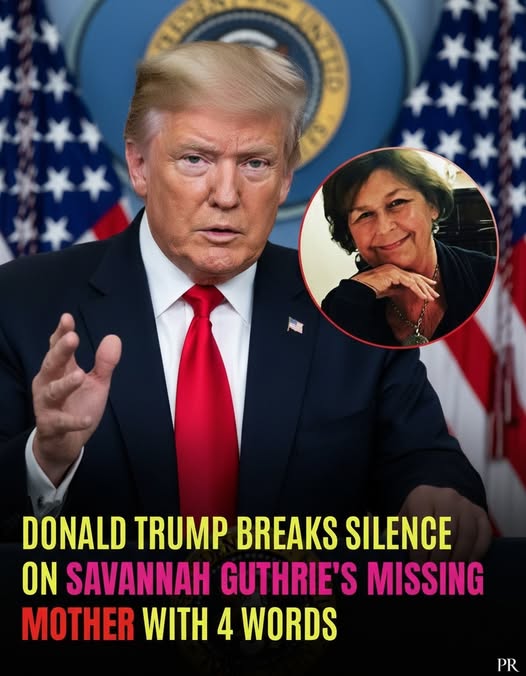
When Donald Trump broke his silence on the disappearance of Nancy Guthrie with just four words, “Very sad. Very troubling,” it was a moment that rippled across the nation’s media and political landscape. The brevity of the remark was striking, especially given Trump’s reputation for expansive, often unscripted commentary. Yet, it was not simply the words themselves that drew attention, but the context in which they were delivered. The disappearance of Savannah Guthrie’s mother—a story that has already captivated and unsettled the country—was suddenly amplified by the involvement of a former president whose every utterance carries weight and, often, controversy. Trump’s understated response became an unexpected focal point, igniting debate, speculation, and a fresh round of scrutiny on a case already fraught with public anxiety and investigative uncertainty.
Nancy Guthrie’s vanishing from her Tucson-area home in early February was, at first, treated as a possible medical or accidental event—a not-uncommon occurrence when dealing with elderly individuals. But it quickly became apparent that this was no ordinary missing person case. Authorities found no evidence that Nancy had left on her own, the terrain surrounding her home showed no footprints or clues, and her absence from routine activities raised immediate alarm. The search rapidly escalated from local concern to a multi-agency criminal investigation, with federal resources brought in and the FBI offering a $50,000 reward for information. As the days wore on with no breakthrough, the story grew into a national preoccupation, one that transcended geographic and demographic boundaries as people across the country empathized with the Guthrie family’s ordeal.
The gravity of the case was further heightened by the emergence of ransom-related communications. At least one message was confirmed to be a hoax, while others remain under investigation. The specter of exploitation—whether from opportunists, pranksters, or potentially something more sinister—added a layer of complexity and urgency. Meanwhile, Savannah Guthrie, best known for her role as the steady, unflappable co-anchor of NBC’s Today show, became a figure at the center of her own personal tragedy. Her emotional public appeals for information, and above all for credible proof of her mother’s well-being, resonated with viewers and underscored the case’s deeply human stakes.
It was against this backdrop that Trump’s four-word comment landed. Asked by a reporter to weigh in, he offered no political spin, no reference to his own contentious history with Savannah Guthrie—whose interviews with him as president were often pointed and, at times, adversarial. Instead, he delivered a response that was, for him, uncharacteristically muted. Some observers praised the tone as respectful, focusing on the family’s suffering rather than the political optics. Others, however, questioned whether the restraint was calculated, a way to avoid inflaming tensions or drawing the story into the vortex of partisan conflict. On social media, debate flared, but the conversation repeatedly circled back to the missing woman at its center, a reminder of the power such cases hold to unite and divide public sentiment.
For authorities, the renewed attention brought by Trump’s comment was a double-edged sword. On the one hand, it kept the case in the national spotlight, potentially increasing the flow of tips and information. On the other, it risked turning a delicate investigation into a political football, with every statement and rumor pored over for hidden meaning or partisan implication. Investigators reiterated the need for factual information, not speculation or theory, and urged the public to focus on the search for evidence. The family, meanwhile, continued to wait, their hopes and fears magnified by the glare of publicity and the uncertainty that comes with each passing day.
The disappearance of Nancy Guthrie remains an open and painful mystery. No evidence suggests she left of her own accord, and the investigation is as active—and as fraught—as ever. In the space between fear and hope, the country watches, debates, and waits for answers. Trump’s four words, though simple, serve as a reminder of how high-profile cases can become mirrors for national anxieties, political tensions, and the perennial struggle to balance empathy with spectacle. As Savannah Guthrie and her family cling to hope, the search for truth continues—one marked by the weight of silence, the intensity of public interest, and the unresolved questions that haunt every missing person’s story.