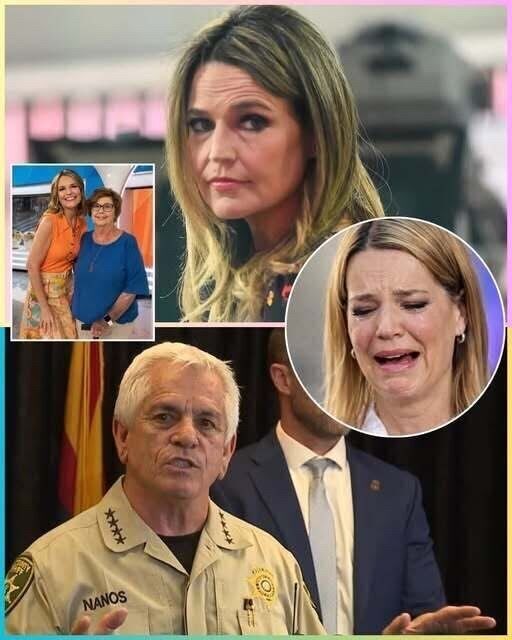
The day Nancy Guthrie vanished, the word “disappearance” took on a new, intimate weight for Savannah Guthrie—the familiar morning anchor who has long narrated the nation’s stories from a posture of calm authority. In an instant, Guthrie crossed an invisible threshold from observer to participant, her life upended by the same uncertainty and dread she has so often described for others. Her 84-year-old mother’s absence was not just a headline or a tragic curiosity for the evening news; it was the ache of unanswered calls, a home left too quiet, and the gnawing realization that the roles of storyteller and subject had abruptly merged. The shock of the moment radiated far beyond her family’s walls, drawing in viewers, colleagues, and strangers who felt the familiar terror of not knowing, and the fragile hope that each new hour might bring answers.
In Tucson, what began as a routine welfare check quickly escalated into a full-scale emergency. The transition was marked by the arrival of police tape and the solemn focus of investigators, who treated the residence as a crime scene—a space to be preserved, documented, and interpreted with the gravity reserved for profound concern. Nancy’s absence from church, a missed phone call, and the unsettling details inside her home collectively signaled that this was not a case of simple confusion or wandering. Law enforcement quickly dismissed the idea of an accidental disappearance, shifting the mood from anxious waiting to urgent action. Federal partners were called in, and the search expanded, as teams combed through timelines and scrutinized the last known moments of a life that had, until then, moved in predictable, comforting rhythms.
As the search for Nancy grew, so did the circle of attention around the case. What might have remained a private ordeal instead became a matter of national empathy, precisely because it was so easy to imagine oneself in Guthrie’s place. The vulnerability of aging, the unpredictability of crisis, and the helplessness of waiting for news are universal fears. Officials walked a careful line, asking the public for tips and vigilance while urging restraint in speculation. The urgency of the moment pressed hard against the slow, methodical pace of real investigative work. In this liminal space, facts emerged only after careful vetting, while rumors—so easily amplified by social media—threatened to muddy the search. For every family, this is the defining agony: the interminable pause between hope and finality, between the last known fact and the next piece of evidence.
For Savannah Guthrie, the experience has been as disorienting as it has been public. A journalist used to controlling the narrative now finds herself living inside the story, forced to surrender to the same uncertainty she has asked others to endure. The rituals of professionalism—composure, distance, control—offer little protection when the story is your own. Messages of support have poured in from across the country, an outpouring of sympathy from those who see in her ordeal a reflection of fears they hope never to realize. When she eventually returns to the anchor desk, the camera will not capture a return to normal, but a quiet resilience—an endurance born of carrying private grief in a public light, and the knowledge that the questions she asks may now be tinged with a deeper, personal understanding.
Behind the scenes, investigators continue their work with painstaking care. Each lead is checked, each piece of footage reviewed, and every timeline reconstructed in the hope that one overlooked detail might break the case open. The drama here is not found in wild speculation or sensational headlines, but in the discipline of patience—the long, slow wait for facts to emerge. For families in crisis, these hours stretch endlessly, every minute heavy with fear but buoyed by the stubborn refusal to give in to despair. It is an emotional limbo, a space where faith and dread coexist, and where hope—however fragile—persists because the alternative is simply unthinkable.
The nation now waits beside Savannah Guthrie and her family, sharing in the unbearable pause that separates fear from knowledge. Reporters, neighbors, and strangers alike understand that the outcome is unknowable, and that the only responsible path is to honor the process: to keep searching, to keep asking, to keep believing that answers are still possible. In this fragile space, the quiet endurance of those who wait becomes a collective act of hope—a testament to the human capacity to persist, to care, and to believe that, even in darkness, truth and resolution can still be found.