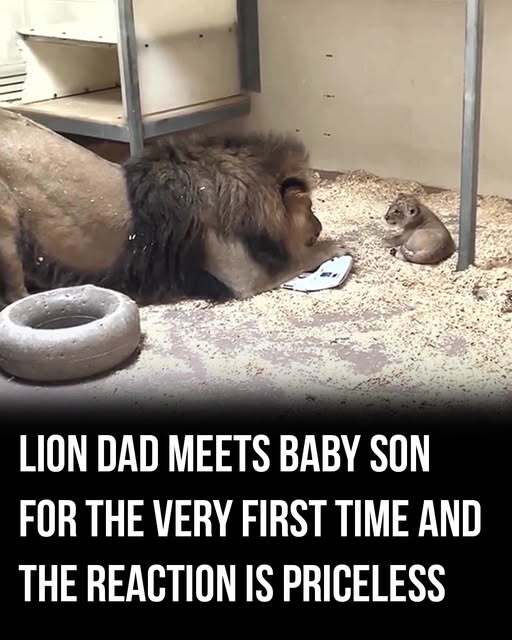
There are moments in nature so quietly profound that they transcend the boundaries between species, speaking to something deep and universal in all of us. The viral video of a full-grown lion meeting his baby son for the very first time is one such moment—a breathtaking illustration of vulnerability, strength, and the instinctive bonds that unite families, whether human or animal. In the now-iconic scene, the lion father, a symbol of raw power and regal dominance, lies calmly on the ground while his tiny, uncertain cub sits a few feet away. The world, watching through a camera lens, collectively holds its breath. Will the king of beasts thunder with authority, or will something softer unfold?
What follows is a lesson in patience, gentleness, and the complexity of animal behavior. The lion father does not roar or pounce. Instead, he remains perfectly still, his gaze locked on the cub, every movement measured and deliberate. The cub, heart pounding, inches forward in jerky, cautious steps, his hesitation mirroring the universal anxiety of a child meeting a parent in unfamiliar circumstances. The contrast is striking: one creature embodies the apex of physical might; the other, the essence of fragility. Yet, within the space that separates them, a bridge of understanding begins to form. The father’s posture is relaxed, almost protective, as if he instinctively understands the significance of this first encounter.
Observers are often surprised by the tenderness of the interaction. Popular culture has long portrayed lions as fearsome predators, their lives dominated by hierarchy and confrontation. Yet, in the wild, social bonds within a pride are finely balanced, blending competition with cooperation, discipline with care. The first meeting between a lion father and his cub is a critical moment. It sets the tone for acceptance, safety, and the future integration of the youngster into pride life. Even in a controlled environment, where the pressures of survival are softened but instincts remain, the father’s gentle restraint speaks volumes about the depth and nuance of animal relationships.
The emotional resonance of this moment is palpable. Viewers from around the globe have described feeling unexpectedly moved, their preconceptions about wild animals challenged by the sight of strength yielding to gentleness. There is something profoundly moving about seeing raw power held in check, about witnessing a creature capable of astonishing violence choose, instead, the path of patience and welcome. It is a reminder that animal behavior is not one-dimensional; that beneath the surface of dominance and predation lies a complex web of recognition, communication, and care passed down through generations.
Biologically, these first meetings are crucial. In lion prides, the introduction of new cubs to adult males carries risk but also opportunity. A peaceful, accepting encounter increases the cub’s chances of survival, not only because it ensures protection from external threats but also because it fosters the social learning essential for pride life. The father’s calmness signals to the rest of the pride that the newcomer is to be accepted, weaving the cub into the social fabric that will define his world. Scientists have long studied such interactions to better understand the balance of aggression and affection that underpins mammalian social structures.
Yet, the power of this moment extends beyond scientific explanation. It taps into the universal themes of parenthood, vulnerability, and the tentative steps that define every new relationship. Whether it is a lion father and his cub, or a human parent meeting their newborn for the first time, the uncertainty and intensity of that first connection is something we all understand. It is in these quiet, unguarded moments that bonds are forged and the future is set in motion. The viral video of the lion and his son resonates because it is, at its core, a story about the possibility of gentleness in a world often defined by strength—and about the hope that, even among the fiercest, love finds a way.
In the end, the lion father’s meeting with his cub is more than a heartwarming snapshot; it is a window into the shared instincts that bind all living things. It reminds us that every family’s story—no matter how wild or ordinary—begins with a first meeting, heavy with meaning and possibility. It is a testament to the enduring truth that, in the presence of new life, even kings bow to the power of connection and care.