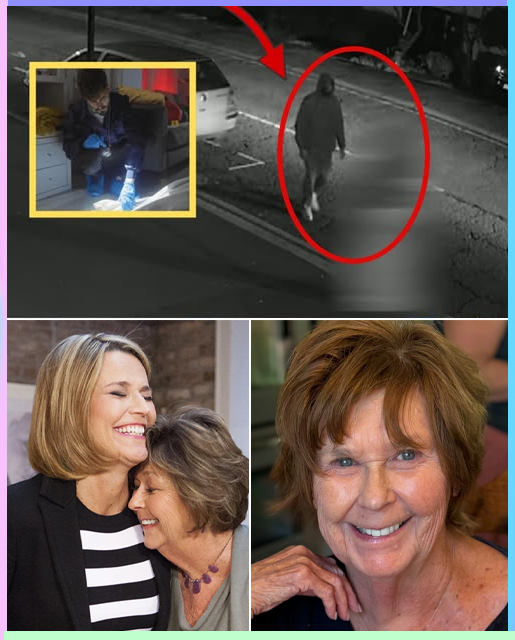
When police recovered security camera footage from a neighbor’s home showing the moments surrounding Nancy Guthrie’s disappearance, they hoped it would finally offer clarity in a case that has baffled investigators and broken the hearts of a nation. Instead, the video raised as many questions as it answered. The recovered tape—just fifty-seven seconds long—shows a quiet residential street at night, illuminated by the soft glow of porch lights and the occasional sweep of a car’s headlights. Within those brief seconds, Nancy Guthrie, the mother of beloved journalist Savannah Guthrie, steps into view, moving with the same gentle confidence that her family had always known. There is no sign of fear, confusion, or distress. No visible struggle. No approaching vehicle. No other figure within the frame. And then, as suddenly as she appeared, Nancy vanishes from sight. The ordinariness of the moment has become its most haunting feature, a mystery suspended in silence.
For detectives, the footage is both a breakthrough and a riddle. It has reshaped the direction of the investigation, prompting a painstaking, frame-by-frame analysis in search of anything that might explain Nancy’s sudden disappearance. Investigators are examining every shadow, every glimmer of movement, every hint of a reflection that might suggest the presence of someone—or something—unseen by the naked eye. The absence of an obvious struggle or a second figure in the frame complicates the case, challenging the working theories that had previously guided the search. The notion that Nancy, who appeared calm and purposeful, would simply vanish without a trace is deeply puzzling, and detectives have described the tape as both a gift and a torment: a glimpse of truth, but one that refuses to yield its secrets.
For the Guthrie family, the recovered footage has become a focal point of heartbreak and hope. Savannah Guthrie, balancing her public role as a national news anchor with the private agony of a daughter in search of her mother, has spoken openly about the emotional toll of the investigation’s twists and turns. Each new development brings a surge of optimism, quickly tempered by the realization that the answers remain elusive. Friends and neighbors, too, find themselves drawn back to those fifty-seven seconds, replaying the video in their minds and wondering what they missed—what they misunderstood, what small detail might have changed everything. The ordinariness of Nancy’s final recorded moments only deepens the pain: a quiet stroll on a familiar street, transformed by fate into the last visible trace of a loved one.
The video’s impact extends beyond the investigation, touching anyone who has ever experienced the agony of unanswered questions. It is a stark reminder of the fragility of certainty and the unpredictability of loss. For every family waiting for news, every community rallying in support, the footage is a symbol of the thin line that separates presence from absence, knowing from not knowing. It captures the human longing for resolution, for a narrative that makes sense of tragedy and offers a path toward healing. For Savannah and her family, the tape is more than evidence—it is a frozen memory, a testament to Nancy’s enduring presence and the silence that has replaced her voice.
As detectives continue their painstaking analysis, the investigation remains open and intensely active. Authorities emphasize that the video, while critical, is only one piece of a much larger puzzle. Other leads are being pursued, witness statements are being reviewed, and forensic evidence is being re-examined in light of the new timeline established by the footage. Investigators urge the public not to jump to conclusions based solely on what is seen—or not seen—within those fifty-seven seconds. The search for truth, they remind everyone, is rarely linear. It requires patience, persistence, and the willingness to look beyond the surface.
For now, the Guthrie family endures the hardest kind of waiting: the kind that balances hope with the fear that answers may never come. Their ordeal has become a national story not only because of Savannah’s public profile, but because their pain and perseverance echo the experiences of countless families facing similar uncertainties. In their patience and faith, they offer a quiet call for compassion—a reminder that, in the face of tragedy, even the smallest details, even a few seconds of light on a dark street, can matter more than we realize.
As the world continues to watch and wait, the mystery of Nancy Guthrie’s disappearance remains unresolved. Yet amid the darkness, the family holds onto the belief that truth is still possible, that hope can endure, and that, one day, the silence captured in those fifty-seven seconds may finally give way to answers. Until then, they continue to wait, to search, and to hope—trusting that, even in the quietest moments, love and memory will light the way home.