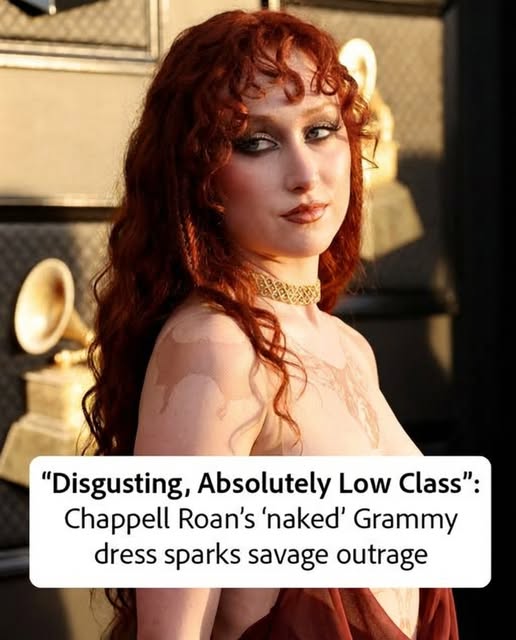
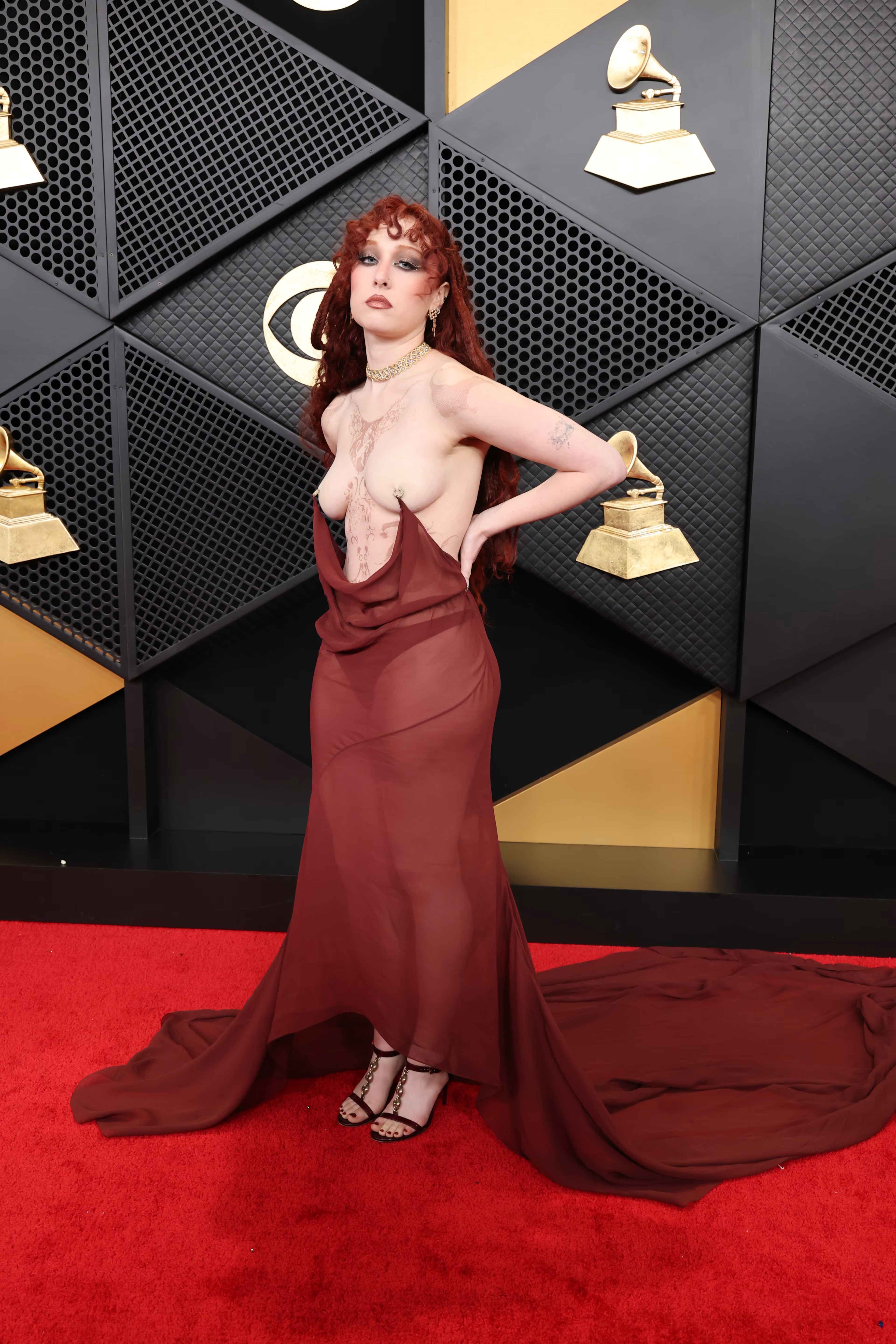
Chappell Roan, fresh off her 2025 Best New Artist win, arrived at the 2026 Grammy Awards in Los Angeles wearing a daring maroon Mugler gown that quickly dominated social media conversation. The ensemble, a reinterpretation of a 1998 archival design, featured a sheer bodice with faux nipples accented by metallic rings, flowing tulle layers revealing black undergarments, and a dramatic cape that trailed behind her. Her long crimson hair fell strategically across her chest, merging performance art with couture. In an evening full of music, awards, and spectacle, Roan’s look became a cultural lightning rod, drawing both admiration and critique from fashion enthusiasts, journalists, and casual viewers alike.
Fashion commentators praised the gown for its theatricality and historical nods, highlighting the way Roan merged archival inspiration with contemporary vision. Critics, however, argued that the outfit leaned toward shock-value, questioning the appropriateness of its revealing nature for such a high-profile, widely broadcast event. Across platforms like Instagram, TikTok, and Twitter, the public debated the line between self-expression and attention-grabbing, illustrating the modern tensions surrounding celebrity fashion. Roan’s choice reflects a broader cultural conversation about autonomy in personal presentation, the evolving expectations of red carpet appearances, and the interplay between artistry and public perception.
Roan’s appearance aligns with a growing trend of celebrities embracing boundary-pushing styles on awards show red carpets. Florence Pugh, Kristen Stewart, Dakota Johnson, and Julia Fox, among others, have worn similarly audacious ensembles in recent years, sparking discussions about fashion as an extension of identity rather than a mere wardrobe choice. Social media coverage amplifies these debates, making outfits viral statements that invite public engagement and commentary. In this environment, what a star wears is no longer just fashion—it becomes part of their narrative, an accessory to the persona they project and the conversation they inspire.
Fans familiar with Roan’s career pointed out that her look was consistent with her artistic ethos, which blends music, performance, and visual storytelling. Her style has long incorporated theatricality, bold gestures, and symbolic elements that challenge conventional boundaries. By combining archival inspiration with avant-garde design, Roan’s Grammys appearance reaffirmed her willingness to defy norms and embrace a visual identity that is unapologetically her own. Whether viewers responded with praise or criticism, the outfit succeeded in engaging audiences and reinforcing her reputation as a fearless creative force.
The debate surrounding the gown also highlights the generational and cultural shifts in fashion perception. Older audiences and traditionalists often interpret revealing red carpet outfits as controversial, while younger viewers and fashion insiders increasingly view them as expressions of autonomy and artistry. In this way, Roan’s ensemble becomes more than clothing—it is a conversation starter about evolving standards, individual agency, and how public figures negotiate visibility, identity, and expectation in an era dominated by instant online reaction.
Ultimately, Chappell Roan’s appearance at the 2026 Grammys demonstrates the power of fashion to provoke thought, dialogue, and emotion. Beyond the music and the awards, the red carpet has become a stage for expression, creativity, and societal reflection. Roan, through her bold choice, not only maintained her position as a musical standout but also cemented her role as a cultural provocateur. As the Grammys and awards seasons continue to unfold, her look serves as a reminder that style and music are intertwined, both capable of inspiring conversation, challenging norms, and leaving an indelible mark on popular culture.