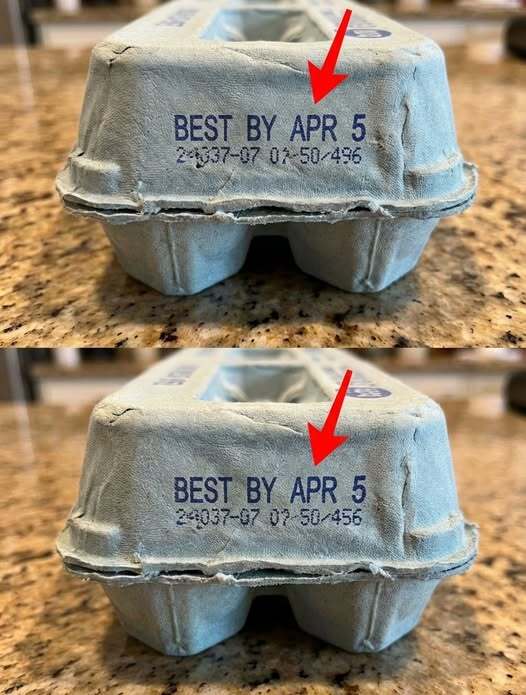
Most people glance at an egg carton, check the expiration or sell-by date, and move on without a second thought. Hidden in plain sight, however, is a three-digit number that tells a far more important story than most shoppers realize. This number, known as the Julian date, marks the exact day of the year the eggs were packed. It is not decorative, random, or meant only for distributors—it is a direct indicator of freshness. Ignoring it means relying on guesswork, and when it comes to eggs, guesswork can lead to foodborne illness even if the eggs look and smell perfectly fine.
The Julian date ranges from 001 to 365 and corresponds to the calendar year, with 001 representing January 1 and 365 representing December 31. A carton stamped with “120,” for example, indicates the eggs were packed on the 120th day of the year, which is April 30. This date is far more meaningful than the printed “sell-by” or “best-by” date, which exists primarily for store inventory management rather than consumer safety. Eggs can remain safe to eat for three to five weeks after the pack date when properly refrigerated, even if the sell-by date has passed. Without understanding this distinction, many people unknowingly use eggs that are much older than they assume.
The real danger lies in the fact that egg-related illness often provides no obvious warning signs. Salmonella bacteria does not alter the appearance, smell, or taste of eggs. An egg can look pristine, crack cleanly, and still contain bacteria capable of causing severe gastrointestinal symptoms. Nausea, vomiting, abdominal cramps, fever, and diarrhea may appear hours or even days after consumption. Because the bacteria can exist inside the egg before the shell forms, washing the shell offers no protection. Only proper refrigeration and thorough cooking to an internal temperature of 160°F can reliably eliminate the risk.
🔢
The Three-Digit Number: It’s the Julian Date!
That number (usually between 001 and 365) is the Julian date—the day of the year the eggs were packed.
001 = January 1
032 = February 1
365 = December 31
So if your carton says “120,” the eggs were packed on April 30 (the 120th day of the year).
🥚
Important: This is not the expiration date—it’s the pack date.
📅
How Long Are Eggs Safe to Eat?
According to the USDA:
Raw eggs in the shell are safe for 3–5 weeks after the pack date—even if the “sell-by” date has passed.
Always refrigerate eggs at or below 40°F (4°C). Room temperature storage dramatically shortens shelf life.
⚠️
Critical tip: The “sell-by” or “best-by” date on the carton is not a safety cutoff—it’s designed for store inventory rotation. The Julian date is what truly matters.
🤢
Why Your Quiche Made Everyone Sick
Even if eggs look and smell fine, they can harbor Salmonella—a bacterium that causes nausea, vomiting, cramps, and diarrhea.
Salmonella doesn’t change an egg’s appearance, smell, or taste.
And it isn’t destroyed by cracking or mixing—only by proper cooking to 160°F (71°C).
If your eggs were old, improperly stored, or part of a contaminated batch, even a baked quiche may not have reached a high enough internal temperature to kill the bacteria.
🧪
Fact: Salmonella can be inside the egg before the shell forms—so washing the shell won’t help.
✅
How to Use the Julian Date Safely
Find the number on the short side of the carton, often near the USDA grade mark.
Calculate the pack date (a Julian date converter can help if needed).
Use eggs within 3–5 weeks of that date.
When in doubt, throw them out—especially for dishes like quiche, hollandaise, or tiramisu that use undercooked eggs.
🥚
Bonus: Other Egg Carton Codes Decoded
Grade AA, A, or B
Indicates quality and texture (AA = firmest whites, roundest yolks)
“Organic”
Hens fed organic feed, no antibiotics, outdoor access
“Cage-Free”
Hens not kept in cages—but may still live indoors
“Pasture-Raised”
Hens roam outdoors (often considered most humane with potential nutritional benefits)
Plant code (e.g., P-1234)
Identifies the processing facility and allows tracing during recalls
🛡️
Tips to Prevent Egg-Related Illness
Never eat raw or undercooked eggs unless pasteurized
Cook egg dishes to 160°F (use a thermometer for quiche, custards, and casseroles)
Don’t leave eggs out for more than two hours (one hour if temperatures exceed 90°F)
Wash hands and surfaces after handling raw eggs
Purchase eggs with clean, uncracked shells
The Bottom Line
That little number isn’t just packaging filler—it’s a freshness timestamp that could save you from a miserable foodborne illness or a ruined dinner party.
So the next time you grab a carton, check the Julian date. It takes two seconds—and it might keep your guests comfortably full instead of painfully ill.
Freshness isn’t just about taste—it’s about safety.
Improper storage accelerates the problem. Eggs left out at room temperature, even briefly, lose their protective barrier and become far more vulnerable to bacterial growth. This is why eggs should always be stored at or below 40°F and returned to the refrigerator promptly after use. Dishes such as quiche, custards, hollandaise sauce, and tiramisu carry higher risk because they rely on eggs that may not reach sufficient internal temperatures during preparation. When older or improperly stored eggs are used in these recipes, the likelihood of illness rises sharply.
Beyond the Julian date, egg cartons include additional information that can help consumers make informed choices. Grade AA, A, or B reflects quality and texture, not safety. Labels like organic, cage-free, and pasture-raised describe farming practices rather than freshness. The plant code identifies the processing facility and enables traceability during recalls. Understanding these distinctions helps prevent the common assumption that premium labels automatically mean safer eggs.
Ultimately, that small three-digit number is one of the most valuable food safety tools available to home cooks. Checking it takes seconds, yet it can prevent days of illness and serious discomfort. Food safety is rarely about dramatic mistakes—it’s about small details overlooked repeatedly. By understanding the Julian date, storing eggs correctly, and cooking them thoroughly, you transform an everyday grocery item into a safer ingredient. Freshness isn’t just about flavor—it’s about protecting the people you cook for.
The Julian date shows the exact day eggs were packed.
It matters more than the sell-by or expiration date.
Eggs can look fine while still containing harmful bacteria.
Proper refrigeration and thorough cooking are essential.
Labels describe quality and farming—not safety.
Checking one small number can prevent serious illness.