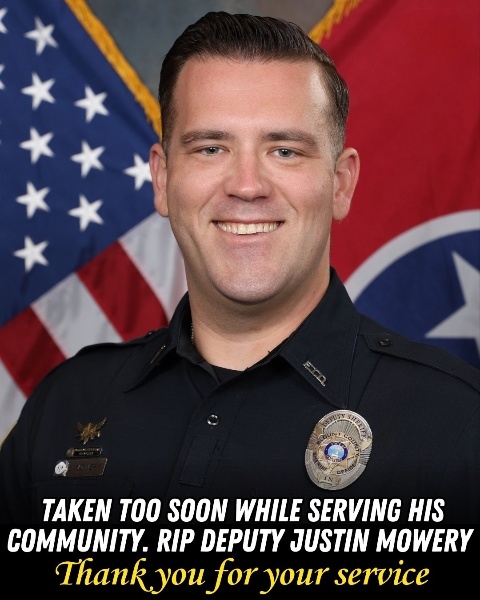
The funeral procession for Deputy Justin Mowery unfolded beneath a somber gray Tennessee sky, a quiet reflection of the grief felt across Blount County. Family, colleagues, friends, and community members gathered to pay their respects to a man whose life and work embodied courage, selflessness, and unwavering dedication. At just 30 years old, Mowery had built a career in law enforcement that balanced rigorous professionalism with quiet compassion, leaving an impression on everyone he encountered. A field training officer, SWAT team member, and mentor to younger deputies, he faced daily dangers with a resolve that seemed innate, accepting the risks inherent in a profession that often asks more than it gives. The day’s ceremony, filled with solemn hymns, ceremonial flags, and reflective silence, served as a reminder not only of his ultimate sacrifice but also of the countless moments in which he chose service over personal safety.
At the graveside, the significance of Mowery’s sacrifice was palpable. Fellow officers stood in precise formation, their faces composed but etched with the silent weight of grief. The flag-draped casket symbolized more than protocol; it represented a life dedicated to the protection of others, a tangible acknowledgment of the profound debt owed to those who serve. Mowery’s brother spoke passionately, reflecting on the faith, resilience, and determination that characterized his sibling’s life. “Justin taught us what it means to get back up,” he said, his voice steady despite emotion. “Every challenge, every danger, every setback — he met it with unwavering courage. And now, as we say goodbye, we carry his strength with us.” His words resonated with officers and civilians alike, highlighting the human element often overshadowed by discussions of policy, law enforcement, and procedural obligations.
Justin Mowery’s life was marked by both bravery and humility. Outside the uniforms, badges, and tactical gear, he was known for his quiet kindness, mentorship, and willingness to help anyone in need. Colleagues recalled instances where Mowery stayed late to train new recruits, ensuring they understood not only the mechanics of law enforcement but also the responsibility and ethics that define true public service. His dedication to community outreach, whether through school programs, neighborhood safety initiatives, or support for families affected by crime, underscored a profound understanding that law enforcement extends beyond immediate enforcement into the fabric of daily life. In these acts, Mowery exemplified the principle that courage is not only measured in moments of crisis but also in consistent, thoughtful action that strengthens the bonds of community.
The circumstances of Mowery’s line-of-duty death brought an acute awareness of the dangers faced by officers nationwide. Each call, each assignment carries inherent risk, yet few civilians grasp the mental, physical, and emotional toll of such work. Mowery’s passing prompted conversations within Blount County and across Tennessee about officer safety, training, and the structures in place to protect law enforcement personnel while they serve. Advocates emphasized the need for ongoing investment in equipment, support systems, and mental health resources to ensure that officers like Mowery can continue to serve with reduced risk. His death, while tragic, highlighted the essential dialogue between public safety imperatives and community responsibility — a dialogue that now carries the additional weight of personal loss.
Beyond his professional accomplishments, Mowery’s impact was deeply personal. For the families he assisted, the children he mentored, and the neighbors he protected, his absence is intensely felt. Stories shared during the funeral described small yet significant moments: returning a lost pet, calming a frightened resident, or offering a quiet word of reassurance during a crisis. These moments, often invisible in official records or statistics, painted a portrait of a man who understood that heroism is found in everyday decisions as much as in moments of acute danger. By balancing authority with empathy, Mowery created ripples of trust and security that extended far beyond his immediate colleagues, leaving a lasting impression on the community he served.
As the ceremony concluded, the symbolism of the final salute, the lowered casket, and the folded flag crystallized the essence of Mowery’s legacy. His colleagues, although grieving, were reminded of the enduring mission that defined his life: to serve, to protect, and to stand as a steady presence in the face of uncertainty. The community, in turn, recognized the fragility and preciousness of those who answer the call of duty daily. Deputy Justin Mowery’s story is one of sacrifice, courage, and unwavering commitment — a legacy that transcends rank, badge, and circumstance. His life and death serve as a testament to the extraordinary costs borne by those who protect society, the profound gratitude owed by the communities they serve, and the enduring light that remains even in the shadow of loss.