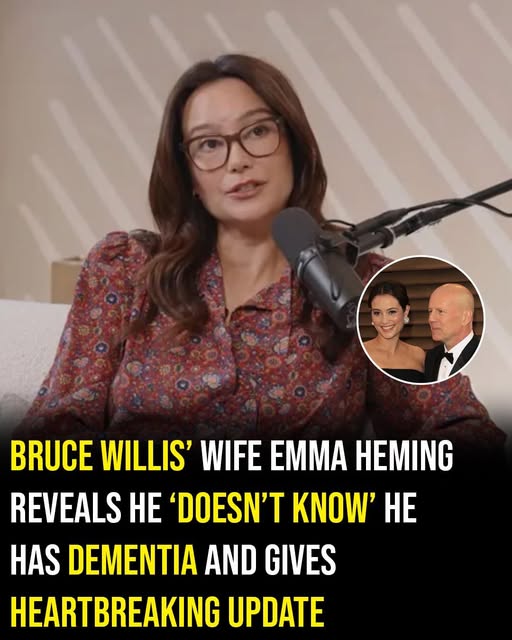
Actor Bruce Willis’ dementia diagnosis marked a heartbreaking turning point not only for his family, but for millions of fans around the world. For decades, Willis had been a constant presence on screen, known for his sharp wit, physical intensity, and unmistakable charisma. When the news broke that he would be stepping away from acting, it felt like the quiet closing of an era. Nearly four years after the family first shared his health struggles publicly, his wife, Emma Heming Willis, has offered a deeply personal update that sheds light on how their lives have changed, how they continue to adapt, and how love has taken on a new, more deliberate meaning.
In 2022, the Willis family revealed that Bruce had been diagnosed with aphasia, a condition that affects a person’s ability to communicate. At the time, the announcement explained why continuing his acting career was no longer possible, but it was only the beginning of a much larger and more difficult journey. About a year later, the diagnosis was updated to frontotemporal dementia, or FTD, a progressive neurological condition that affects the frontal and temporal lobes of the brain. According to medical experts, these areas are responsible for personality, behavior, decision-making, and language, making the disease especially complex and emotionally challenging for both patients and caregivers.
Unlike Alzheimer’s disease, which is most commonly associated with memory loss, FTD often presents differently. It tends to affect people at a younger age and may initially leave memory relatively intact while altering behavior, language, or emotional responses. Bruce Willis was 67 when he received the FTD diagnosis, placing him within the typical age range for the condition. Emma Heming Willis has consistently emphasized how important it is for the public to understand these distinctions, not only for Bruce’s story, but for the many families navigating similar diagnoses without public attention or resources.
Emma has been notably open and honest about what life looks like behind the scenes. In a recent appearance on The Unexpected Journey podcast hosted by Cameron Oaks Rogers, she shared an update that was both heartbreaking and unexpectedly gentle. She explained that Bruce is not aware that he has dementia and, in her words, has “never connected the dots” about his condition. Rather than seeing this as purely tragic, Emma described it as a strange combination of blessing and curse. She expressed genuine relief that he does not fully understand the diagnosis or what it means, saying that she is “really happy” he doesn’t carry that awareness.
When asked whether Bruce still has moments of recognition and connection, Emma’s response was quiet but powerful. She explained that he is still very much present, that the disease has progressed slowly, and that the family has grown alongside that progression. They have adapted together, learning new ways to communicate, to connect, and to measure closeness. She clarified that questions about whether Bruce recognizes her often stem from confusion with Alzheimer’s disease. Because Bruce has FTD, memory loss has not been the defining feature—at least not yet—and he does know who she and their children are.
What has changed, Emma explained, is the way connection happens. The emotional language is different now, but it has not disappeared. She described his connection with her and their children as still beautiful and still meaningful, even if it no longer looks the way it once did. Love, in this phase of life, has required flexibility, patience, and a willingness to release old expectations. Instead of mourning what has been lost every day, the family focuses on what still exists, even when it arrives in unfamiliar forms.
Emma’s reflections resonate far beyond celebrity culture because they touch on a reality faced by countless families living with neurodegenerative disease. Her words highlight an often-unspoken truth: caregiving is not just about endurance or sacrifice, but about constant emotional recalibration. It is about learning to meet someone where they are, rather than where they used to be, and finding meaning in presence instead of performance. In stepping away from Hollywood’s spotlight, the Willis family has been forced to redefine success, fulfillment, and connection on their own terms.
The update is both devastating and reassuring. Devastating because it confirms the irreversible nature of Bruce Willis’ illness, and reassuring because it shows that love can remain intact even as circumstances radically change. Emma Heming Willis’ candor offers comfort to families who feel unseen, reminding them that adaptation is not failure, and that a different life can still be a meaningful one. Beyond fame, awards, and red carpets, this chapter of Bruce Willis’ life is being shaped by care, dignity, and quiet devotion—and that may be the most human role of all.