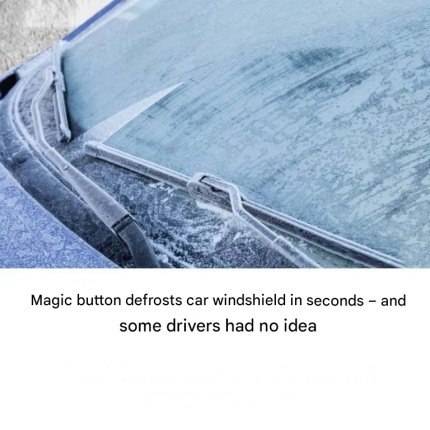
Winter has a way of turning ordinary routines into small daily battles, and for drivers, few rituals are as universally dreaded as confronting a frozen windshield before sunrise. The scene is familiar: breath visible in the cold air, hands stiff with numbness, an ice scraper scraping stubborn frost while precious minutes slip away. For decades, this moment defined winter driving, accepted as an unavoidable inconvenience. Yet hidden in plain sight on the dashboards of most modern vehicles is a feature capable of transforming that ritual entirely. Often marked by a simple icon of a windshield with rising arrows, the front defrost button was designed to address this exact problem, but many drivers either misunderstand its purpose or have never been taught how powerful it truly is. This small control represents a quiet triumph of automotive engineering, one that blends heat, airflow, and moisture control to solve a problem once tackled with brute force and frozen patience. Its existence challenges the assumption that winter discomfort is inevitable, revealing instead that the solution has been there all along, waiting to be used correctly.
The effectiveness of this so-called “magic” button lies in how it uses multiple systems simultaneously rather than relying on heat alone. When activated, the defrost function directs warm air at high intensity toward the interior surface of the windshield while also engaging the air conditioning system. To many drivers, the idea of using air conditioning in winter sounds counterintuitive, yet it is precisely this combination that makes the system so efficient. Cold weather air holds moisture, and when warm air alone hits cold glass, fogging can occur, slowing the defrosting process. The air conditioning removes excess humidity, allowing the warm air to work faster and more evenly. Instead of scraping ice from the outside, the windshield is gently heated from within, loosening frost and melting ice without stressing the glass. This approach not only speeds up the process but also preserves the integrity of the windshield, which can be compromised by aggressive scraping or sudden temperature shocks.
Despite its benefits, the defrost button remains one of the most underappreciated features in modern vehicles, largely because of habit and a lack of instruction. Many drivers learn to operate a car through repetition rather than education, mastering the essentials while overlooking secondary controls whose value isn’t immediately obvious. Ice scrapers, warm water, and idling engines have been passed down as winter survival tools, even though some of these methods carry risks. Pouring hot water on a frozen windshield, for example, can cause cracks due to rapid temperature changes, while excessive scraping can leave micro-scratches that weaken the glass over time. The defrost function avoids these issues entirely, yet it often goes unused simply because drivers don’t trust it or don’t realize how quickly it works when used properly. This disconnect highlights a broader issue in automotive culture, where advanced features are introduced faster than drivers are taught to use them effectively.
Safety is perhaps the most compelling argument for embracing the windshield defrost system, as visibility is critical in winter driving conditions. A partially cleared windshield, streaked with ice or fog, can distort depth perception and delay reaction times at exactly the moment when roads are slick and stopping distances are longer. The defrost button helps ensure a clear, evenly warmed surface that remains fog-free once the vehicle is in motion. This consistency matters, especially during early-morning commutes or sudden weather changes when visibility can deteriorate quickly. Moreover, using the defrost function allows drivers to remain inside the vehicle rather than stepping into icy conditions to scrape glass, reducing the risk of slips, falls, or frostbite. In this sense, the button is not merely a convenience but a safety feature designed to protect both the driver and others on the road.
For vehicles that lack a dedicated defrost button, the conversation shifts from overlooked technology to practical alternatives, yet the underlying principle remains the same: managing heat and moisture effectively. Commercial de-icing sprays can speed up frost removal, while windshield covers prevent ice from forming in the first place. Some drivers rely on homemade solutions, such as a mixture of water and isopropyl alcohol, to loosen ice quickly. While these methods can be effective, they still require preparation and effort, reinforcing just how transformative the built-in defrost system can be when available. Its presence reflects decades of incremental improvements in automotive design, where small refinements accumulate into meaningful gains in comfort and safety. The irony is that this progress often goes unnoticed precisely because it works so seamlessly when used correctly.
Beyond the mechanics, the story of the windshield defrost button speaks to a broader theme about modern technology and human behavior. We live surrounded by tools designed to make life easier, yet familiarity and routine often blind us to their full potential. In cars, as in many aspects of daily life, drivers tend to rely on what they know rather than exploring what is possible. The defrost button challenges that mindset by offering immediate, tangible proof that a small change in habit can produce outsized benefits. It invites drivers to rethink their relationship with their vehicles, encouraging curiosity and a willingness to learn. When used consistently, it reshapes winter mornings from a source of stress into a manageable, even forgettable, step in the day.
In the end, the true value of this hidden “magic” button lies not just in melted ice or saved minutes, but in the quiet reminder that convenience and safety are often closer than we think. Winter driving will always demand caution, patience, and preparation, but it no longer has to begin with frozen fingers and frustration. By understanding and using the tools already built into modern vehicles, drivers can reclaim time, protect their cars, and start their mornings with clarity rather than chaos. What was once an accepted seasonal hardship becomes, with a single press of a button, a solved problem—proof that sometimes the most meaningful improvements are the ones we overlook every day.