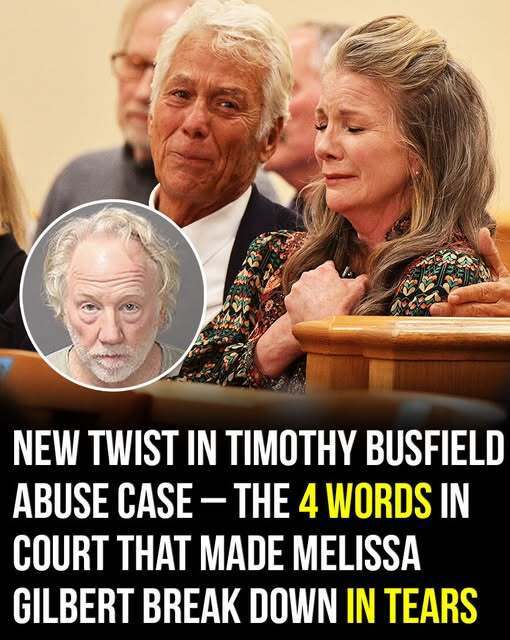
The New Mexico courtroom felt unusually heavy as Judge David Murphy prepared to deliver a ruling that would shape the immediate future of Timothy Busfield and profoundly affect those seated beside him. Silence settled over the room as weeks of legal maneuvering, public speculation, and emotional strain narrowed into a single moment of decision. Melissa Gilbert, sitting close to her husband, held herself rigidly, her expression betraying the toll of prolonged uncertainty. Prosecutors had argued forcefully that Busfield should remain in custody, emphasizing the gravity of the allegations and the duty of the court to prioritize public safety, particularly when accusations involve minors. Defense attorneys responded with a portrait of a man defined by decades of professional work, advancing age, and an absence of prior criminal history, insisting that these factors demonstrated reliability rather than risk. When the judge announced that Busfield would be released on his own recognizance under strict conditions, the room exhaled. Gilbert’s composure faltered as tears surfaced, not as a sign of victory or vindication, but as a visible release of fear, exhaustion, and momentary relief. The ruling did not resolve the case or diminish the seriousness of the charges; it merely altered the conditions under which the long legal process would continue.
The terms of Busfield’s release were detailed and restrictive, reflecting the court’s attempt to strike a careful balance between constitutional principles and community protection. He was placed under the supervision of pretrial services, required to attend every court appearance, and ordered to comply with regular monitoring. The judge barred him from possessing firearms or weapons of any kind, prohibited the use of alcohol and illegal substances, and imposed strict limits on travel and communication. Busfield was explicitly forbidden from contacting the alleged victims or their families and instructed not to discuss the case with potential witnesses. Additional restrictions limited his contact with minors and required immediate notification of any change in residence. These conditions effectively placed his daily life under continuous oversight, ensuring that release did not equate to freedom from accountability. For Gilbert, the decision offered the comfort of returning home together, but it also introduced a new reality defined by legal constraints, constant vigilance, and the emotional burden of waiting as the case proceeds through a slow and uncertain judicial path.
Prosecutors voiced strong objections to release, outlining concerns they believed warranted continued detention. Central to their argument was a previous allegation made by actress Claudia Christian, who claimed Busfield assaulted her during a professional engagement and reported the incident at the time to an assistant director. The state argued that this account suggested troubling behavior beyond the current charges and should factor into any assessment of risk. Prosecutors also scrutinized Busfield’s actions after learning an arrest warrant had been issued. Rather than surrendering immediately, he traveled a considerable distance and underwent a polygraph examination before reporting to authorities. While acknowledging that defendants have the right to consult counsel and prepare a response, the prosecution framed this delay as a sign of potential noncompliance. From their perspective, the combination of unresolved allegations, alleged past behavior, and delayed surrender justified keeping Busfield in custody, particularly given the sensitive nature of the case and the public interest involved. Despite these objections, the judge determined that supervision and strict conditions could adequately address concerns at this preliminary stage.
A significant component of the defense’s presentation was a psychosexual evaluation submitted to the court prior to the hearing. Such assessments are commonly used in cases involving allegations of sexual misconduct to help judges evaluate potential risk, not to determine guilt or innocence. According to court documents, the evaluation involved extensive interviews, psychological testing, and discussions with individuals close to Busfield, including Gilbert. The report described his marriage as stable and emotionally supportive, portraying the relationship as grounded in mutual respect, companionship, and long-term commitment. Busfield and Gilbert reportedly spoke candidly about their bond, emphasizing shared values and emotional reliance developed over years together. Evaluators characterized Busfield as cooperative, reflective, and socially stable, citing consistent employment, strong family connections, and community ties. Based on these factors, the evaluation concluded that he presented a “very low risk” of reoffending, a finding defense attorneys argued weighed heavily in favor of supervised release. While courts often caution that such evaluations are only one piece of a larger puzzle, they can influence decisions about custody by shaping perceptions of a defendant’s conduct outside jail.
The judge also reviewed an extensive collection of more than seventy-five letters submitted in support of Busfield. Written by family members, colleagues, and longtime acquaintances, the letters painted a picture of a man described as compassionate, professional, and deeply devoted to those around him. Several letters came from Gilbert herself, in which she referred to her husband as her emotional anchor and creative partner, describing him as her “rock” during a period she characterized as isolating and overwhelming. She wrote of the anguish of watching someone she loved face severe allegations while feeling powerless to shield him from public judgment. Other supporters echoed similar themes, highlighting Busfield’s mentorship, kindness, and commitment to family life. These letters were intended to humanize him beyond the charges, offering context and personal testimony to counterbalance the prosecution’s narrative. Yet their presence also underscored a central tension of the case: the collision between personal loyalty and the justice system’s responsibility to address allegations that carry serious implications for public trust and safety.
The allegations themselves remain unresolved and deeply serious. According to the criminal complaint, Busfield is accused of engaging in inappropriate conduct involving two minors while working on a television set, with claims that the behavior occurred over an extended period. Medical professionals later advised the children’s parents that certain behaviors were consistent with grooming, prompting a formal investigation and the issuance of an arrest warrant. Busfield has denied all accusations and stated publicly that he intends to contest the charges fully in court. If convicted, he could face significant prison time, a reality that looms over every procedural step. The case remains in its early stages, with evidence review, legal motions, and potential testimony still ahead. Gilbert’s emotional reaction in court reflected not resolution, but the human cost of prolonged uncertainty, public scrutiny, and the strain of standing beside someone facing life-altering allegations. The judge’s ruling answered only one narrow question—where Busfield would wait for trial—while leaving the larger questions of truth, accountability, and consequence suspended in the space between accusation, defense, and judgment.