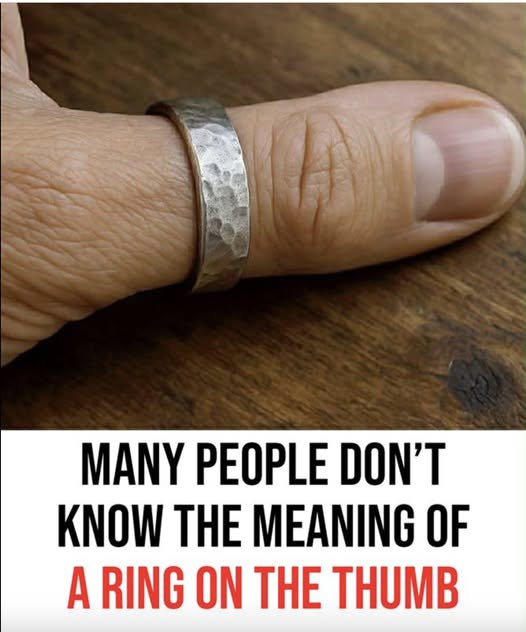
Jewelry has never been merely decorative. Across civilizations, rings have carried messages about status, loyalty, power, and identity, often communicating meaning without a single word being spoken. Among all fingers, the thumb stands apart both physically and symbolically. It is thicker, stronger, and more independent in movement than the others, making it a natural focal point when adorned. A ring worn on the thumb draws attention precisely because it defies the more traditional placement on the ring finger or index finger. Over time, this unconventional choice has accumulated layers of meaning, shaped by history, gender norms, cultural symbolism, and personal expression. Whether chosen consciously or instinctively, a thumb ring often reflects something deeper than fashion alone, revealing how individuals relate to power, autonomy, and their own sense of self.
From a symbolic perspective, the thumb has long been associated with strength and willpower. It enables grip, precision, and control, qualities essential for survival and craftsmanship throughout human history. In many symbolic systems, the thumb represents self-assertion and personal agency, standing as a metaphor for the ability to act independently rather than merely follow. Wearing a ring on this finger amplifies that symbolism, signaling confidence and self-ownership. Unlike rings tied to marital status or social obligation, a thumb ring rarely carries imposed meaning. Instead, it tends to reflect choice, suggesting that the wearer is comfortable occupying space, making decisions, and expressing individuality. This is why thumb rings often attract people who value independence, whether consciously or subconsciously, as they visually reinforce the idea of standing apart rather than blending in.
For women, the symbolism of thumb rings has often intersected with ideas of independence and resistance to restrictive norms. Historically, women’s jewelry was frequently designed to signal availability, marital status, or family affiliation. A ring worn on the thumb disrupts those expectations. It does not conform to traditional etiquette, and for that reason alone it has been interpreted as a quiet statement of autonomy. Many women who choose thumb rings describe them as empowering, a way to visually assert confidence without overt declarations. During the late twentieth century, particularly in the 1990s and early 2000s, thumb rings became associated in some cultures with feminist expression and LGBTQ+ identity. For some, wearing a thumb ring—especially on the right hand—served as a subtle signal of solidarity, self-definition, or nonconformity in environments where open expression felt unsafe or unwelcome. While these associations were never universal, they illustrate how jewelry can become a coded language shaped by social context and shared understanding.
Fashion, however, has always played a parallel role in shaping meaning. Thumb rings are visually striking because they are unexpected, often larger, and harder to ignore than rings on other fingers. For many women today, the choice is less about signaling a specific identity and more about aesthetic confidence. A thumb ring can suggest boldness, creativity, and a willingness to experiment beyond conventional style boundaries. It often pairs with a sense of comfort in one’s body and presence, as wearing jewelry on the thumb requires a certain ease with attention. Even when chosen purely for design, the effect remains the same: it subtly communicates assurance and self-awareness. This blending of fashion and symbolism reflects a broader cultural shift in which personal style becomes a form of storytelling, allowing individuals to curate how they are perceived while retaining the freedom to redefine meaning on their own terms.
For men, the symbolism of thumb rings reaches deep into history. In ancient Rome, rings were markers of status and authority, and thumb rings in particular were associated with wealth, influence, and power. The thumb’s association with strength made it an ideal symbol for dominance and command. In parts of Asia, especially in China, thumb rings were traditionally worn by archers to protect the thumb during bow use. Over time, these functional objects evolved into symbols of rank and masculinity, crafted from materials like jade, gold, or ivory. Such rings were not merely decorative; they conveyed discipline, skill, and social standing. These historical roots continue to echo in modern interpretations, where a man wearing a thumb ring may unconsciously evoke themes of strength, control, and assertiveness, even if the original context has long faded.
In contemporary culture, men’s thumb rings often signal individuality and resistance to conformity. As traditional masculine norms around jewelry have softened, thumb rings have emerged as a way to experiment with self-expression without relying on mainstream trends. For some men, wearing a thumb ring feels rebellious, a subtle challenge to expectations about how masculinity should look. For others, it is a way to emphasize creativity, confidence, or a connection to alternative fashion subcultures. The placement itself suggests intentionality; it is not accidental or inherited, but chosen. In certain interpretations, a thumb ring on the left hand has been associated with sexual confidence and openness, reflecting comfort with one’s desires and identity. Whether or not the wearer subscribes to these meanings, the symbolism persists because observers naturally search for intention in unconventional choices.
Ultimately, the meaning of a thumb ring is fluid, shaped as much by the wearer’s intent as by cultural perception. What remains consistent is its association with self-definition. Unlike rings bound to tradition, a thumb ring resists a single narrative, making it a powerful symbol in a world increasingly defined by personal expression. It can represent independence, creativity, confidence, or quiet rebellion, depending on who wears it and why. In this sense, the thumb ring becomes less about gendered meaning and more about agency. It reflects the universal human desire to be seen on one’s own terms, to signal presence without explanation, and to carry meaning in small, everyday choices. Whether worn for history, fashion, identity, or instinct, a thumb ring continues to stand out because it speaks to something timeless: the assertion of self in a world full of expectations.