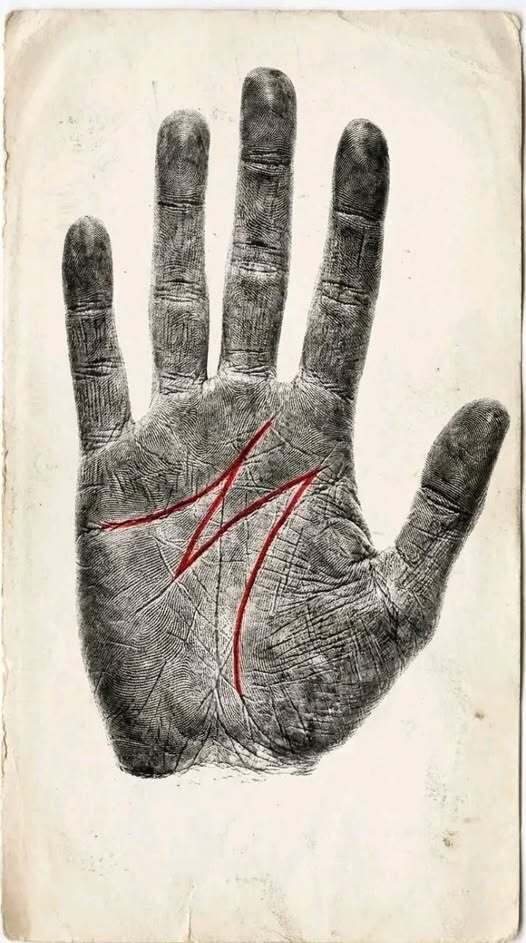
For as long as human beings have searched for meaning, they have looked not only to the stars, sacred texts, or the natural world, but also inward—to the body itself. Hands, in particular, have occupied a special place in this curiosity. They are tools of creation, expression, and survival, yet they also carry lines and markings that seem mysterious and deeply personal. Palmistry, one of the oldest systems of symbolic interpretation, is rooted in the idea that the lines of the hand reflect aspects of temperament, emotional tendencies, and life approach rather than fixed destiny. Among the many markings palm readers discuss, few attract as much fascination as the formation of the letter “M” on the palm. This shape is said to emerge when major lines—most commonly the heart line, head line, life line, and fate or intuition lines—intersect in a particular way. The intrigue surrounding the “M” lies not only in its rarity, but in the qualities traditionally associated with it, including intuition, leadership, resilience, and clarity of judgment. While modern science does not support palmistry as a predictive discipline, the symbolic language of the hand continues to resonate because it reflects humanity’s enduring desire to understand character, potential, and inner strength.
In palmistry traditions, the “M” is often described as a mark of heightened awareness and perception. People said to have this formation are believed to notice details others overlook, to sense underlying motives, and to trust their instincts in moments of uncertainty. This interpretation aligns with broader symbolic thinking found across cultures, where letters and shapes are imbued with meaning beyond their literal form. The “M” is sometimes linked to ideas of mastery, momentum, or mind, reinforcing the notion that those with this marking possess mental clarity and emotional intelligence. Palm readers frequently emphasize that such individuals are not necessarily born into ease or privilege; rather, they are thought to develop strength through challenge. The marking is associated with determination and an ability to recover from setbacks, suggesting a personality shaped by perseverance rather than luck. Whether or not one accepts these interpretations as literal truth, they reveal how symbolic systems attempt to map internal qualities onto visible features, transforming ordinary lines into stories about human potential.
One of the reasons the “M” marking is considered uncommon is its occasional association with the Simian line, a single transverse crease that replaces the usual separation between the head and heart lines. Anatomically, this line is a recognized variation found in a small percentage of the population, estimated at around one to two percent. In palmistry, the Simian line has long been viewed as a sign of intense focus, emotional depth, and unified thinking, because it symbolically merges logic and feeling into a single pathway. When an “M” shape appears in conjunction with or near this line, palm readers often interpret it as an amplification of these traits. Such individuals are said to approach life with passion and concentration, sometimes experiencing emotions more strongly than others. Historically, the Simian line has been misunderstood or stigmatized, but modern perspectives increasingly recognize it simply as a natural variation. Its inclusion in palmistry narratives highlights how physical features are often woven into symbolic frameworks that reflect cultural values, fears, and admiration for perceived intensity or uniqueness.
The hand on which the “M” appears also carries interpretive weight within palmistry belief systems. Traditionally, the dominant hand is thought to represent how a person acts in the world—their learned behaviors, choices, and outward expression—while the non-dominant hand is associated with innate tendencies and internal qualities. When an “M” appears on the non-dominant hand, palm readers often describe the individual as possessing natural judgment, ethical awareness, and a strong internal compass. These individuals are believed to value honesty and responsibility, approaching decisions with care rather than impulse. They are often described as calm in crisis, capable of weighing consequences before acting, and resistant to manipulation. Such interpretations appeal to the idea that character is something deeply ingrained, visible even before experience shapes behavior. In this way, the “M” becomes a symbol of moral steadiness and thoughtful engagement with the world.
When the “M” appears on the dominant hand, palmistry interpretations tend to focus on practicality, discipline, and execution. Individuals with this marking are often described as builders rather than dreamers—people who translate ideas into action through effort, structure, and persistence. Palm readers associate this placement with adaptability, problem-solving ability, and a willingness to shoulder responsibility. There is also a frequent connection drawn between a dominant-hand “M” and financial awareness, not in the sense of effortless wealth, but as an indicator of careful planning and long-term thinking. These individuals are said to understand the value of resources and to make decisions that favor stability over risk. In symbolic terms, the marking reflects a grounded relationship with reality, where success is viewed as something constructed gradually rather than discovered suddenly. Whether accurate or not, such interpretations resonate because they echo widely admired traits in modern society: discipline, foresight, and reliability.
Perhaps the most striking interpretation arises when palm readers claim to see an “M” on both palms. This is often described as a rare balance between intuition and logic, emotion and reason. Individuals associated with this feature are believed to move fluidly between inner insight and external action, combining sensitivity with decisiveness. In palmistry lore, such balance is seen as a hallmark of effective leadership—not leadership defined by authority alone, but by the ability to understand others while maintaining clarity of purpose. These individuals are often described as persuasive without being forceful, confident without being rigid, and adaptable without losing direction. From a symbolic standpoint, the dual “M” represents harmony within complexity, an idea that has long fascinated philosophers and spiritual traditions alike. Even for those who view palmistry purely as cultural storytelling, this interpretation reflects a deeper human aspiration: the hope of integrating thought and feeling into a coherent, meaningful way of living. Ultimately, the fascination with the “M” on the palm says less about destiny written in lines and more about humanity’s enduring search for identity, strength, and understanding within the marks we carry every day on our own hands.