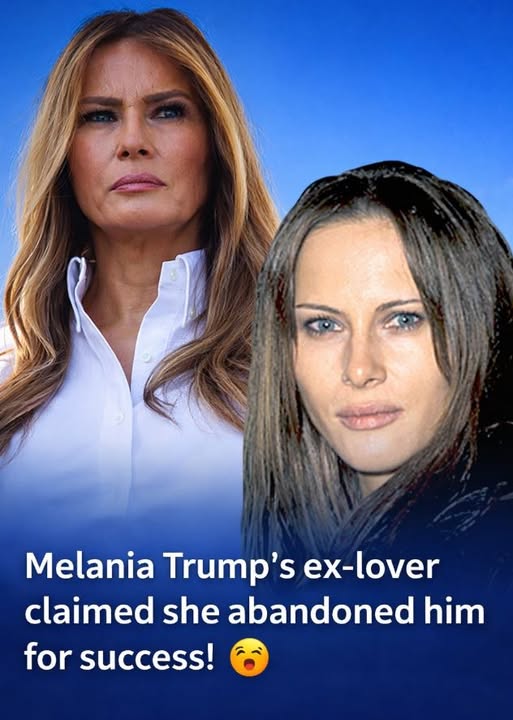
Public fascination with Melania Trump has always been marked by contradiction. As one of the most recognizable women in the world during her years as First Lady of the United States, she remained simultaneously visible and elusive, admired yet rarely understood. Unlike many public figures whose lives unfold openly before the media, Melania cultivated distance, revealing little beyond what was necessary. That reserve did not begin in the White House; it was present long before she entered American political life. Born Melanija Knavs in the Slovenian town of Sevnica, she grew up in a modest, structured environment shaped by routine, discipline, and self-reliance. Those who knew her in her youth often describe a young woman focused on advancement rather than attention, driven by ambition but wary of exposure. Modeling provided a path outward, yet even as her career expanded across Europe, she avoided the excesses often associated with that world. This early pattern—forward movement paired with emotional privacy—became a defining characteristic, one that later confused critics and intrigued supporters when she assumed a global spotlight she never seemed eager to court.
Her modeling career, which took her from Ljubljana to Milan and Paris before landing in New York, was built methodically rather than impulsively. Colleagues from that period recall professionalism rather than flamboyance, a woman who treated modeling as work, not lifestyle. While rumors and retrospective speculation have surrounded her early relationships, confirmed details remain sparse, largely because she declined to narrate her past for public consumption. Former acquaintances in Slovenia have occasionally stepped forward, offering fragmented memories of teenage romances or short-lived relationships, though many of these accounts later softened or contradicted themselves. What emerges is not a dramatic personal history, but a series of transitional moments defined by departure and reinvention. Each move forward came with a clean break, suggesting a deliberate refusal to anchor herself to nostalgia or unfinished attachments. By the time she reached New York, Melania had already learned how to compartmentalize, preserving a private self even as her public image became increasingly polished and visible.
Her meeting with Donald Trump in 1998 has been retold countless times, often framed as a pivotal turning point rather than one step in a longer journey. Introduced by agent Paolo Zampolli at a Fashion Week party, their first interaction reflected Melania’s instinct for boundaries. Trump arrived accompanied, yet pursued her attention directly, asking for her phone number. She refused, insisting instead that he give her his. This moment has been repeatedly cited as evidence of her independence and confidence, qualities sometimes overlooked in later portrayals of her as passive or silent. Friends from that period describe her as socially selective and resistant to superficial attention, uninterested in celebrity culture despite operating within it. When she and Trump eventually began a relationship, it developed under scrutiny, but Melania continued to speak sparingly, allowing actions rather than commentary to define her role. Even then, she appeared more comfortable observing than performing, a trait that would later shape her public presence as First Lady.
As her relationship with Trump progressed, Melania remained largely outside the political realm, yet she displayed an acute awareness of ambition and power. Years before his presidential campaign, she publicly expressed confidence in his leadership potential, once stating that he would make “a great president.” This comment, often revisited after his election, suggested not political involvement but perceptiveness. She understood the trajectory he envisioned and the environment it would demand. When they married in 2005, their union was unmistakably public, yet Melania continued to limit personal disclosure. Unlike many political spouses who actively shape narratives around family life, she chose restraint. Her role evolved cautiously, balancing loyalty with self-protection. Even as expectations mounted, she avoided aligning herself too closely with partisan battles, reinforcing an image of separation between her private identity and her husband’s political persona.
During her time as First Lady, this separation became both her defining strength and her greatest source of criticism. Supporters viewed her silence as dignity, a refusal to perform outrage or conformity. Critics interpreted it as detachment or indifference. Yet throughout those years, Melania remained consistent in one respect: she did not trade privacy for approval. She appeared selectively, spoke carefully, and retreated when scrutiny intensified. This approach mirrored her earlier life, where advancement never required emotional transparency. Behind the scenes, former staff have described her as attentive, detail-oriented, and fiercely protective of her family’s boundaries. Her commitment to shielding her son from excessive exposure further reinforced the sense that motherhood, rather than politics, defined her priorities. In an era of constant commentary, her refusal to explain herself became a statement in its own right.
Now, years removed from the White House spotlight, renewed attention to Melania Trump’s private life reflects broader curiosity about figures who resist easy categorization. Her journey from Slovenia to global prominence was not accidental, nor was it theatrical. It was shaped by strategic distance, personal discipline, and a consistent refusal to surrender autonomy, even when circumstances demanded visibility. The fragments of her past that occasionally surface do not reveal scandal or spectacle, but a pattern of controlled transition—leaving one life behind before fully entering the next. In that sense, Melania Trump remains exactly as she has always been: present, observed, and ultimately unknowable on her own terms. Her story continues to resist simplification, not because it is hidden, but because it was never meant to be shared in full.