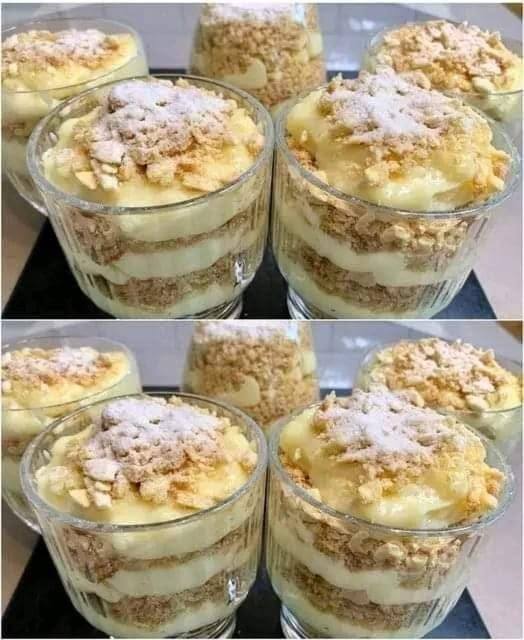
There are moments when a craving hits suddenly, stubborn and demanding, yet motivation is nowhere to be found. On days like these, dessert must be comforting, fast, and deeply satisfying despite minimal effort. The Napoleon in a glass transforms a traditionally elaborate French pastry into a playful, accessible treat that fits perfectly into these small, urgent moments of indulgence. Instead of painstakingly rolling dough, baking fragile layers, and meticulously assembling the pastry, the dessert breaks down into simple components that stack beautifully in a jar or glass. Its charm lies in honesty: it does not pretend to be elaborate, nor does it ask for culinary heroics. The magic comes from contrast—crunch meeting cream, warmth meeting sweetness—transforming a fleeting craving into a miniature triumph. Within minutes, what could have been a frustrating battle between hunger and laziness becomes a quiet, pleasurable victory, leaving the spoon scraping the bottom and a satisfied smile lingering in its wake.
What makes this variation particularly appealing is how it preserves the soul of the classic dessert while eliminating its demands. Traditional Napoleons rely on precise layers of flaky pastry and smooth custard, a balance that requires patience, skill, and a careful hand. By deconstructing it, the flavors and textures remain intact, but the pressure evaporates. The pastry becomes golden crumbs, gently toasted to release warmth and aroma, filling the kitchen with comforting scents. Custard, rich yet straightforward, is prepared in a single pan, thickening slowly to reward gentle whisking. Layering in a glass turns the act into assembly rather than baking, freeing the cook from the anxiety of perfection. Each portion feels personal, intimate, and designed for the person holding the spoon, offering a sense of ownership and satisfaction that the traditional presentation sometimes masks.
The beauty of this dessert is also in its simplicity of ingredients. Flour, butter, sugar, eggs, and milk—staples of nearly every kitchen—come together effortlessly. The crumbs start with flour and sugar, enhanced by a pinch of salt, creating balance rather than cloying sweetness. Cold butter, grated and melted gradually, produces crisp, golden fragments that provide both structure and texture. Toasting them offers an almost meditative experience, with the transformation from pale to amber signaling readiness. The custard, made from yolks, sugar, milk, and flour, thickens into silky indulgence, yielding richness without heaviness. Optional touches like fresh fruit, chocolate shavings, or powdered sugar personalize each serving, but even in its simplest form, the dessert stands confidently, proof that simplicity does not compromise pleasure.
Assembling the Napoleon in a glass is where anticipation meets gratification. Crisp crumbs settle first, followed by smooth custard that weaves through gaps, creating layers both visual and textural. Repeating the process builds excitement, with each bite offering a new combination of creaminess and crunch. Symmetry is unnecessary; there is no pressure for perfection, making the experience calming rather than stressful. A brief refrigeration allows flavors to meld without sacrificing texture, and when finally tasted, each spoonful delights with contrast and richness. Quick, intimate, and deeply satisfying, this dessert invites immediate enjoyment, often disappearing faster than expected, leaving only a clean glass as evidence of indulgence.
Its adaptability makes it ideal for real life, thriving in spontaneous moments. Whether for a quiet evening or unexpected company, it provides a solution that feels thoughtful yet effortless. Clear glasses or jars lend charm to even hurried presentations, while the recipe scales easily for one or many servings. Variations abound: seasonal fruits brighten the profile, chocolate or caramel enhance decadence, and even simple adjustments let the dessert reflect individual tastes. Despite this versatility, the core recipe excels on its own, delivering a comforting treat without the need for fuss or ceremony. It proves that desserts can be both fast and impressive, indulgent yet accessible, satisfying the deepest cravings without monopolizing time.
Ultimately, the appeal of a Napoleon in a glass lies in its efficiency, honesty, and immediate pleasure. It acknowledges that laziness is not failure but a natural state deserving accommodation, particularly when paired with a sweet craving. The dessert fulfills every promise—speed, flavor, satisfaction—without pretense. Its quick disappearance is not a critique but a testament to its success, reminding us that in a world often glorifying effort and complexity, joy can reside in simplicity. Sometimes, the most memorable indulgences are not the painstakingly perfected pastries, but the effortless creations that arrive, delight, and vanish, leaving only contentment and the quiet pleasure of a job well done—or a craving well satisfied.