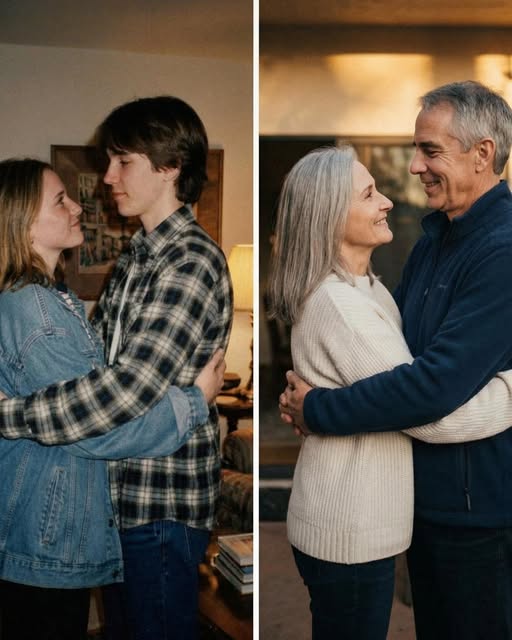
I was fifty-five, newly widowed, and learning in the harshest way how fragile life—and certainty—truly is. For thirty-six years, I had been someone’s wife, sharing a life built on quiet rhythms and steady companionship. Since I was nineteen, Greg—Raymond Gregory on formal documents, but always Greg to me—had been my constant. His shoes lined neatly by the door, his presence filling the silent hours of the night, became the framework around which my existence revolved. Then, in a single instant on a rainy Tuesday, all of that collapsed. A truck that failed to stop changed everything. In a moment, my world was split into two eras: Before and After. The life I had known, the shared memories, and the routine certainty of love and companionship were gone, leaving a hollow ache that words could scarcely touch. Grief, I quickly learned, was not a single emotion but a layered experience, intertwining sorrow, disbelief, and a creeping sense of vulnerability that made every small sound, every shadow, feel amplified.
Our marriage had been quiet, yet profoundly real. It was built not on grand gestures, but on the intimacy of everyday life: grocery lists shared, oil changes scheduled, anniversaries remembered, quiet evenings on the couch, and small rituals that quietly defined the years we had spent together. I had always believed that this stability, this unremarkable devotion, was enough, a sanctuary from life’s chaos. I had thought love’s proof was not in fireworks or declarations, but in the consistency of presence. And yet, at the viewing, as I approached the casket with a single red rose in hand, preparing for what I assumed would be my final act of care, a subtle shift rattled that belief. Greg lay there in his navy suit, hands neatly folded, hair combed as though he were merely asleep, serene and still. But then, as I stepped forward, my eyes caught something unexpected: a small white rectangle tucked beneath his fingers. In that moment, the hollow certainty of grief deepened into confusion, a jarring intrusion that felt almost surreal. Someone had left something for him. Someone had breached the private space of mourning and memory, and I would soon learn just how devastatingly personal that breach would feel.
I took the note with trembling hands to a nearby restroom, heart pounding in disbelief. The words written inside stopped me cold: “Even though we could never be together the way we deserved… my kids and I will love you forever.” Confusion turned to shock. Greg and I had no children, never had any reason to imagine a secret family, never suspected anything of the kind. My mind raced, replaying every day, every detail, searching for hints I had missed, any clue that would explain how someone could leave such a claim, such a deception. Security footage revealed Susan Miller, a coworker of Greg’s, slipping the note into the casket, an act that felt brazen in its cruelty. Confronting her brought an immediate, chilling revelation: she claimed Greg had fathered children she and her family were now asserting a right to love. The world I had built around Greg, the certainty of his devotion, seemed suddenly vulnerable to doubt. Every memory, every quiet evening together, was reframed through the lens of suspicion, and the note became a catalyst for a pain that was both new and indescribably piercing.
But grief, while raw, also sharpened clarity. In the days that followed, I turned to Greg’s journals, seeking solace, guidance, and understanding of the man I had shared my life with for more than three decades. There, in his own handwriting, I found the truth that the note had obscured. Susan’s claim was a fabrication, a deliberate cruelty meant to wound, not to reveal fact. Greg had never hidden another family, never betrayed the life we had built. The journals chronicled our years together, the mundane and the extraordinary, the laughter and the small disagreements, and most importantly, his steadfast love. “I love her,” he had written repeatedly, in ways both tender and ordinary, the words echoing across time to reassure me that our marriage had been real, and that no outside deception could diminish the depth of what we shared. The relief was overwhelming, yet it carried with it a profound sadness—grief compounded by the awareness of human cruelty and the fragility of peace in mourning. I cried then, deep and unrelenting, yet amidst the tears, a subtle strength began to emerge, a recognition that love, unlike lies, leaves a mark that cannot be erased.
That night, as the house grew quiet and the rain tapped softly against the window, I began to write. I wrote about Greg, about the red rose, about the shock of the note, about Susan’s lies, and about the deep, unshakable truth that had emerged from the pain. Writing became my conduit for grief, a way to hold on to what was real while letting go of what had threatened to distort reality. Through the process, I realized that love endures even when threatened by doubt, that fidelity is not merely about absence of infidelity, but about the clarity of devotion that survives even the most jarring tests. I chronicled every detail, every memory, every fleeting moment of intimacy that had defined our shared life, understanding that to document these truths was to preserve them against any falsehood. The act of writing, of bearing witness to both grief and joy, became a form of reclamation, a way of asserting control over my narrative in a world that had briefly felt unmoored.
Over time, the initial shock subsided, leaving behind a tempered grief and a resolute clarity. The experience had shaken me to my core, yet it also reinforced the strength of love when grounded in trust, transparency, and lived experience. Greg’s journals, his words, and the life we had shared became anchors, reminders that even in the face of cruelty and confusion, truth and devotion prevail. The red rose, once a small ceremonial gesture, now symbolized the endurance of care and the persistence of memory. The note, rather than undermining my understanding of Greg, had inadvertently highlighted the resilience of our bond, proving that the love we cultivated over decades could withstand challenges, even after death. From that place of reflection, I began to understand that grief is not solely about loss, but about adaptation, the capacity to integrate new truths into the story of a life once thought fixed, and the ability to emerge from pain with wisdom and resilience intact.
Ultimately, the revelation in Greg’s casket became more than a shocking moment; it transformed into a testament to the power of love, fidelity, and the human spirit’s capacity for healing. Lies may intrude, cruelty may seek to wound, yet the fundamental truth of a committed, lived love cannot be erased. I learned that even amidst grief, there is clarity, even in betrayal, there is perspective, and even in loss, there is the enduring mark of a life shared fully and honestly. Greg’s words, his journals, and the ordinary beauty of decades spent together now guide me, reminding me that love is both fragile and indestructible, delicate yet unwavering. Through this journey, I have come to understand that certainty may be rare, but the power of truth and devotion endures, leaving a legacy far greater than any deception could ever diminish.