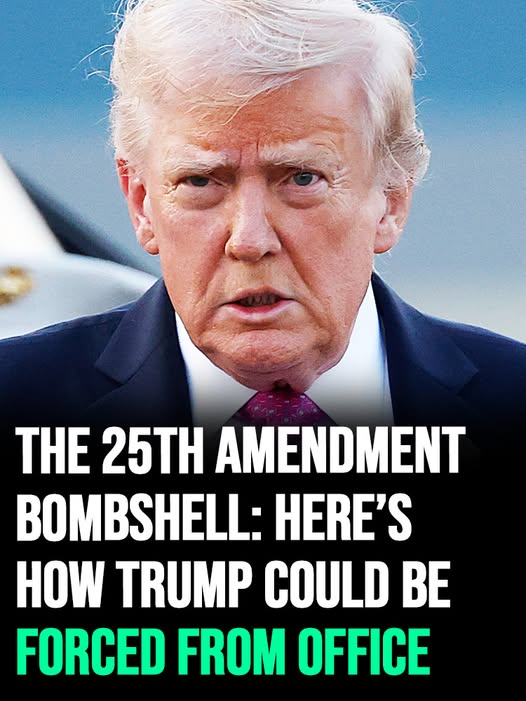
In January 2026, political tensions in the United States heightened as a rare diplomatic controversy spilled into public debate about presidential fitness and constitutional safeguards. This moment did not begin with emotion but with an extraordinary exchange in which President Donald Trump sent an unusual message to Norway’s prime minister that linked his ambitions regarding the Arctic island of Greenland to not having received the 2025 Nobel Peace Prize. Norwegian authorities confirmed they received the message, which contained assertions about U.S. security, NATO, and Greenland’s governance, and attributed to the president comments suggesting his foreign policy calculus had shifted in response to the perceived snub. The unusual contents of that communication quickly ignited criticism domestically, with some lawmakers expressing alarm and invoking the rarely discussed 25th Amendment as a constitutional mechanism to address alleged incapacity of a sitting president. This development thrust into the spotlight a constitutional provision understood by few and invoked even less often, prompting widespread discussion about how, or whether, it might actually be used in contemporary politics.
At the heart of the debate was the text message itself, which was first reported by journalists and later verified by Norway’s prime minister, Jonas Gahr Støre. In the message, the president stated that because his country did not award him the Nobel Peace Prize—an award actually granted by an independent committee and not by any government entity—he no longer felt he had to “think purely of peace,” and argued for U.S. strategic control over Greenland. He also made claims about ending multiple wars and about NATO’s obligations, mixing political assertions with hyperbolic language. Fact‑checking organizations later identified factual inaccuracies in aspects of the president’s message, such as confusing the role of the Norwegian government with that of the Nobel Committee and overstating personal influence over foreign conflicts. On the international stage, the letter added strain to transatlantic relations, coming amid disagreements over tariffs involving European countries and nationalist rhetoric tied to Arctic geopolitics.
Domestically, the reaction was swift and polarized. Members of Congress and political commentators seized on the episode as evidence of erratic conduct, with some Democrats — including Representatives Yassamin Ansari and Sydney Kamlager‑Dove, as well as Senator Ed Markey — publicly calling for consideration of invoking the 25th Amendment to remove the president from office. Representative Ansari’s comments included strong language about the president’s mental state, an appeal that drew both support and criticism across the political spectrum. On the other hand, many Republican lawmakers rejected calls for constitutional action, framing the controversy as media sensationalism or political posturing. Some conservative voices argued that border, trade, and security policies, however controversial, did not constitute incapacity. Regardless of partisan positioning, the public conversation quickly moved beyond the specific contents of the letter to a broader discussion about the nature and purpose of constitutional safeguards like the 25th Amendment, and whether such mechanisms were designed for political disagreements or for genuine incapacity.
The 25th Amendment itself was ratified in 1967 following the assassination of President John F. Kennedy, which raised questions about presidential succession and continuity. It consists of several sections designed to address different scenarios. Section 1 ensures that if a president dies, resigns, or is removed from office, the vice president becomes president. Section 2 allows for the appointment of a new vice president if that office becomes vacant, subject to confirmation by both houses of Congress. Of more relevance to the recent debate are Sections 3 and 4: Section 3 permits a president to voluntarily transfer power temporarily, such as during medical procedures, by submitting a written declaration that they are unable to discharge the duties of the office. Section 4 is the most consequential for removal — it allows the vice president, together with a majority of the Cabinet, to declare in writing that the president is unable to fulfill the duties of the presidency. Under Section 4, the vice president becomes acting president immediately upon such a declaration. If the president contests the declaration, Congress must then decide the matter, and the president may remain sidelined only if two‑thirds of both the House and Senate agree that the president is unfit.
Legal scholars and constitutional experts have been careful to underline the high threshold and specific intent of this process. The amendment was drafted to deal with inability, such as physical or mental incapacitation that prevents the president from performing essential duties, and not simply to settle political disputes or differences in policy. As a University of Maryland law professor explained in recent coverage, while political rhetoric can be intense and even unsettling, the 25th Amendment was not designed as a tool for removing a president simply for controversial decisions or unpopular positions. According to this interpretation, invoking the 25th Amendment would require clear evidence that the president’s capacity to carry out constitutional duties is compromised in a substantive and demonstrable way, not merely that political opponents disagree with his actions or rhetoric. Indeed, commentators and constitutional scholars highlight that the amendment has never been invoked to permanently remove a president and that doing so would require an extraordinary consensus rarely attainable in deeply polarized times.
As news of calls for the amendment’s invocation spread, the broader political and public reaction revealed the deep divides in contemporary American politics. Supporters of the president criticized what they saw as opportunism by opponents, insisting that policy disagreements and unconventional diplomatic language should be addressed through elections and political processes, not constitutional coercion. They argued that debates over administration priorities — including matters like Greenland, Arctic security, or NATO contributions — are normal features of democratic discourse and not signs of incompetence. Meanwhile, critics of the president pointed to the episode as symptomatic of what they perceive to be erratic judgment and a lack of respect for diplomatic norms. Many observers on all sides recognized that such disputes are likely to continue shaping political narratives leading into future elections, with each side using constitutional and institutional arguments to bolster their positions.
Despite the intensity of the public conversation, constitutional experts emphasize that actual invocation of the 25th Amendment remains extremely unlikely in this case. The amendment was designed to be a last resort in genuine incapacitation scenarios, and has only been invoked in limited circumstances — typically when a president temporarily transfers authority during medical procedures. Even among lawmakers calling for its use, there is acknowledgment that achieving the necessary legal and political thresholds — particularly the consent of the vice president and a majority of the Cabinet — would be highly challenging. Furthermore, if contested by the president, the requirement that two‑thirds of both chambers of Congress agree on incapacity makes it a high bar even in cases of bipartisan concern. Advocates for restraint stress that while vigorous debate about presidential conduct is healthy in a democracy, constitutional mechanisms like the 25th Amendment should be reserved for clear, empirically supported incapacity, not for policy disagreements or unilateral expressions of frustration, however controversial they may be.
What this episode has done, however, is push a constitutional concept that many Americans had only a passing familiarity with into broader public discourse, prompting discussions about governance, presidential power, and the safeguards built into the U.S. Constitution. Public understanding of how and why the 25th Amendment could theoretically be invoked — and why it has seldom been used — reflects a maturing political conversation about institutions, norms, and the balance between political accountability and constitutional order. In the end, while calls for invoking the 25th Amendment have grabbed headlines, the practical realities of constitutional process, legal interpretation, and political feasibility mean that such action remains deeply unlikely. Instead, this unfolding moment will likely be remembered not as a constitutional crisis, but as a significant flashpoint in the ongoing debate over presidential conduct, institutional integrity, and the enduring resilience of democratic norms in the United States.