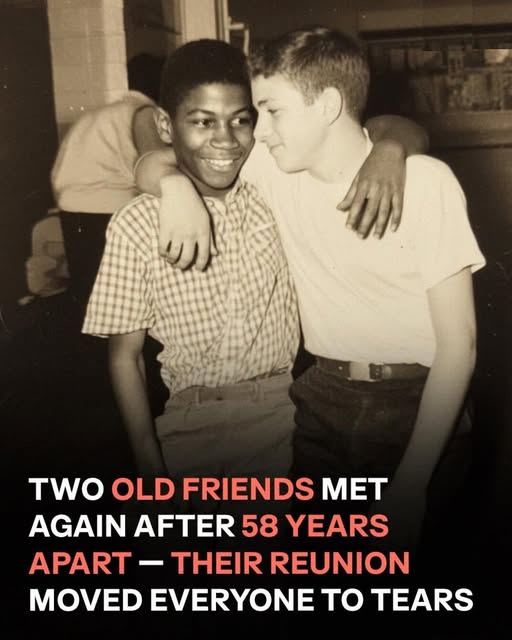
The reunion did not begin with ceremony or certainty, but with the quiet weight of anticipation that settles when people approach something long imagined yet never guaranteed. Robert arrived first, moving carefully, aware of each step and the dull ache that had become a familiar companion. Beneath his measured pace, however, was a restless energy that felt unexpectedly familiar. It reminded him of another kind of waiting long ago, outside classrooms and along sidewalks, when patience came easily and the future felt endless. Michael, approaching from the opposite direction, felt the same mixture of disbelief and cautious hope. His hands tightened on the steering wheel as memories surfaced without warning. They had spoken by phone, laughed, paused into silence, and laughed again, yet words had only brushed the surface of what this meeting represented. It was not simply about seeing a face shaped by time, but about encountering the version of themselves that existed before responsibilities, losses, and compromises took hold. When Michael finally stepped inside and their eyes met, recognition required no explanation. The years did not disappear because they were forgotten, but because, in that moment, they no longer mattered. What endured was the feeling of continuity, the quiet certainty that something essential had survived untouched.
Their story began in circumstances so ordinary that neither could have imagined their lasting significance. Sixth grade was not a time of grand ambition, but of shared desks, scuffed shoes, and small acts of loyalty that passed without notice. Robert was restless and impulsive, filling space effortlessly, while Michael was quiet and observant, attentive to details others overlooked. Together they formed a balance neither could name but both instinctively understood. They walked home together, argued over trivial matters, defended one another without hesitation, and made promises that felt permanent because they had not yet learned how fragile circumstances could be. Their days were shaped by routines that now feel almost sacred in their simplicity: lockers slamming shut, apples split and shared when lunches ran thin, jokes whispered during lessons. Friendship felt like a permanent state rather than something requiring care. When life intervened, there was no dramatic rupture, only a quiet separation brought on by necessity. A job was lost, a family moved, and what once felt immutable simply vanished. Letters slowed, addresses changed, and silence settled in, not as a decision, but as time moved forward without waiting.
Adulthood arrived for both men with its full measure of duty and compromise. Michael remained rooted in familiar ground, building a life defined by steady work, family responsibility, and a community that knew him not as a boy with neatly lined pencils, but as a man who could be relied upon. Marriage, children, and later grandchildren gave his days structure and meaning, even as loss gradually reshaped his understanding of permanence. Robert’s life unfolded in motion, shaped by military service, relocations, and the discipline of structure that demanded resilience and adaptability. He married, raised children, and learned to measure time in deployments and transfers, forming bonds that were often intense yet temporary. Both men knew joy and grief in equal measure, burying parents, losing friends, and learning to live with absences that could not be repaired. Yet beneath these full adult lives remained a quiet undercurrent of memory. Michael kept a class photo not out of longing, but as a reminder of a time when belonging felt effortless. Robert carried a nickname no one else used, a private link to a friendship that had shaped him before he had words for it. Neither searched for the other, yet neither fully let go, as though some part of them understood that certain bonds do not require constant tending to endure.
Their reconnection came not through intention, but through chance, carried by curiosity and technology across generations that had never known the original story. A grandchild’s interest, a moment of recognition, and a digital post bridged a distance that once seemed unbridgeable. When the first message arrived, it carried disbelief tempered by guarded hope. The initial phone call unfolded slowly, marked by pauses where emotion pressed against language. Laughter came easily, followed by silence heavy with what did not need to be explained. Neither man felt compelled to account for the missing years. The past had not been paused; it had been lived fully, and that truth did not diminish what they had shared. Agreeing to meet required quiet courage, an acceptance that reopening old doors carries risk as well as promise. Yet when they finally sat together and shared a simple apple, as they once had, the gesture carried an unplanned symbolism. It was not nostalgia, but recognition, proof that something essential had remained intact even as everything else had changed.
From that day forward, their friendship settled into a rhythm both new and familiar, shaped by age and by the freedom that comes with no longer needing to prove anything. Weekly meetings became an anchor not because they were remarkable, but because they were reliably ordinary. Coffee, conversation, and the comfort of silence created space where reflection felt natural. They spoke of spouses now gone, of children grown, of regrets softened by time and achievements viewed with quiet pride. They did not attempt to reclaim the past, but allowed it to inform the present, drawing meaning from experience without being defined by it. Their families watched with affection and curiosity, sensing something rare and instructive. Grandchildren listened to stories that conveyed values not easily taught: loyalty without obligation, affection without demand, and the understanding that relationships need not be constant to be profound.
The significance of Robert and Michael’s reunion lay not in dramatic transformation, but in its quiet challenge to the idea that time erases all things. Their friendship endured not by resisting change, but by accommodating it, flexible enough to survive separation without resentment. In reconnecting, they did not reclaim youth, but something deeper: the sense of being known without explanation. Their story resonated because it suggested that some connections exist beyond the timelines imposed on them, waiting not to be pursued, but to align. Through simple presence and shared memory, they demonstrated that human bonds are not sustained by proximity alone, but by sincerity at their origin. In choosing to recognize one another again when the chance appeared, they affirmed that certain relationships do not fade with time, but deepen quietly, gathering meaning until the moment they are rediscovered.