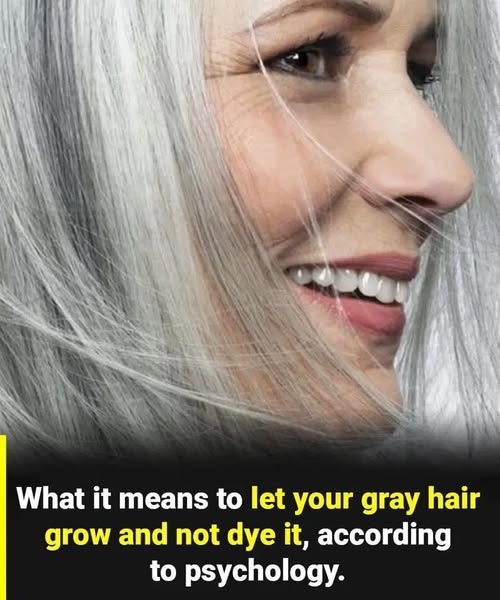
Leaving gray hair natural, without concealing it with dye, has increasingly become more than a simple aesthetic choice. For many, it represents a deeply symbolic decision tied to inner change, emotional awareness, and a shifting relationship with time and identity. For decades, gray hair was framed almost exclusively as a flaw to be corrected or delayed, reinforced by cultural narratives equating youth with beauty, relevance, and worth. Aging, by contrast, was often portrayed as decline or invisibility. Against this backdrop, allowing gray hair to show can feel like a quiet but profound departure from long-standing norms. Psychologically, the choice often emerges during periods of reflection, when individuals begin questioning external expectations and placing greater value on internal coherence and self-respect. Rather than signaling resignation, the decision frequently reflects an active embrace of reality and a desire to live more honestly within one’s own body.
From an identity standpoint, hair functions as a powerful symbol of self-presentation and social meaning. Throughout life, changing or coloring hair has been a way to manage narratives about vitality, desirability, and age. Choosing to stop dyeing gray hair often coincides with a broader process of identity redefinition, in which people reassess who they are beyond roles, achievements, or appearances. Psychologists note that this shift commonly occurs during midlife transitions, though it can arise at any stage when personal values evolve. By letting gray hair remain visible, individuals may be signaling that their sense of self is no longer anchored primarily in others’ approval. This does not suggest indifference to appearance, but rather a shift toward a more stable and internally grounded self-worth that is less dependent on constant external validation.
Emotionally, allowing gray hair to grow naturally is often linked to acceptance and reduced anxiety. Maintaining dyed hair can create subtle but persistent pressure, as roots reappear and the body’s natural processes feel like problems to manage or hide. Psychologically, this reinforces the belief that aging is something to fight. Letting go of that cycle can bring a sense of relief, removing a recurring reminder that time must be resisted. Many people describe feeling calmer, freer, and more authentic after making this transition. This emotional shift reflects a deeper acceptance of impermanence, an understanding that change is not only inevitable but meaningful. Gray hair becomes less a symbol of loss and more a visible record of experience, continuity, and resilience.
Socially, embracing gray hair challenges deeply embedded beauty standards, particularly those applied to women. While men’s gray hair has often been associated with authority or distinction, women have historically faced stronger pressure to conceal it to maintain social value. Choosing not to comply with this expectation can be an act of quiet resistance and empowerment. Psychologically, it involves confronting fears of judgment, invisibility, or rejection and choosing authenticity despite those risks. Over time, this choice can strengthen self-trust and confidence, as individuals learn to stand by their values even when they diverge from mainstream ideals. That confidence often extends beyond appearance, influencing how people set boundaries, voice opinions, and navigate relationships. In this way, embracing gray hair becomes intertwined with broader personal growth and autonomy.
At a deeper level, letting gray hair show reflects a changing relationship with time itself. Modern culture often promotes the illusion that aging can be delayed, reversed, or controlled through effort and consumption. Psychologically, internalizing this belief can lead to chronic dissatisfaction, as the body inevitably resists control. Accepting gray hair marks a shift toward a more compassionate and realistic understanding of the human lifespan. Time is no longer treated as an enemy but as a companion that shapes identity and meaning. This perspective is associated with greater emotional resilience, as individuals become less reactive to signs of change and more focused on presence and fulfillment. Gray hair, in this sense, becomes a reminder not of what is gone, but of what has been lived.
Ultimately, the psychological meaning of letting gray hair go natural lies in authenticity and self-alignment. It is not a universal statement or a moral stance; for some, dyeing hair remains a joyful and valid form of self-expression. However, for those who choose to stop, the decision often reflects a desire to live with fewer masks and less internal conflict. It signals readiness to be seen as one truly is, without apology or disguise. In a culture that frequently equates worth with youth and perfection, embracing gray hair can become a powerful declaration that value does not diminish with time. Instead, it deepens, shaped by experience, self-knowledge, and the quiet courage to stand comfortably in one’s evolving identity.