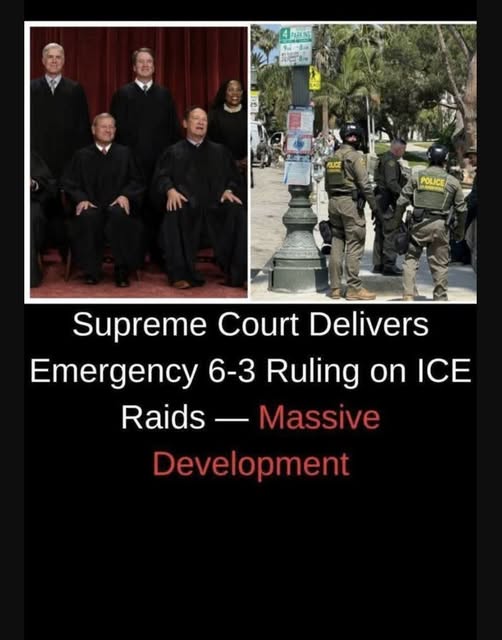
The U.S. Supreme Court’s decision on September 8, 2025, to lift lower-court restrictions on federal immigration enforcement in the Los Angeles region marked a consequential turning point in America’s long-running struggle over immigration, civil liberties, and the reach of executive power. By granting the Trump administration’s emergency request, the Court allowed Immigration and Customs Enforcement and other federal agencies to resume so-called “roving patrols,” a controversial enforcement tactic that had been halted months earlier by a federal judge who found them likely unconstitutional. These patrols authorize immigration agents to stop and question individuals in public spaces without warrants, often relying on broad indicators rather than individualized suspicion. Although the ruling did not decide the ultimate legality of the practice, it immediately altered daily life for millions of residents in one of the nation’s most diverse metropolitan areas. Streets, workplaces, transit hubs, and neighborhoods that had briefly experienced a sense of legal restraint now returned to a climate of uncertainty, where the line between lawful enforcement and intrusive surveillance once again felt perilously thin.
At the center of the controversy lies a fundamental constitutional tension: how far the federal government may go in enforcing immigration laws without violating the Fourth Amendment’s protections against unreasonable searches and seizures. U.S. District Judge Maame Ewusi-Mensah Frimpong had concluded that ICE agents operating in Los Angeles were likely crossing that constitutional boundary. Her injunction barred officers from relying on factors such as race, language, accent, or occupation as proxies for unlawful presence, emphasizing that such characteristics are shared by millions of U.S. citizens and lawful residents. The ruling highlighted testimony and evidence suggesting that individuals were being stopped for speaking Spanish, appearing Latino, or working in construction, agriculture, or service industries. For the court, these practices threatened to normalize suspicion based on identity rather than evidence. The Trump administration, however, argued that the injunction imposed unrealistic constraints on enforcement, framing it as judicial micromanagement that crippled the executive branch’s ability to carry out federal law. When the Supreme Court lifted the injunction, it effectively restored broad discretion to immigration officers, even as unresolved constitutional questions continued to loom over the practice.
The Court’s order, reportedly decided along a 6–3 ideological divide, arrived without a full written opinion, a procedural feature common to emergency rulings but one that intensified criticism from legal scholars and civil rights advocates. Justice Brett Kavanaugh wrote a separate concurrence attempting to clarify the majority’s reasoning. He suggested that brief, consensual encounters between immigration officers and individuals do not inherently violate the Constitution and argued that officers may rely on “common sense” factors when deciding whom to approach. Importantly, he stopped short of endorsing detention or arrest based solely on those indicators, drawing a formal distinction between questioning and coercion. Supporters of the decision seized on this reasoning as a pragmatic acknowledgment of law enforcement realities. Critics, however, warned that in practice the distinction between a voluntary conversation and a coercive stop often collapses, particularly when armed federal agents question individuals in communities shaped by fear of detention, deportation, or family separation. In such contexts, “consent” can feel more theoretical than real.
That concern was forcefully articulated in a sharply worded dissent by Justice Sonia Sotomayor, joined by Justices Elena Kagan and Ketanji Brown Jackson. Sotomayor warned that the Court’s intervention risks normalizing discriminatory enforcement practices under the guise of administrative necessity. She argued that allowing officers to rely on appearance, language, or economic status moves the nation closer to a system in which entire communities live under perpetual suspicion. The Fourth Amendment, she emphasized, demands particularized and individualized suspicion, not broad assumptions rooted in stereotypes. In her view, the Court failed to meet a critical moment for constitutional vigilance, signaling instead that core protections may bend under political pressure. The dissent framed the issue not merely as a technical legal dispute but as a moral reckoning over whether constitutional guarantees apply equally to all people or selectively to those deemed politically vulnerable.
The legal battle that culminated in the Supreme Court’s decision unfolded rapidly and against a backdrop of intensified immigration enforcement nationwide. After Judge Frimpong issued her injunction in July, the Justice Department appealed to the Ninth Circuit Court of Appeals, arguing that the order placed ICE agents in a “straitjacket” and undermined the administration’s mass-deportation agenda. A unanimous three-judge panel declined to pause the injunction, expressing concern over allegations that the White House had set an informal target of 3,000 immigration arrests per day. While administration officials denied the existence of a formal quota, public statements emphasizing numerical enforcement goals fueled suspicion that agents were under pressure to prioritize volume over legality. Civil rights organizations argued that such incentives increase the risk of unlawful stops and racial profiling, while the administration maintained that aggressive enforcement was necessary to restore order and uphold the rule of law. The Supreme Court’s decision to override the lower courts reshaped the legal terrain, signaling a readiness to intervene decisively when executive authority and judicial oversight collide.
Beyond Los Angeles, the ruling carries far-reaching implications for immigration policy, federal power, and the judiciary’s role during periods of political polarization. It arrives amid other high-stakes disputes, including challenges to presidential authority over independent agencies and the deployment of federal forces within states that oppose certain enforcement strategies. Collectively, these cases underscore the Supreme Court’s central position in defining the balance of power between branches of government. For immigrant communities, the decision has intensified fears of heightened surveillance, arbitrary stops, and family disruption, reinforcing a sense that legal protections are fragile and contingent. For proponents of stricter immigration control, the ruling represents a necessary correction to what they view as judicial obstruction of lawful enforcement. Ultimately, the case raises enduring questions about how a democratic society enforces its laws without eroding the freedoms that define it, and whether constitutional protections can remain resilient when tested by fear, politics, and the immense pressures of governing a diverse and divided nation.