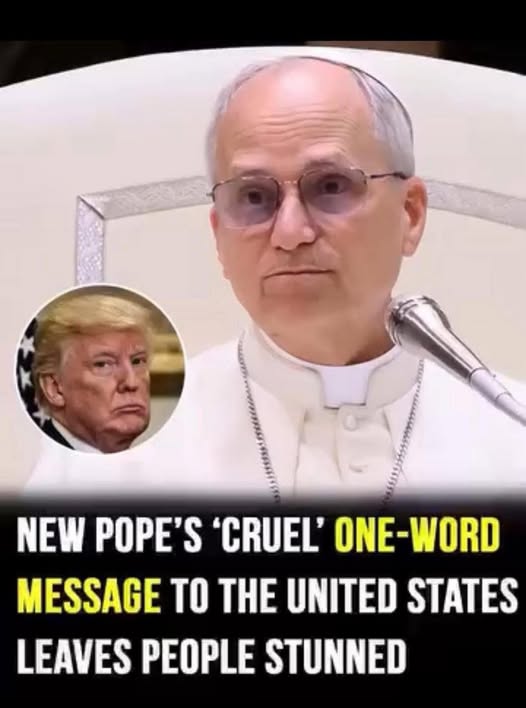
A single word can sometimes do what long speeches cannot, and that truth was unexpectedly illustrated during one of Pope Leo XIV’s earliest public encounters with the press. Only days into his papacy, amid the swirl of cameras, questions, and global curiosity, the Pope was asked whether he had a message for the United States. He paused briefly, smiled with ease rather than calculation, and answered simply, “Many,” before offering a familiar blessing. The exchange lasted only seconds, yet it carried a quiet weight that lingered long after the microphones were lowered. In an era where public figures are expected to deliver carefully structured statements designed to avoid ambiguity, the restraint of his response felt striking. It resisted the instinct to explain, persuade, or clarify, choosing instead to leave meaning open. That choice transformed a routine press moment into a reflection on leadership, communication, and the power of understatement, demonstrating how presence and intention can sometimes speak louder than elaboration.
As the clip circulated across social media platforms and news outlets, its impact grew rapidly, shaped by the very digital ecosystem it quietly critiqued. Viewers replayed the moment, slowed it down, analyzed facial expressions, and debated intent. Some interpreted the word “many” as a gentle acknowledgment of the complex challenges facing the United States, while others saw it as a subtle affirmation of hope, diversity, or responsibility. Memes and commentary appeared alongside thoughtful essays and theological reflections, all drawing from the same brief exchange. What made the moment so compelling was not that it delivered a clear directive, but that it invited projection. In leaving space rather than filling it, the Pope allowed people to bring their own concerns, values, and questions into the interpretation. In a media environment accustomed to certainty and immediacy, this openness felt almost radical, reminding audiences that meaning does not always arrive prepackaged.
The response also resonated because it aligned closely with Pope Leo XIV’s emerging public persona and personal history. As a pontiff with roots in the United States and a life shaped by both American culture and global religious service, he embodies a bridge between local identity and universal responsibility. His previous remarks and actions have emphasized compassion, dialogue, and humility over confrontation. Within that context, the one-word answer felt less like evasion and more like intentional restraint. It suggested a leader aware of the limitations of sound bites and the dangers of oversimplification. Rather than issuing a message that could be reduced to headlines or weaponized in political discourse, he chose an answer that acknowledged complexity without defining it. This approach reflected a broader philosophy of leadership that values listening as much as speaking and understands that authority does not always need to announce itself loudly.
The symbolic weight of addressing the United States in such a minimal way cannot be separated from the country’s size, influence, and internal diversity. Any message aimed at a nation of millions, marked by cultural, political, and social plurality, risks flattening lived realities into abstraction. By saying “many,” the Pope appeared to recognize that no single statement could adequately encompass the experiences, struggles, and hopes of such a vast population. The word functioned less as a conclusion and more as an opening, acknowledging that there are many stories, many challenges, many responsibilities, and many possibilities. In doing so, it subtly affirmed the dignity of complexity. Rather than prescribing a unified interpretation, the Pope’s response respected the idea that meaning must often be discovered individually and collectively over time.
This moment also highlighted how modern communication amplifies simplicity into symbolism. In earlier eras, such a brief exchange might have passed unnoticed, absorbed into the larger rhythm of public appearances. Today, however, even fleeting remarks can become global events, refracted through countless screens and perspectives. The Pope’s answer became a case study in how media attention does not always favor the loudest or longest message, but sometimes the most restrained. In a digital landscape saturated with constant commentary, outrage, and reaction, silence and brevity can stand out sharply. The exchange suggested that leadership in the modern age may require not only the ability to speak effectively, but the wisdom to know when less is more. By resisting the pressure to fill every moment with explanation, the Pope demonstrated how calm presence can interrupt noise and invite reflection.
Many observers noted the emotional tone of the moment as much as the words themselves. The pause before the answer, the relaxed smile, and the gentle delivery all contributed to its effect. Communication scholars often emphasize that meaning is conveyed not only through language, but through demeanor, pacing, and context. In this case, the Pope’s body language conveyed confidence without arrogance and openness without vagueness. The absence of defensiveness or urgency suggested a leader comfortable with uncertainty and unafraid of interpretation. That comfort resonated in a time when many public figures appear tightly scripted and reactive. The moment served as a reminder that authenticity can emerge not from saying more, but from saying what feels true and allowing others to engage with it.
The broader discussion sparked by the exchange revealed as much about audiences as it did about the Pope. Supporters and critics alike projected their hopes, anxieties, and assumptions onto the single word. Some viewed it as a moral prompt, encouraging Americans to reflect on issues such as justice, compassion, and responsibility. Others read it as a diplomatic neutrality, avoiding entanglement in national debates. Still others simply appreciated the humanity of the response, finding comfort in its lightness. This diversity of interpretations underscored a key insight: meaning is co-created between speaker and listener. By leaving space, the Pope allowed that process to unfold publicly, turning a brief moment into a collective exercise in reflection rather than instruction.
Ultimately, the exchange became emblematic of a larger question facing leaders in the digital age: how to communicate with depth in a medium that often rewards speed and certainty. Pope Leo XIV’s answer did not resolve debates or deliver policy guidance, yet it achieved something arguably more enduring. It reminded people that wisdom can reside in restraint, that leadership can be expressed through presence rather than proclamation, and that simplicity can carry profound symbolic power. In a world where every word is dissected and amplified, the courage to speak lightly can be a form of strength. The Pope’s “many” did not close a conversation; it opened one, demonstrating that sometimes the most meaningful messages are those that invite us to think, listen, and reflect long after the words themselves have faded.