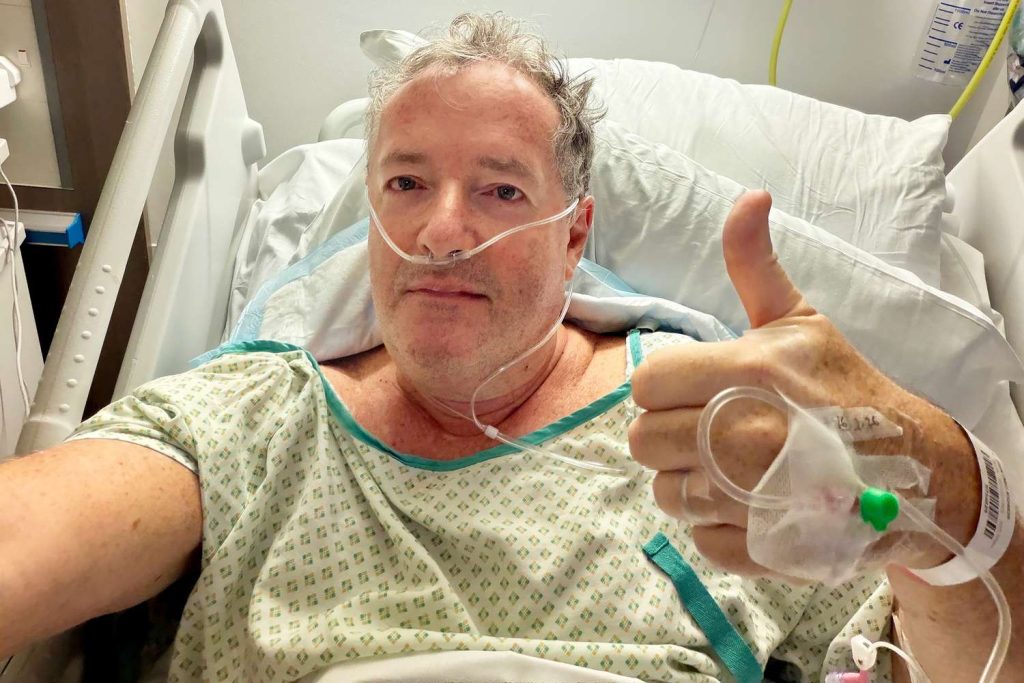
British television personality Piers Morgan, renowned for his sharp commentary and provocative style, surprised followers when he announced that a sudden fall in a London hotel restaurant resulted in a fractured hip. The incident, triggered by a small step that sent him crashing “like a sack of spuds,” required a full hip replacement and forced the 60-year-old broadcaster into weeks on crutches, halting long-haul travel. While the injury itself would be sobering for anyone, Morgan framed the experience in his trademark manner, blending dark humor with candid disclosure. By doing so, he transformed a personal health crisis into a public moment that resonated widely on social media and news platforms, reflecting his enduring ability to shape narrative even outside the studio.
Morgan’s post on Threads quickly captured attention not just for the injury, but for the tone and presentation. He enumerated events in a numbered list, turning the mishap into a sardonic checklist that balanced self-mockery with medical reality. Amid references to surgery, recovery timelines, and travel limitations, he quipped that his 2026 was “off to a cracking start” and concluded with the line: “I blame Donald Trump.” The comment, though tongue-in-cheek, tapped into a long-standing public feud. For Morgan, humor and politics are inseparable, and even personal misfortune becomes part of a broader narrative inviting public reaction and interpretation. His announcement illustrates how, in the digital era, private incidents are rarely just private—they are platforms for commentary, identity shaping, and engagement.
Understanding the impact of Morgan’s Trump reference requires context. The two men shared a public friendship in earlier years, with Morgan often defending Trump’s actions and emphasizing personal loyalty. That relationship fractured after the January 6, 2021, Capitol attack, when Morgan publicly condemned Trump’s conduct and rhetoric. The rupture transformed Morgan from perceived ally to vocal critic within British and international media, a shift that continues to shape his commentary and the reception of his public persona. His hospital humor, therefore, resonated as a satirical nod to an ongoing political narrative rather than a literal accusation, reaffirming his identity as a broadcaster unafraid of confrontation.
Morgan’s approach to commentary extends beyond Trump, reflecting a career built on challenging cultural norms, provoking discussion, and refusing to retreat from backlash. Admirers laud his courage and forthrightness; critics claim he prioritizes outrage over nuance. Even his hospitalization sparked polarized responses, with some expressing sympathy and others questioning whether the incident would become another vehicle for self-promotion. The episode demonstrates how his public persona shapes audience perception, blurring the boundary between private hardship and public spectacle, and revealing how notoriety amplifies scrutiny of even everyday experiences.
Recent events, including Morgan’s condemnation of Trump’s comments about the late Rob Reiner, further underscore the moral dimension of his commentary. After Reiner and his wife Michele were murdered, Trump’s social media posts mocked the director’s political stances, prompting Morgan to emphasize that basic decency must remain inviolable. In this context, Morgan’s tongue-in-cheek reference to Trump in his hospitalization post carried additional meaning, blending humor, political critique, and commentary on declining civility in public discourse. The incident highlights Morgan’s ongoing effort to merge commentary with personal conviction, using public moments to underscore ethical and social boundaries.
As Morgan begins recovery, the fall invites reflection on the vulnerability of public figures, often perceived as larger than life. A minor misstep can disrupt routine, reminding audiences that celebrity does not shield from life’s fragility. Yet, for Morgan, vulnerability is another narrative tool. By sharing medical details, recovery challenges, and humor, he communicates transparency, resilience, and defiance. Whether seen as an accident, a political quip, or an illustration of media prowess, the incident reinforces the intersection of identity, conflict, and performance in his life. From a hospital room rather than a studio, Morgan continues to shape discourse, proving that even a fractured hip can become a stage for reflection, provocation, and debate.