A quiet but meaningful shift is taking place in online queer spaces, one that reflects how deeply people crave language that accurately mirrors their lived experiences. Across forums, identity wikis, and social media platforms, a growing number of individuals are encountering a term that feels unexpectedly precise: berrisexuality. For many, discovering this word brings an immediate sense of recognition, like stumbling upon a description that had been missing for years. Berrisexuality describes attraction to people of all genders, while acknowledging a stronger, more consistent pull toward women, feminine-presenting individuals, and androgynous people. This distinction, subtle yet powerful, resonates with those who have long identified as bisexual or pansexual but felt a quiet disconnect between the label and their actual patterns of attraction. Rather than signaling confusion, the emergence of this term reflects a deepening cultural understanding that desire does not distribute itself evenly or symmetrically, and that nuance matters.
For years, many people lived with a private sense of misalignment. They knew they were capable of attraction to multiple genders, yet noticed that their romantic or sexual interest gravitated most often toward femininity in its many forms. While their attraction to men or masculine-aligned individuals was real, it was less frequent or less central, creating an imbalance they struggled to articulate. Within broader labels, some worried they were being misleading, exaggerating parts of themselves, or failing to live up to an unspoken expectation of equal attraction. This internal tension could feel isolating, particularly in spaces where bisexuality or pansexuality is often framed as symmetrical or evenly distributed. Berrisexuality gives this experience a name, offering not just clarity but relief. It reassures people that their attraction is not flawed or incomplete, but simply shaped in a particular way that deserves acknowledgment.
The rise of berrisexuality has been most visible in online communities, where people are often freer to explore identity without immediate social consequences. Reddit threads, personal blogs, and queer-focused platforms have become places of collective discovery, with individuals sharing stories of how encountering the term felt like reading a private journal entry written by someone else. Many describe an emotional jolt—relief mixed with excitement—at realizing they were not alone. The language allowed them to stop explaining themselves in paragraphs and start speaking with precision. In these digital spaces, berrisexuality has become a point of connection, enabling conversations that move beyond generalities and into shared understanding. The communal nature of these discoveries highlights how identity labels often emerge not from institutions, but from people comparing notes on their inner lives.
Importantly, berrisexuality is not positioned as a replacement for established identities like bisexuality or pansexuality, nor does it attempt to fragment communities. Instead, it functions as a refinement, a way of personalizing broader labels rather than rejecting them. Many who use the term still identify as bi or pan, seeing berrisexuality as an additional layer of specificity rather than a separate category altogether. This approach reflects a growing recognition that identity labels are tools, not rules. They exist to help people communicate honestly, not to box them into rigid definitions. By naming a specific shape of attraction, berrisexuality affirms that variation within identities is natural and worthy of recognition, challenging the idea that attraction must conform to neat or balanced formulas.
The psychological impact of having precise language can be profound. For some, adopting the term berrisexual reduces long-standing self-doubt, replacing uncertainty with confidence. It offers a way to explain attraction patterns to partners without feeling defensive or apologetic, improving communication and self-understanding. Socially, it opens doors to communities where similar experiences are shared, easing feelings of isolation. Language, in this sense, becomes a form of validation. It tells people that their experiences are real, intelligible, and shared by others. This validation can foster emotional well-being, particularly for those who previously felt invisible within both heterosexual and queer spaces. Knowing that there is a word for how one feels can be an act of quiet empowerment.
Berrisexuality also reflects a broader cultural shift in how sexuality is understood. Increasingly, attraction is seen not as a fixed point but as a spectrum with countless variations. The emergence of micro-labels does not signal confusion or excess; rather, it demonstrates how communities adapt language to better reflect reality. As queer discourse evolves, there is growing acceptance that specificity does not dilute identity, but enriches it. Each new term is an attempt to honor lived experience with accuracy and empathy. In this way, berrisexuality is part of a larger movement toward recognizing the complexity of desire and resisting oversimplification. It underscores the idea that identities are descriptive, not prescriptive, and that individuals are the ultimate authorities on their own experiences.
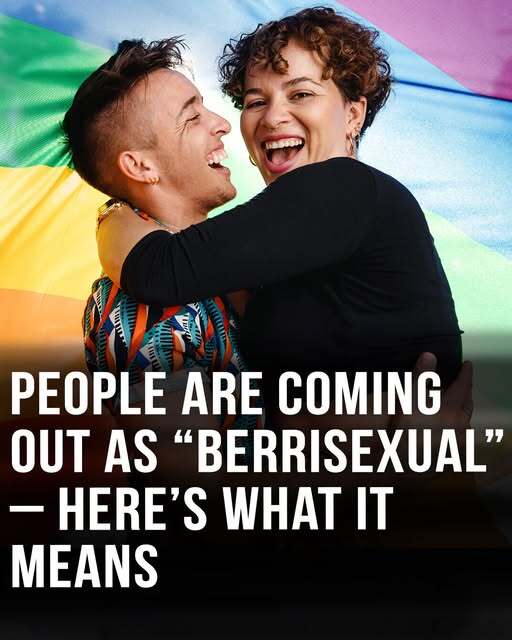
Ultimately, the resonance of berrisexuality lies in its ability to make people feel seen. For those who adopt it, the label does not create attraction; it clarifies it. It offers a way to speak honestly about desire without erasing any part of it, embracing both breadth and preference. In a world that often pressures people to simplify who they are, berrisexuality provides permission to be specific, nuanced, and whole. Its rise is a reminder that language evolves to meet human need, and that even a small word can carry immense emotional weight. Through this emerging identity, many are finding not only a label, but a sense of belonging, self-trust, and connection—proof that naming an experience can be a powerful step toward understanding and acceptance.
