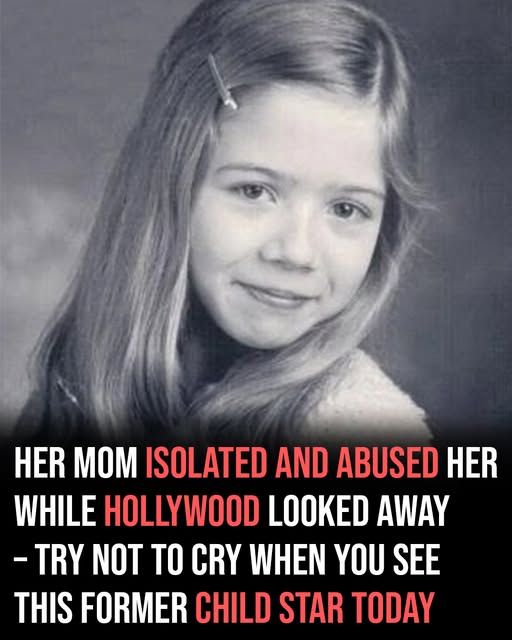
She was a bright, charismatic child whose face became familiar to millions before she was old enough to understand what fame truly meant. From the outside, her early life appeared like a dream fulfilled: steady work, financial success, and adoration from fans who saw only her cheerful performances. Yet behind closed doors, her childhood unfolded under intense control, isolation, and emotional manipulation that stripped away any sense of normalcy. Homeschooled and separated from peers, she grew up inside an environment where love and approval were often conditional, tied closely to performance and productivity. The weight of adult responsibility settled on her far too early, as she became the family’s primary source of income while still a child herself. What should have been years of curiosity, play, and discovery instead became years of pressure, fear, and silence. Her story exposes how easily childhood innocence can be overshadowed when ambition, financial desperation, and unchecked authority collide, particularly within an industry that rewards success without asking what it costs the child delivering it.
At the center of her early life was a mother whose influence shaped nearly every aspect of her existence. Following a cancer diagnosis, her mother’s behavior grew increasingly erratic, marked by hoarding, control, and emotional volatility that turned their home into a place of chaos rather than safety. Rooms became unusable, privacy disappeared, and boundaries eroded entirely. The young girl slept on gym mats amid clutter, learning early that her comfort was secondary to survival. Acting, which began as a spark of inspiration, quickly became an obligation fueled by her mother’s belief that success could rescue the family from financial instability. While the intention may have been framed as love or opportunity, the execution was relentless. Her mother managed her career, body, diet, and personal life with an intensity that left no room for autonomy. The child learned that compliance meant approval and resistance meant guilt, creating a psychological framework where obedience felt like survival. This dynamic blurred the line between care and control, leaving lasting scars that would only become visible years later.
As her career accelerated, so did the disconnect between her public image and private reality. On screen, she was energetic, confident, and effortlessly funny—qualities that made her a standout in children’s television. Off screen, she battled anxiety, disordered eating, and a growing sense of isolation. Puberty, identity, and emotional development unfolded under constant scrutiny, with no space to process them safely or privately. Her mother’s involvement extended into deeply invasive territory, erasing personal boundaries under the guise of protection and medical concern. These experiences left her confused, ashamed, and unable to distinguish normal parental care from abuse. Meanwhile, the industry surrounding her largely looked away. Adults who should have intervened either normalized what they saw or chose silence, prioritizing production schedules and profits over a child’s well-being. The result was a young performer learning to survive by compartmentalizing pain, smiling through distress, and convincing herself that discomfort was simply the price of success.
The turning point came not as a single moment, but as a slow unraveling. The death of her mother, while devastating, also removed the central figure who had controlled her life for years. In the aftermath, grief intertwined with confusion, guilt, and an unfamiliar sense of freedom. Without the structure—however damaging—that had defined her existence, she struggled to find balance. Alcohol, unhealthy relationships, and emotional numbing became coping mechanisms for pain she had never been allowed to acknowledge. Therapy eventually became a lifeline, offering language for experiences she had buried and validation for feelings she had long dismissed. Through professional support, she began to understand that what she endured was not normal, deserved, or her fault. This realization was both liberating and painful, forcing her to grieve not only her mother, but the childhood she never had. Healing, she learned, was not about erasing the past, but about finally telling the truth.
Stepping away from acting marked a profound act of self-preservation. For the first time, she chose herself over expectations imposed since childhood. Writing became her way forward—a method of reclaiming narrative control and transforming silence into clarity. Her memoir shocked readers not because it sought attention, but because it spoke with unflinching honesty about abuse, exploitation, and complicity. By naming what happened to her, she challenged long-standing myths about child stardom and parental sacrifice. She revealed how deeply personal trauma can be hidden beneath polished performances and how easily systems fail when success obscures suffering. The book resonated far beyond celebrity culture, striking a chord with readers who recognized similar patterns of control, shame, and emotional neglect in their own lives. In telling her story, she not only processed her trauma but gave others permission to examine theirs.
Today, she stands not as a victim frozen in the past, but as a woman actively shaping her future. Through podcasts, writing, and public reflection, she speaks about mental health, boundaries, and the importance of self-definition outside external validation. Her life no longer revolves around applause or approval, but around authenticity and choice. She has redefined success on her own terms, proving that stepping away can be as powerful as rising to fame. Her journey serves as a reminder that resilience is not about enduring pain silently, but about confronting it honestly and choosing healing over habit. By reclaiming her voice, she has transformed personal suffering into collective awareness, ensuring that her story is no longer one of being abused and ignored—but of being heard, understood, and finally free.