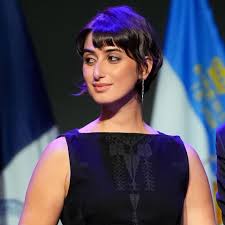
Rama Duwaji did not seek public attention, yet it found her anyway, arriving swiftly and loudly in the wake of her husband Zohran Mamdani’s historic election as mayor of New York City. Until that moment, Duwaji lived largely outside the political spotlight, known primarily within artistic and cultural circles as a Brooklyn-based visual artist whose work explored themes of identity, womanhood, sisterhood, and community. Her life, by most measures, reflected the rhythms of a working artist: studio time, collaborations, exhibitions, and freelance projects for respected institutions. The sudden interest in her personal life, appearance, and background came not because of anything she had said or done publicly, but because of who she married. That shift—from relative anonymity to public curiosity—has defined her recent experience, forcing her to navigate a delicate balance between visibility and self-protection. In a political culture eager to scrutinize every detail, Duwaji has responded not with spectacle or self-promotion, but with restraint, clarity, and an insistence that her work speak louder than her proximity to power.
Duwaji met Mamdani in 2021 through the dating app Hinge, a modern detail that humanized the couple for many supporters while underscoring how ordinary their beginnings were. Their relationship unfolded far from cameras and campaign trails, rooted instead in shared values, mutual respect, and creative ambition. In early 2025, they married quietly at the New York City Clerk’s office, choosing a simple civil ceremony over a public celebration. At the time, Mamdani was already a rising political figure, but few outside their immediate circles paid attention to his spouse. That changed dramatically after his electoral victory, when media outlets and social platforms began searching for details about the woman beside him. Mamdani responded publicly in May 2025 with a firm but affectionate Instagram post, writing, “Rama isn’t just my wife, she’s an incredible artist who deserves to be known on her own terms.” The statement served as both a defense and a boundary, signaling that admiration should not slide into entitlement. It also revealed something essential about their partnership: a shared understanding that love does not require surrendering identity.
Born in the United States and raised partly with deep Syrian roots, Duwaji has spoken sparingly but thoughtfully about her background. In one past reflection, she noted, “I was born in the States and lived here till I was nine,” a simple statement that hints at a life shaped by movement, dual belonging, and cultural layering. These experiences quietly inform her art, which often grapples with questions of home, inheritance, and the spaces women carve out for one another within complex social worlds. Her work resists easy categorization, blending illustration, narrative, and symbolism in ways that feel intimate without being confessional. Over the years, she has collaborated with clients such as The New Yorker and Tate Modern, achievements that speak to her credibility long before political attention arrived. To those familiar with her career, the sudden fascination with her personal life feels misplaced, even reductive. Her artistic identity was already fully formed; the public simply hadn’t been paying attention.
When journalists sought interviews following Mamdani’s primary victory, Duwaji declined most requests, later telling The New York Times that the attention felt overwhelming. That admission resonated with many who recognized the emotional toll of being thrust into visibility without consent. Unlike politicians, artists are rarely trained to manage public scrutiny at scale, nor are they obligated to do so. Duwaji’s decision to step back was not a rejection of public engagement, but a form of self-preservation. In an era when social media often collapses boundaries between admiration and intrusion, her restraint stood out. While online commentary fixated on her appearance, poise, and perceived symbolism, she continued to define herself through her work and values rather than responding to every narrative constructed around her. This refusal to perform a public role she did not choose has, paradoxically, strengthened her credibility, reinforcing the sense that she is guided by intention rather than opportunism.The fascination with political spouses is hardly new, but it often reveals more about societal expectations than about the individuals themselves. Women married to powerful men are frequently cast as extensions of their partners—decorative, symbolic, or strategic—rather than autonomous figures with their own ambitions. Duwaji’s story disrupts that pattern precisely because she resists it. She is not positioning herself as a political surrogate, influencer, or lifestyle icon. Instead, she remains rooted in her creative practice, allowing her art to engage with the world on its own terms. Her themes of sisterhood and community take on added resonance in this context, suggesting a quiet critique of systems that reduce women to supporting roles. By declining to monetize attention or reshape her identity to fit public expectations, Duwaji challenges the assumption that visibility must be exploited to be valuable.
Ultimately, Rama Duwaji’s emergence into public awareness is less a transformation than a test—of media restraint, public curiosity, and cultural maturity. Her life illustrates the tension between public interest and personal autonomy in a time when political success often drags entire families into the spotlight. Rather than embracing that attention, she has chosen a different path, one marked by discretion, creative integrity, and a clear sense of self. In doing so, she reminds observers that proximity to power does not erase individuality, and that not every compelling story needs constant narration. Whether or not she ever chooses to speak more openly, Duwaji has already made a statement through her choices. She remains, first and foremost, an artist—defined not by her husband’s office, but by her own vision, discipline, and refusal to be reduced to a headline.