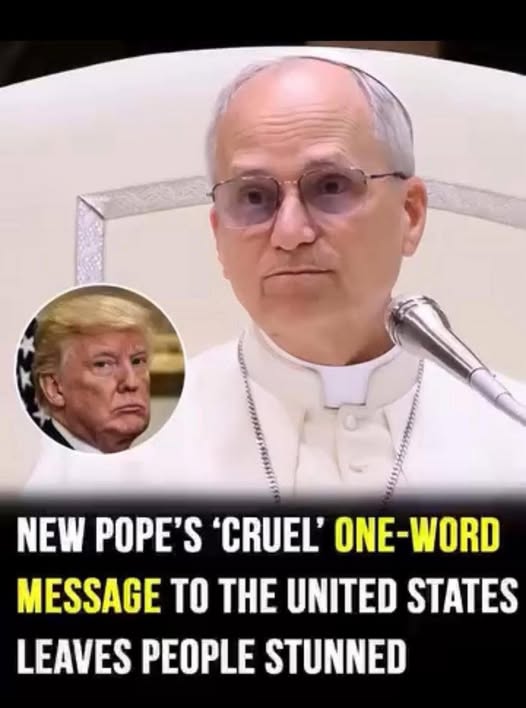
In an era defined by constant commentary, instant reactions, and an almost relentless demand for explanation, it is often the smallest moments that resonate most deeply. Such was the case when Pope Leo XIV, only days into his papacy, was asked during a press interaction whether he had a message for the United States. The question itself seemed to invite a prepared response—perhaps a diplomatic statement, a moral exhortation, or a carefully balanced reflection addressing politics, culture, and faith. Instead, the Pope paused, smiled gently, and answered with a single word: “Many.” He then offered a familiar blessing and moved on. The brevity of the response stood in sharp contrast to the expectations placed on global leaders, particularly those whose words are routinely dissected for political, spiritual, and cultural meaning. Yet it was precisely this restraint that transformed the moment into something larger than a sound bite. In declining to elaborate, Pope Leo XIV resisted the modern impulse to define, explain, and clarify everything. He left space—space for interpretation, contemplation, and personal reflection. Almost immediately, the exchange began circulating online, shared across platforms and replayed in news segments, not because it was dramatic or provocative, but because it was disarmingly simple. In a world saturated with language, the absence of excess speech felt startling, almost radical, reminding audiences that communication does not always gain power through expansion, but sometimes through careful limitation.
As the clip spread, it quickly became clear that the Pope’s one-word reply functioned less as an answer and more as a catalyst. Social media users, commentators, and analysts began projecting their own meanings onto the word “many,” transforming it into a kind of collective mirror. Some interpreted it as an acknowledgment of the numerous challenges facing the United States, from political polarization and social inequality to questions of moral responsibility in a global context. Others saw humility in the response, reading it as a refusal to reduce a complex nation to a single judgment or directive. Still others approached it with humor, irony, or curiosity, demonstrating how ambiguity invites creativity as much as seriousness. What united these reactions was not agreement, but engagement. The Pope’s refusal to define his meaning created a rare pause in the usual cycle of instant interpretation, allowing people to linger with uncertainty rather than rushing toward conclusions. In this way, the moment exposed a deeper truth about modern communication: clarity is not always the same as understanding. By offering a word that carried multiple possible meanings, Pope Leo XIV acknowledged the layered reality of the world he addresses. The response did not impose a narrative; it invited participation. In an age where public dis
Observers were quick to connect the moment to Pope Leo XIV’s personal background and emerging leadership style. As someone born in the United States and later shaped by decades of global pastoral experience, he occupies a unique position between familiarity and distance. He understands American culture from within, yet speaks now from a role that transcends national identity. His public remarks since assuming the papacy have consistently emphasized dialogue, compassion, and the importance of listening—values that align closely with the restraint shown in this brief exchange. The simplicity of his answer did not suggest uncertainty or avoidance, but rather confidence in silence. The pause before he spoke, the gentle smile, and the calm delivery all communicated a sense of intentionality. This was not a man caught off guard, but a leader choosing not to overfill the moment with words. In doing so, he demonstrated an understanding that leadership communication is as much about tone and presence as it is about content. The Pope’s response reminded audiences that authority does not require verbosity, and that moral leadership can be expressed through gestures that encourage reflection rather than compliance. In a media environment that rewards constant output, his restraint felt almost countercultural, reinforcing the idea that wisdom is sometimes most visible in what is left unsaid.
The word “many” also carried particular weight given the diversity and complexity of the United States itself. Addressing a nation of vast geographic, cultural, political, and spiritual variation is an inherently difficult task, especially from a global religious platform. Any singular message risks flattening that complexity or privileging one perspective over others. By offering an open-ended response, Pope Leo XIV appeared to acknowledge this reality. The United States is not a monolith; it is a tapestry of histories, beliefs, struggles, and aspirations that cannot be captured in a single sentence. In this light, “many” becomes less a deflection and more a recognition of plurality. It suggests that there are many conversations to be had, many responsibilities to consider, many paths to justice and reconciliation. Rather than prescribing a unified direction, the Pope’s answer subtly returned responsibility to individuals and communities, inviting them to discern their own roles within a shared moral landscape. This approach aligns with a broader vision of faith and leadership that values conscience, dialogue, and personal accountability over top-down instruction. The message, if it can be called that, was not delivered from above but opened outward, encouraging reflection rather than obedience.
The significance of the moment was amplified by its timing within a digital culture defined by speed and saturation. Public figures today operate under immense pressure to respond immediately, often with statements crafted to survive intense scrutiny and rapid dissemination. Words are clipped, quoted, reframed, and contested within seconds of being spoken. In such an environment, verbosity can become a liability, providing endless material for misinterpretation or controversy. Pope Leo XIV’s brevity functioned as a form of clarity through restraint. By offering so little, he left little to distort. Instead of feeding the churn of commentary, he created a pause within it. That pause, paradoxically, became newsworthy precisely because it disrupted expectations. It reminded audiences that communication does not always have to compete for attention; sometimes it can command attention by refusing to do so. The moment illustrated how simplicity can cut through digital noise more effectively than elaboration. In choosing to say less, the Pope demonstrated an acute awareness of the media environment and a willingness to engage with it on his own terms, rather than being shaped by its demands.
Ultimately, the brief exchange transcended its immediate context to become a symbol of communication in a globalized, hyper-connected age. Pope Leo XIV’s single word did not resolve debates or deliver policy guidance, yet it succeeded in sparking widespread reflection across cultures and platforms. It showed how meaning can emerge not from explanation alone, but from the space left for interpretation. In a world accustomed to constant messaging, the restraint of “many” felt both ancient and modern—a reminder of rhetorical traditions that value silence, contemplation, and humility, even as it circulated through the most contemporary digital channels. The moment suggested that global leadership in the twenty-first century may depend less on dominating conversations and more on shaping the conditions for thoughtful engagement. By trusting listeners to find meaning for themselves, the Pope affirmed a shared responsibility in communication. His response stands as a quiet lesson: that in times of noise, simplicity can still carry depth, and that sometimes the most enduring messages are those that invite us to think, rather than telling us what to think.