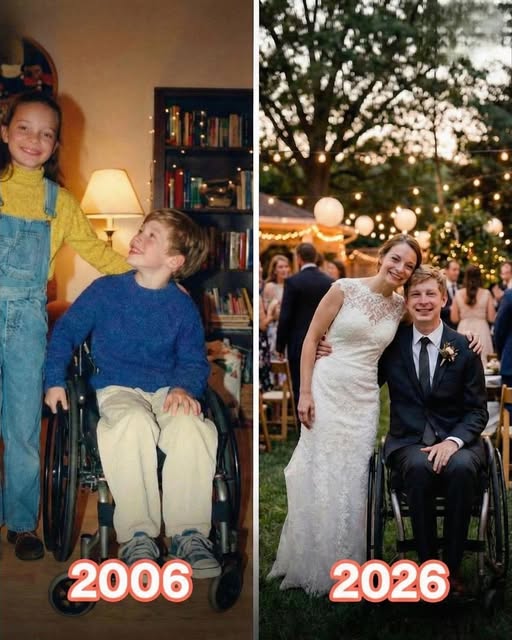
My name is Claire, and for most of my childhood, I learned that life was something temporary. Homes were temporary, people were temporary, even the sense of who I was felt provisional, shaped by the next move that always seemed inevitable. Foster care taught me how to live lightly, how to pack quickly, and how not to grow roots too deep. By the time I arrived at my last group home, I had stopped expecting permanence. I focused on routines, on getting through days without standing out too much, on protecting myself from disappointment. That was where I met Noah. He was quieter than the other kids, often sitting by the window in his wheelchair, watching the world rather than trying to fight it. One afternoon, I sat beside him with a book and joked about sharing the view. He smiled, introduced himself, and something settled into place. We didn’t rush into friendship; it grew naturally, built on long conversations, shared silences, and an unspoken understanding that neither of us had much, but we had each other. In a place defined by transience, we became something steady.
As the years passed, Noah and I grew up side by side. We shared jokes only we understood, talked late into the night about our fears, and imagined futures that felt almost fictional. When the day came for us to age out of the system, we walked out together carrying everything we owned in plastic bags. It was terrifying and exhilarating all at once. We found a small apartment with thin walls and unreliable heat, worked multiple jobs, and enrolled in community college because it felt like a door that might lead somewhere better. Our furniture came from thrift stores and curbside finds, and our meals were simple, but we built a life from what we had. Somewhere in the middle of shared exhaustion and quiet victories, friendship softened into love. There were no dramatic confessions, just the steady realization that we were already choosing each other every day. When Noah proposed in our tiny kitchen, asking if we wanted to keep building a future together, I said yes before he finished the sentence.
Our wedding reflected who we were—small, modest, and deeply personal. Secondhand decorations, borrowed chairs, and laughter filled the space. Friends from school, coworkers, and a few former group home staff came to celebrate with us. It wasn’t glamorous, but it felt honest, and that mattered more. That night, we fell asleep believing that the hardest chapters of our lives were behind us. We had survived instability, poverty, and uncertainty together, and we assumed the future would be more of the same—manageable, if not easy. The next morning, though, reality shifted in a way neither of us could have anticipated. A firm knock at the door interrupted our quiet breakfast. A well-dressed man named Thomas introduced himself and asked to speak with Noah. He explained that he had been searching for him for years and carried a letter from someone named Harold Peters. Noah didn’t recognize the name, but the seriousness in Thomas’s voice made us listen.The letter told a story from years earlier, one Noah barely remembered. An elderly man had fallen outside a grocery store while people hurried past, unwilling or unable to stop. A young boy in a wheelchair had paused, helped him up, and stayed until he was safe. That boy was Noah. Harold never forgot the kindness shown to him on a day when he felt invisible. With no close family of his own, he decided to leave his home and savings to the person who had treated him with dignity when it mattered most. Thomas confirmed the letter was real. There was a modest house, some savings, and a trust placed in Noah’s name. It wasn’t wealth in the way people usually imagine it, but to us, it felt unreal. When Thomas left, Noah and I sat on our worn couch in stunned silence, holding hands, trying to understand how a single act of kindness had traveled across decades to meet us at the very start of our marriage.
Weeks later, we visited the house Harold had left behind. It was simple and lived-in, with sunlight streaming through the windows and a ramp leading to the front door. It felt welcoming in a way no place ever had before. Noah rolled into the living room and whispered that he never imagined living in a home that couldn’t be taken away. His words hit me harder than I expected. For both of us, security had always been conditional, dependent on systems or circumstances beyond our control. Standing there, I realized this wasn’t just a house—it was proof that kindness leaves echoes. Harold had seen Noah fully in a moment when the world looked away, and that recognition had shaped our future. We weren’t suddenly rich, and our lives didn’t become perfect, but for the first time, we weren’t just surviving.
Now, when I think about our story, I understand that everything we have is built on small, human choices. Noah helping a stranger. Me sitting beside a quiet boy by a window. Two kids deciding to leave the system together rather than alone. Our marriage didn’t change us into different people; it revealed what had always been there. We are still learning how to live with stability, how to plan without fear, how to believe that good things can last. But each morning in that sunlit house, I’m reminded that love, kindness, and presence matter in ways we can’t always see. For the first time in our lives, the future doesn’t feel borrowed or fragile. It feels chosen—and it feels like home.