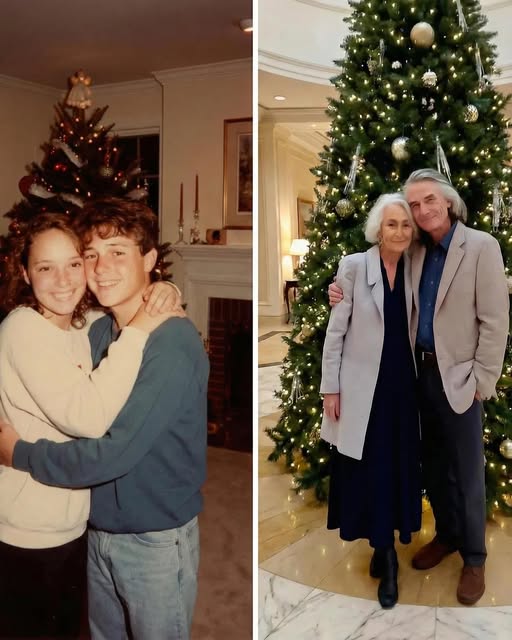
I am sixty-two years old, a literature teacher who has long believed that December follows a predictable rhythm: essays stacked like unfinished conversations, mugs of tea gone cold before I remember to drink them, and students insisting they are immune to the sentimental pull of the season. I have taught long enough to recognize patterns, not only in novels and poems, but in my own life. The holidays had become something I observed rather than felt, a backdrop of lights and music that no longer reached very deep. That was why I was unprepared for how easily everything shifted because of one quiet student and one gentle question. Emily rarely spoke unless called upon, and when she asked to interview me for a class assignment about meaningful holiday memories, I almost declined. I told her, honestly, that my life held nothing remarkable in that regard. She hesitated, then asked softly if I had ever loved someone around Christmas. The question echoed through me, opening a door I had carefully kept shut. Without intending to, I spoke a name I had not said aloud in decades: Daniel. I was seventeen when I loved him, and seventeen when he vanished from my life without a word. I had spent years convincing myself that silence was its own kind of ending.
After that conversation, I thought little more would come of it. I assumed Emily would write her paper, I would return to grading essays, and the past would settle back into its familiar, manageable shape. Instead, a week later, she burst into my classroom with a kind of breathless urgency that startled me. She showed me a post she had found online, its title simple and impossible to ignore: “Searching for the girl I loved 40 years ago.” As I read, my body reacted before my mind could catch up. The details were too precise to dismiss—my blue winter coat, the chipped tooth I had been self-conscious about, my dream of becoming a teacher when I was still a girl who believed dreams were promises. Then there was a photograph, grainy but unmistakable, of my younger self staring out from a time I thought was lost. The man who had written it was Daniel. My instinct was to retreat, to explain it away as coincidence or sentimentality, but Emily watched me with a calm certainty that felt wiser than her years. She said some stories pause rather than end. When she offered to message him on my behalf, my hands trembled as I nodded. That evening, his reply arrived. It was brief, careful, and devastating in its honesty. He told me he had been waiting a very long time to find me.
By the time Saturday arrived, I felt as though I were walking into a memory rather than a meeting. I chose my clothes with more intention than I had in years, not to appear younger, but to appear real. When I entered the café, warm with holiday lights and the low murmur of conversation, I recognized him immediately. Time had changed him, as it had changed me. His hair was silver, his face marked by years of responsibility and restraint, yet his eyes were unmistakable. They held the same warmth I had carried with me, unknowingly, through marriages, heartbreaks, and the steady march of adulthood. We spoke for hours, our words weaving between past and present. We talked about careers built and abandoned, relationships that had promised permanence and quietly dissolved, children grown and gone. There was laughter, but also a shared understanding of loss—not only of each other, but of the people we might have been. Eventually, I asked the question that had shaped so many silent years: why he disappeared. His answer was heavy and unadorned. His father’s scandal had uprooted their family overnight, and shame had convinced him that leaving me without explanation was a twisted form of protection. He had searched for me later, but my married name had erased me from his path.
When we finally stood to leave, Daniel placed something small and familiar into my hand. It was the locket I had lost in high school, the one containing a photograph of my parents, a piece of my identity I had mourned and then forgotten. He told me he had kept it not as evidence of the past, but as a reminder that something real had once existed between us. We did not pretend we could reclaim the years we lost, or undo the lives we had lived. We simply acknowledged that what we shared had mattered, and still did, in ways neither of us could deny. On Monday, I thanked Emily, who smiled and said only that I deserved to know. Now, at sixty-two, with an old locket resting against my heart and a cautious hope unfolding inside me, I stand at the threshold of something unexpected—not a return to youth, but an invitation to begin again, honestly and without fear, in the time I still have.