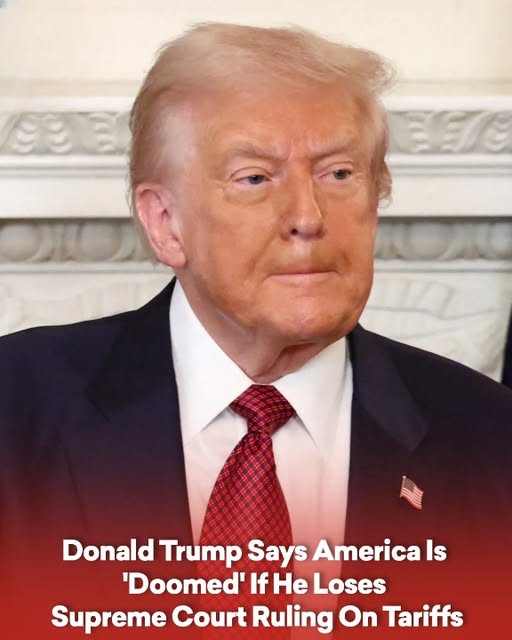
President Donald Trump has once again reached for dramatic language, declaring that the United States would be “doomed” or “screwed” if the Supreme Court moves to block his administration’s use of emergency powers to impose sweeping tariffs. The warning reflects more than campaign rhetoric or political brinkmanship; it underscores a pivotal legal and constitutional confrontation that could permanently reshape how economic power is exercised in Washington. At issue is whether the president can rely on emergency statutes to fundamentally alter trade policy without explicit congressional approval. Trump argues that such authority is essential to protect American workers, industries, and national security in a global economy he describes as predatory and hostile. Critics counter that allowing any president such latitude risks eroding constitutional checks and balances, opening the door to unilateral economic policymaking with consequences that reach far beyond any single administration.
The case before the Supreme Court, Learning Resources v. Trump, centers on the interpretation of the International Emergency Economic Powers Act of 1977, a law designed during the Cold War to give presidents flexibility in responding to extraordinary foreign threats. The statute grants broad authority to regulate economic transactions during national emergencies, but it was not written with modern tariff wars in mind. The plaintiffs argue that while the law allows for targeted sanctions or financial controls, it does not authorize the imposition of sweeping import duties that effectively rewrite U.S. trade policy. They maintain that tariffs have historically fallen under Congress’s constitutional power to regulate commerce, and that bypassing lawmakers through emergency declarations undermines democratic accountability. The administration, however, insists that chronic trade imbalances, supply chain vulnerabilities, and foreign industrial subsidies constitute an ongoing national emergency, justifying aggressive action under the statute.
Lower courts have so far been skeptical of the administration’s position, ruling that the president exceeded his authority by stretching the emergency law beyond its intended scope. Judges have noted that if Congress had meant to grant presidents near-unlimited tariff powers, it would have done so explicitly. Instead, lawmakers have traditionally debated, negotiated, and authorized trade measures through legislation, even when delegating certain powers to the executive branch. These rulings have emboldened critics who see the case as a necessary pushback against what they describe as executive overreach. At the same time, they have alarmed supporters of Trump’s trade strategy, who fear that curtailing emergency powers could leave future presidents hamstrung in responding to economic threats from rival nations.
The financial implications of a ruling against the government are staggering. If the Supreme Court agrees that the tariffs were unlawfully imposed, the federal government could be required to refund importers for duties already collected. Estimates suggest the total could range from $100 billion to $150 billion, a sum large enough to affect federal budgeting, deficit calculations, and long-term fiscal planning. For businesses, the uncertainty is just as troubling. Companies that adjusted supply chains, pricing, and investment strategies around the tariffs could face renewed instability, unsure whether future trade actions will stand or be reversed by the courts. Global partners and competitors are also watching closely, as the decision could signal how predictable—or volatile—U.S. trade policy will be in the years ahead.
Trump’s defense of emergency tariff powers extends beyond economics into the realm of national security and geopolitical leverage. He argues that tariffs are not merely revenue tools but strategic weapons that allow the United States to pressure foreign governments, counter unfair trade practices, and protect critical industries. In his view, forcing every major trade action through Congress would slow responses to rapidly evolving threats and weaken America’s negotiating position. Supporters echo this argument, saying that modern economic warfare requires speed and decisiveness that only the executive branch can provide. They warn that stripping presidents of this authority could embolden adversaries who exploit legal and political delays to gain advantage.
Opponents, however, see the case as a defining test of constitutional governance in an era of expanding executive power. They argue that emergencies, real or perceived, have too often been used to justify actions that bypass legislative debate and public scrutiny. Allowing broad tariff authority under an emergency statute, they say, would set a precedent that future presidents could exploit for purposes far removed from genuine national crises. The Supreme Court’s forthcoming decision is therefore about more than trade or tariffs; it is about where power ultimately resides in the American system. By clarifying the limits of emergency authority, the justices could redraw the boundary between Congress and the presidency, shaping not only economic policy but the balance of power for generations to come.