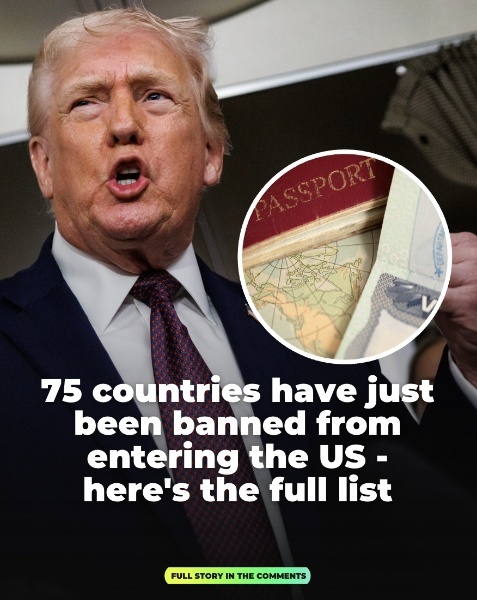
The Trump administration’s decision to indefinitely suspend immigrant visa processing for citizens of 75 countries marks one of the most expansive immigration actions of the current presidency, reshaping legal migration pathways for hundreds of thousands of people worldwide. Announced ahead of its January 21, 2026 implementation date, the policy immediately sent shockwaves through U.S. embassies, immigrant communities, and international observers. Officials framed the move as a measure to protect public resources and ensure that new immigrants entering the United States are financially self-sufficient. Yet the breadth of the suspension—spanning Africa, Asia, Latin America, the Middle East, and Eastern Europe—has reignited intense debate over fairness, economic impact, and America’s long-standing identity as a nation shaped by immigration.
At its core, the suspension halts the processing of immigrant visas, meaning permanent residency pathways such as family-based green cards, employment-based immigration, and diversity visa programs are effectively frozen for applicants from the listed countries. The administration emphasized that the policy does not affect non-immigrant visas, allowing tourist, student, and business travel to continue. However, for those seeking to build permanent lives in the United States, the distinction offers little comfort. Families awaiting reunification, workers preparing for long-term relocation, and individuals already approved but not yet issued visas now face sudden refusals or indefinite delays. The State Department confirmed that even visas previously approved but not printed must be denied under the new rules, underscoring the policy’s immediate and far-reaching impact.
The legal foundation for the suspension lies in an expanded interpretation of the “public charge” rule, a longstanding but controversial component of U.S. immigration law. Under this framework, consular officers may deny visas to applicants deemed likely to rely on government assistance in the future. While previous applications of the rule focused on individual circumstances, critics argue that the new policy effectively applies a collective presumption of risk to entire nations. Consular officers are instructed to evaluate factors such as age, health, financial stability, English proficiency, employment prospects, and potential medical needs. In practice, however, immigration advocates warn that such assessments become far more restrictive when applied within a blanket suspension that shifts the burden of proof almost entirely onto applicants.
Supporters of the policy view it as a necessary recalibration of legal immigration standards. They argue that the United States must prioritize self-sufficiency, especially amid concerns over strained social services, healthcare costs, and economic uncertainty. From this perspective, the suspension empowers consular officers to exercise discretion aligned with an “America First” philosophy, ensuring that newcomers contribute economically rather than rely on public support. Administration officials have emphasized that limited exceptions remain available, including for dual nationals holding passports from non-listed countries or applicants who can demonstrate that their entry serves a clear national interest. Still, these exceptions are expected to apply narrowly, leaving most applicants without viable alternatives.
Opponents, however, see the suspension as a blunt instrument that sacrifices individual merit for sweeping exclusion. Immigration scholars and civil rights groups argue that the policy risks separating families for years, undermining U.S. businesses that depend on immigrant labor, and damaging America’s global reputation. Historically, immigrants have played a central role in entrepreneurship, innovation, and workforce growth, particularly in sectors such as healthcare, technology, agriculture, and construction. By restricting legal pathways from such a wide range of countries—many of which have long-standing ties to the United States—critics warn that the policy may ultimately weaken the very economic foundations it claims to protect. There is also concern that the suspension disproportionately affects developing nations, reinforcing global inequalities rather than addressing them through individualized assessment.
Beyond economics and law, the human consequences of the suspension are already unfolding. For families who have waited years navigating complex immigration processes, the announcement has brought uncertainty, anxiety, and heartbreak. Parents hoping to reunite with children, spouses planning futures together, and skilled workers preparing to contribute to U.S. communities now face an indefinite pause with little clarity about timelines or outcomes. Embassies and consulates worldwide are scrambling to implement the new rules, fielding questions from applicants who suddenly find their plans on hold. The full list of affected countries—ranging from Afghanistan and Nigeria to Brazil, Russia, and North Macedonia—underscores the policy’s global scope and its capacity to reshape migration patterns far beyond U.S. borders.
As the suspension takes effect, it is likely to face legal challenges, diplomatic scrutiny, and sustained political debate. Whether it remains in place indefinitely or evolves through court rulings and future policy shifts, its significance is undeniable. The decision reflects a broader redefinition of who is welcome to immigrate permanently to the United States and under what conditions. For supporters, it represents fiscal responsibility and national prioritization. For critics, it signals a retreat from openness and individualized justice. What remains clear is that for millions watching from abroad—and for communities within the United States shaped by immigration—the policy is not an abstract regulation, but a turning point with lasting consequences for families, economies, and America’s role in the world.