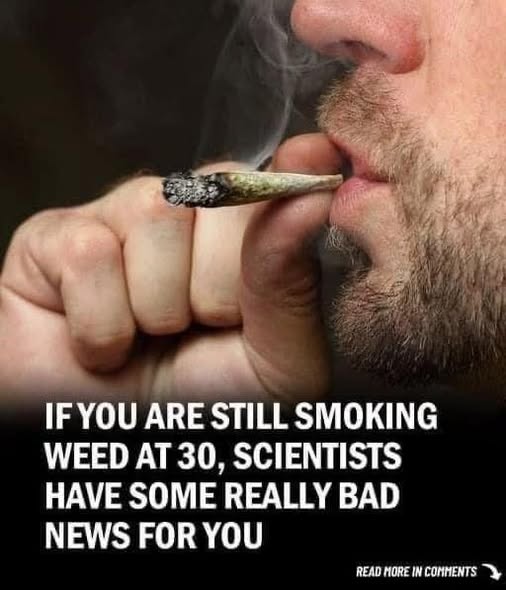
For decades, marijuana has carried a reputation that few other substances enjoy. It has often been framed as natural, gentle, and largely harmless—especially when compared to alcohol, tobacco, or prescription drugs. Many people first encounter cannabis in their teenage years or early twenties, a time when experimentation feels low-risk and consequences seem distant. What begins as occasional use to relax, socialize, or cope with stress can slowly turn into a routine woven into daily life. By the time someone reaches 30, smoking weed may feel as ordinary as having a cup of coffee after work. Yet scientists studying long-term cannabis use are increasingly warning that this sense of harmless familiarity may be misleading. Research suggests that continuing regular marijuana use into adulthood can quietly shape the brain, behavior, and body in ways that are subtle at first—but potentially lasting.
One of the most closely studied areas is the brain itself. Long-term studies that follow individuals from adolescence into their thirties reveal consistent patterns in cognitive performance. Memory, attention, processing speed, and executive function—the mental skills used for planning, problem-solving, and self-control—tend to decline more noticeably in people who continue using cannabis regularly over many years. While the brain completes most of its structural development in the mid-to-late twenties, scientists emphasize that it remains sensitive to chemical influences well into adulthood. THC, the primary psychoactive compound in marijuana, interacts directly with cannabinoid receptors that play a role in learning, memory, and emotional regulation. Over time, frequent stimulation of these receptors appears to alter how efficiently certain brain networks function. Users may not notice a dramatic change overnight, but many report feeling less mentally sharp, slower to react, or more easily distracted compared to earlier years.
What concerns researchers most is that these changes are not always fully reversible. While some cognitive functions improve after quitting, studies suggest that individuals who smoked heavily into their thirties often continue to show measurable differences compared to non-users. Learning new information can take longer, multitasking may feel more exhausting, and complex decision-making can become more challenging. In everyday life, this might look like forgetting appointments, struggling to focus during long meetings, or feeling overwhelmed by tasks that once felt manageable. These effects are rarely dramatic enough to send someone to a doctor, which is why they often go unnoticed. Yet over years, even small declines can accumulate, influencing career performance, productivity, and confidence. Scientists stress that this is not about intelligence, but about efficiency—how smoothly the brain processes and applies information over time.
Mental health is another area where long-term cannabis use raises red flags. While many users turn to marijuana for relief from stress, anxiety, or emotional tension, research increasingly suggests that chronic use may have the opposite effect in the long run. Studies have linked sustained cannabis use with higher rates of anxiety disorders, depressive symptoms, and emotional blunting. Emotional blunting refers to a reduced ability to feel pleasure, excitement, or deep emotional engagement—leaving some users feeling flat or disconnected. Over time, the brain’s natural reward system may become less responsive, making everyday joys feel muted without the substance. This can create a quiet dependency, where marijuana is no longer just a choice, but a crutch needed to feel balanced or “normal.” For individuals predisposed to mental health conditions, cannabis may also increase the risk of paranoia or mood instability, particularly as stress levels rise with adult responsibilities.
Motivation and life engagement are also frequently discussed by scientists studying long-term cannabis habits. While not everyone experiences the so-called “amotivational syndrome,” research suggests that regular marijuana use can dampen drive, persistence, and goal-oriented behavior in some individuals. This doesn’t necessarily mean laziness, but rather a subtle shift in priorities and effort. Tasks that require sustained focus or delayed gratification—such as career advancement, long-term planning, or skill-building—may feel less compelling. Over time, this can influence life trajectories in quiet but meaningful ways. People may settle more easily, avoid challenges, or feel stuck without fully understanding why. Researchers emphasize that these patterns are complex and influenced by personality, environment, and frequency of use, but the association is strong enough to warrant serious attention, especially as people enter their thirties—a decade often defined by long-term decisions.
Physical health, often overlooked in discussions about marijuana, is another area of growing concern. Smoking cannabis exposes the lungs to hot smoke, fine particles, and irritants similar to those found in tobacco smoke. Long-term users are more likely to experience chronic cough, bronchial irritation, and increased mucus production. As the body ages, its ability to repair inflammation and oxidative stress declines, making these effects more pronounced over time. Cardiovascular health is also under scrutiny. Some studies indicate that marijuana use can temporarily increase heart rate and blood pressure shortly after consumption, potentially raising the risk of cardiac events in susceptible individuals. While these risks are lower in young, healthy adults, they may become more significant with age, underlying conditions, or combined lifestyle factors. For those who assumed weed was largely risk-free physically, this emerging data challenges long-held beliefs.
Scientists are careful not to frame their findings in terms of doom or inevitability. Not everyone who smokes marijuana at 30 will experience serious problems, and moderate or occasional use may carry fewer risks than heavy, daily consumption. The central message from researchers is not fear, but awareness. The idea that cannabis has no consequences simply because it is natural or socially accepted is increasingly unsupported by evidence. Habits that felt harmless at 18 can carry different implications at 30, when the brain, body, and life demands have changed. Many researchers suggest that turning 30 can be a meaningful checkpoint—a moment to reassess long-standing behaviors with honesty rather than nostalgia. Reevaluating one’s relationship with cannabis does not require shame or extreme choices, but it does require acknowledging that long-term health is shaped by patterns repeated over years, not isolated moments. In that sense, the science is less about judgment and more about empowerment: understanding the risks early enough to make informed decisions before subtle effects become harder to reverse.