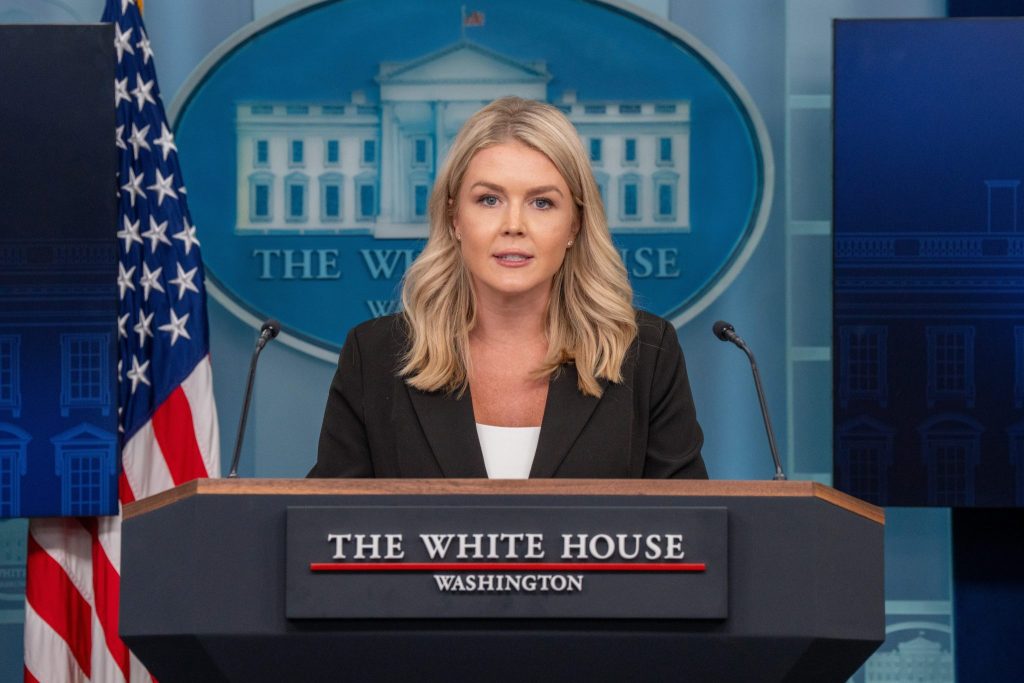
Karoline Leavitt’s ascent to the center of American political life has been nothing short of extraordinary. At just 28 years old, she stepped into history as the youngest White House Press Secretary the nation has ever seen, becoming a daily presence at the podium during one of the most polarized eras in modern U.S. politics. Her confidence, sharp messaging, and unwavering loyalty to President Donald Trump have made her both admired and criticized across the political spectrum. Yet behind the headlines, the briefings, and the relentless scrutiny lies a deeply personal story of sacrifice, identity, and motherhood. While Leavitt’s public persona is defined by discipline and resolve, she has openly admitted to carrying a sense of guilt—an emotion that stems not from political controversy, but from the moments she cannot spend with her young son. This quiet conflict between ambition and maternal instinct has become one of the most human aspects of her otherwise high-powered narrative.
Raised in Atkinson, New Hampshire, Leavitt’s roots are grounded in hard work and traditional values. Her parents owned a small ice cream stand, where she spent her summers learning the meaning of responsibility, perseverance, and service long before politics entered her life. A Catholic education at Central Catholic High School played a formative role, shaping her sense of discipline and faith while instilling a belief in public service. These early influences followed her to Saint Anselm College, where she balanced academics with athletics on a softball scholarship. The lessons she learned on the field—teamwork, resilience, and competing against herself—would later become tools she relied on in Washington. Even as a student, Leavitt’s political convictions were unmistakable. She wrote opinion pieces defending conservative principles, challenged what she viewed as media bias, and immersed herself in political organizations that brought her closer to the heart of national power.
Her first taste of the White House came through an internship in the Office of Presidential Correspondence, a moment that solidified her ambitions. While classmates attended football games, Leavitt stayed behind to perfect applications, convinced that sacrifice was the price of opportunity. That mindset propelled her forward. After graduating, she worked as an assistant press secretary under Kayleigh McEnany during the Trump administration, absorbing the intensity of national politics from the inside. Even after Trump’s 2020 election loss, Leavitt did not step back. She became communications director for Representative Elise Stefanik and later launched her own congressional campaign in New Hampshire. Though she ultimately lost the general election, her visibility and determination caught the attention of Trump’s inner circle. When he returned to the national stage during the 2024 campaign, Leavitt was ready, proving herself as a formidable communicator and earning his trust once again.
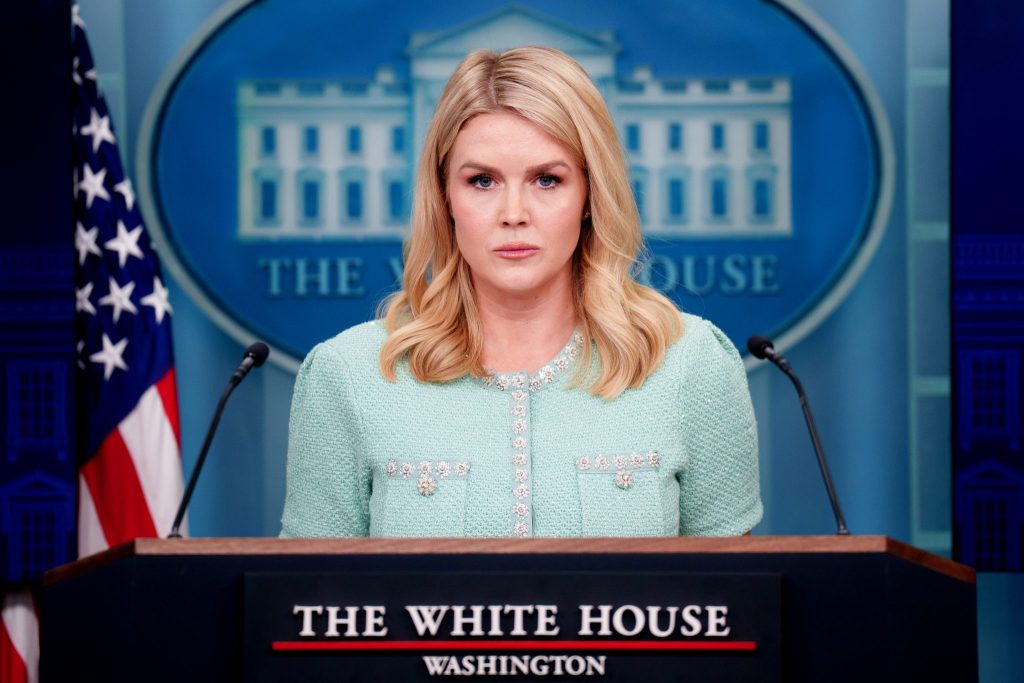
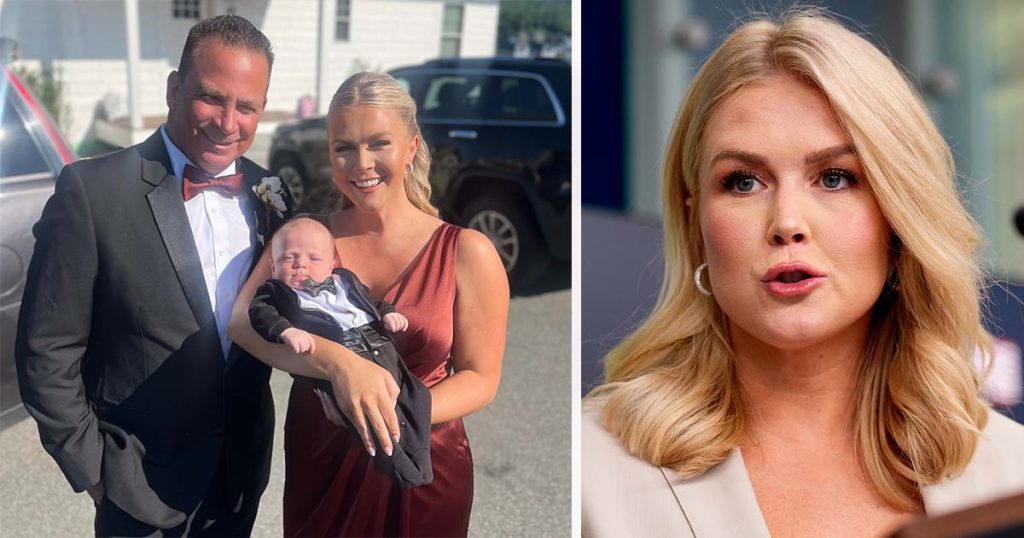
Her appointment as White House Press Secretary marked a historic milestone, but it also coincided with a profound shift in her personal life. Around the same time her career was accelerating, Leavitt was building a family. She married Nicholas Riccio, a successful businessman more than three decades her senior, in what she has openly described as an “atypical love story.” Their relationship, initially met with curiosity and skepticism by the public, became a source of stability for her. Riccio’s support allowed Leavitt to pursue her ambitions without hesitation, and in July 2024, the couple welcomed their first child, a son named Niko. The timing could not have been more intense. Just days after giving birth, a historic assassination attempt on Donald Trump shook the nation, and Leavitt made the controversial decision to return to work almost immediately, driven by a sense of duty and loyalty to the campaign.
It was during this period that the emotional weight of motherhood truly set in. Leavitt has spoken candidly about the difficulty of leaving her newborn son to step back into the relentless rhythm of politics. Though praised by some as a symbol of strength and criticized by others for her choice, she acknowledged that no amount of professional validation could erase the internal conflict she felt. A phone call from Donald and Melania Trump shortly after her son’s birth left a lasting impression, reminding her of the shared humanity behind political roles. Yet even as she embraced her responsibilities at the podium, the sense of missing irreplaceable moments lingered. She has admitted that, like many working mothers, she carries guilt regardless of where she is—feeling torn between the demands of her job and the instinct to be present for every milestone in her child’s life.
Today, as Leavitt prepares to welcome her second child, a daughter expected in 2026, that balance has become even more delicate. She speaks openly about faith as her anchor, describing motherhood as a divine gift and the closest thing to heaven on earth. Despite the age gap in her marriage and the pressure of public scrutiny, she remains unapologetic about her choices, emphasizing the importance of family above all else. When she leaves the White House each evening, titles and power fade, replaced by bedtime routines and quiet moments with her son. Her admission of guilt is not a weakness, but a reflection of a universal struggle faced by countless women striving to excel professionally while honoring their role as mothers. In that honesty, Karoline Leavitt’s story transcends politics, revealing a deeply human portrait of ambition, sacrifice, and love unfolding behind the most famous podium in America.