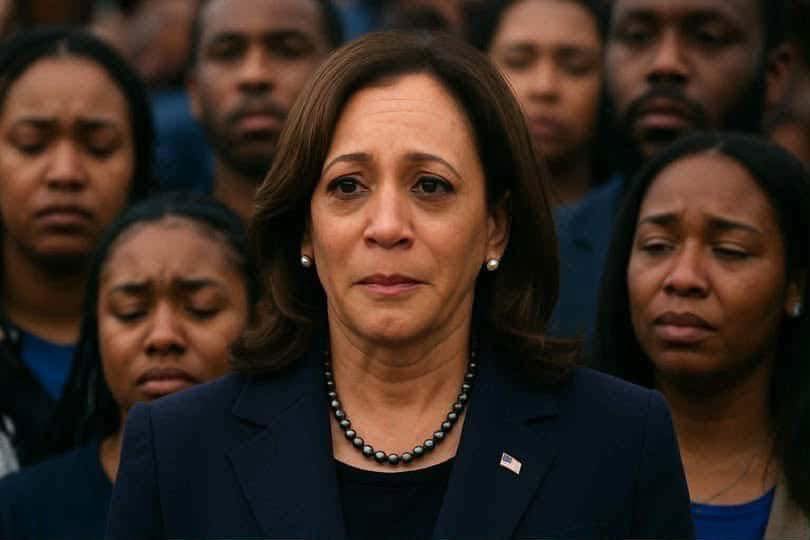
In California, Kamala Harris Delivers a Resonant Call for Courage, Collective Leadership, and Perseverance, Choosing Reflection Over Ambition and Reminding Women Leaders That Progress Is Built Quietly, Together, and Often Under the Heaviest Scrutiny
The room settled into silence before it erupted, not because of theatrics, but because recognition had arrived first. Speaking in her home state of California, under the glare of political scrutiny that never fully recedes, Vice President Kamala Harris did something notable by modern standards: she set aside speculation, ambition, and future electoral narratives. There was no discussion of polls, no coded references to power, and no gestures toward 2028. Instead, Harris spoke about fear — openly, without apology — and about the quiet determination required to lead despite it. Addressing a gathering of Black women leaders in Dana Point, she framed fear not as a disqualifier, but as an inevitable companion to responsibility. The tone was intimate rather than performative, signaling early on that this was not a victory lap, but a moment of shared reflection rooted in experience.
Harris spoke not as a distant national figure, but as someone acutely familiar with the costs of visibility. She addressed what it means to be doubted before being heard, to be dismissed before being understood, and to continue returning to spaces that were not built with you in mind. Her words resonated because they acknowledged a truth often left unspoken in leadership conversations: that resilience is not a personality trait, but a repeated decision. Many in the audience recognized themselves in her description of standing firm while carrying layered expectations tied to race, gender, and authority. Harris did not minimize these pressures or romanticize them. Instead, she named them plainly, offering validation to women whose leadership journeys have required endurance long before recognition.
At the heart of her message was a deceptively simple idea that challenged conventional definitions of success. Leadership, Harris argued, is not measured by how high one climbs, but by who is lifted along the way. She rejected ego as a guiding force, emphasizing that progress loses its meaning if it reinforces old exclusions. Advancement, in her telling, carries responsibility — to widen doors, to mentor deliberately, and to ensure that access is not treated as a scarce resource. This framing resonated deeply with an audience accustomed to doing transformative work without headlines. Harris highlighted how Black women, in particular, have long sustained movements, communities, and institutions while rarely being centered in narratives of leadership. By placing collective uplift at the core of her remarks, she reframed leadership as an act of service rather than self-assertion.
The Vice President grounded these reflections in concrete public priorities, connecting personal courage to policy-driven work. She spoke about protecting voting rights as foundational to democracy, not as an abstract principle but as a lived necessity shaped by local organizing and vigilance. Maternal health was addressed not only as a medical issue, but as a reflection of whose lives are valued and protected. Economic equity, she noted, is built through sustained investment in communities and through leadership that understands the long arc of opportunity rather than short-term wins. In weaving these issues together, Harris portrayed public service as a shared endeavor, dependent on trust, collaboration, and persistence. Change, she reminded the audience, is rarely born on national stages; it is constructed in rooms like this one, through relationships and repeated effort.
What distinguished the moment was Harris’s refusal to separate herself from the struggle she described. Rather than offering platitudes from a position of authority, she spoke with an awareness of exhaustion — the fatigue that accumulates when resistance feels constant and progress incremental. She acknowledged that leadership can be isolating, especially for those who are first through the door and most likely to be targeted for it. Yet she framed perseverance as a form of power in itself. Courage, she suggested, is not a single act but a daily choice to remain engaged, even when outcomes are uncertain. By naming both the weight and the worth of that commitment, Harris offered something more durable than inspiration: affirmation that sustained effort matters, even when it unfolds beyond public view.
As the summit concluded, applause followed, but it was not what lingered. What remained was a sense of assignment rather than celebration — a charge to continue, collectively, despite resistance and fatigue. Harris left her audience with the reminder that progress is cumulative and often invisible before it becomes undeniable. In a political climate defined by noise, acceleration, and constant positioning, her remarks stood out for their restraint. They suggested that leadership does not always require urgency or dominance, but presence, integrity, and shared purpose. For those in the room, the message was clear: keep going, keep lifting, and keep building together, even when the work feels heavy, because that is how lasting change is made.