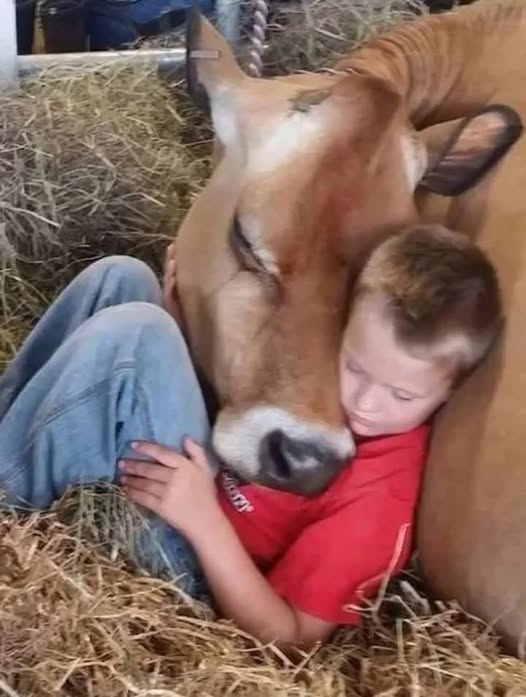
Every night, the same ritual unfolds in our family’s quiet corner of the world. While the house hums with lamps dimming and clocks ticking, my little brother quietly leaves the warmth and predictability of his bed and slips into the barn. He moves with a stillness that belies his age, climbing into the hay beside the cow as though it were the most natural refuge. The cow, large and steady, seems to receive him without judgment or inquiry, offering a presence that is comforting, immediate, and unspoken. This nightly routine is not a whim, nor a fleeting experiment in defiance; it is a profound expression of his understanding of safety, trust, and the kind of solace that cannot be manufactured or rationalized. Where blankets and pillows cannot soothe, the living warmth of another creature, patient and constant, provides what he most needs.
From the earliest memories we have of him, he has always noticed what others overlook. While adults glance at the barn and see animals, chores, and work, he perceives rhythm, presence, and listening. He watches the slow blink of the cow’s eyes, the rise and fall of her breath, and in return, he unburdens the anxieties he cannot voice. In the barn, there is no critique, no expectation, no quiet pressure to explain, perform, or behave. For a child processing experiences that are confusing and sometimes frightening, this silent companionship becomes a language of understanding that words cannot convey. The hay becomes more than bedding; it is a vessel of security. The cow, more than a domestic animal, becomes a witness to the inner landscape of a small human grappling with emotions too large for a bed or a room to contain.
Our family had endured a period of turbulence, one that altered routines and unsettled the stability we all once took for granted. Nights became battlegrounds of restlessness, tears, and frustration. Sleep, a necessary reprieve, arrived in fragments, leaving everyone drained and tense. It was in the aftermath of these events that he began seeking the cow’s company. In the barn, he rediscovered rhythm. His body, coiled with stress and fear, slowly unwound as he lay beside the animal’s flank. His breathing slowed; his muscles relaxed. The transformation was subtle at first—one night he slept through an entire cycle without waking, then another, and another. What doctors might reduce to “comfort” or “coping mechanism” and what adults might dismiss as “childish imagination” was, in reality, a profound reclaiming of peace and autonomy. Here, he was not just surviving the night; he was learning, through experience, what stability and trust truly felt like.
He insists that the cow already knows the truth about him, before he speaks it, before words are formed or explanations considered. This statement may seem whimsical to outsiders, but for him, it is a factual assertion about the reliability of presence. People leave; promises are mutable. Beds are silent, rooms are empty, and walls, though protective, offer no reassurance beyond their structure. But the cow stays, consistent in warmth and proximity. She does not leave, she does not demand, she does not pretend not to hear his fears. In a world that has shifted unpredictably, that steadiness becomes sacred. What he gains in that nightly embrace is a kind of quiet certitude—a knowledge that there exists at least one being who witnesses and accepts him wholly, without negotiation or explanation.
Our family’s initial reaction evolved over time, moving from bemusement to concern and finally to acceptance. At first, the sight of him curled beside a barn animal elicited laughter and gentle admonishments. Then we attempted to redirect him back to his bed, reasoning that comfort could, and should, be found within familiar domestic routines. Yet each night that he returned to the cow demonstrated an ineffable truth: the comfort he derived there could not be replicated by rules, schedules, or logic. We observed him asleep, untroubled, free from the tight coil of anxiety that had otherwise dominated his nights. Slowly, we realized that healing and safety need not conform to adult expectations or conventional methods. Sometimes, recovery comes not in quiet bedrooms or under the weight of soft blankets, but in the unexpected, the living, and the wholly attentive.
Looking toward the future, one cannot predict whether he will eventually choose his bed over the barn. Perhaps in time he will decide that human structures and societal norms suffice, that other forms of reassurance are adequate. But for now, he remains precisely where he needs to be. The barn, the hay, and the cow form a sanctuary that transcends convention, embodying lessons about trust, presence, and the forms that comfort can take. It teaches adults that sometimes, support is less about instruction and more about witness, less about control and more about allowing. In his nightly communion with the cow, he models a kind of wisdom often overlooked: that safety and healing are not always visible, verbal, or tidy—they are often felt, lived, and known in silence.
In the end, the barn becomes more than a place; it is a metaphor for the ways humans seek refuge, understanding, and continuity in a world that is often unpredictable and unyielding. The cow, in her patience and solidity, demonstrates a form of knowledge and care that transcends language. And my little brother, in choosing her side night after night, illustrates the power of instinct, empathy, and the quiet intelligence of children who understand that sometimes, comfort and truth are inseparable. When logic fails and words cannot reach, solace finds its own path, and for him, it has always been in the hay, against the side of a creature who already knows the truth.