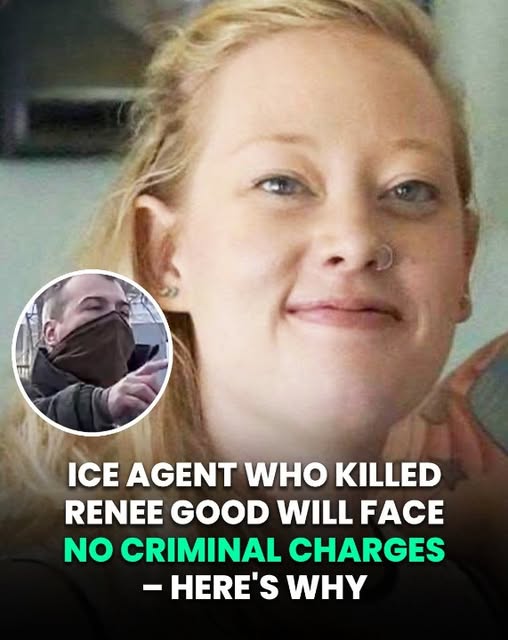
The fatal shooting of Renee Good did not unfold in chaos or panic, but in a moment that appeared measured, restrained, and tragically ordinary. She was seated in her car, surrounded by federal agents, speaking calmly in the seconds before gunfire shattered the encounter. Video footage later revealed words that would echo far beyond the scene: “I’m not mad at you.” In that brief exchange, the distance between citizen and state narrowed to something painfully human. Yet within moments, Renee Good, a 37-year-old mother of three, was dead. The event quickly moved beyond a single act of violence and into a national reckoning about immigration enforcement, use of force, and the near-impenetrable legal shields that protect federal officers. As details emerged, so too did a familiar tension in American public life — the struggle to reconcile individual loss with institutional power.
Jonathan Ross, the ICE agent who fired the shots, was soon identified as a seasoned professional. A ten-year veteran, firearms trainer, and member of a special response team, Ross’s résumé reflected experience, preparation, and authority. His background included leadership roles and coordination with federal agencies such as the FBI, reinforcing the image of an officer deeply embedded in the architecture of federal law enforcement. Supporters pointed to this record as evidence of competence and restraint, arguing that such individuals do not act recklessly or without cause. To them, Ross represented the disciplined face of a system designed to operate under pressure. Yet to Renee Good’s family and many observers, this professional profile only sharpened the pain. If such training and experience could still end in lethal force against a woman seated in her car, then the question became less about individual judgment and more about the structure that permits such outcomes.
The political response was swift and polarizing. The Trump administration moved aggressively to defend Agent Ross, framing the shooting within a narrative of national security and law enforcement necessity. President Trump publicly characterized Good’s actions as domestic terrorism, language that immediately escalated the moral stakes of the incident and positioned the agent’s conduct as a defensive act in a broader battle against perceived threats. Vice President JD Vance went further, asserting that Ross possessed absolute immunity from prosecution, a claim that resonated with supporters but alarmed critics. While such statements do not themselves determine legal outcomes, they exert powerful influence over public perception and institutional posture. In moments like these, rhetoric can harden into assumption, shaping how investigations are conducted and how accountability is imagined, or dismissed, before legal processes have fully unfolded.
At the center of the controversy lies the formidable barrier of federal legal immunity. Under existing law, prosecuting federal officers for actions taken in the course of their duties requires an exceptionally high standard of proof. Investigators must demonstrate not merely error or poor judgment, but reckless disregard for human life — a threshold that has historically shielded officers from criminal charges even in fatal encounters. This framework is often justified as necessary protection for agents operating in volatile situations, where hesitation could cost lives. Yet critics argue that the same protections create a vacuum of accountability, where death becomes an administrative outcome rather than a moral rupture. In the case of Renee Good, the conclusion that no criminal charges will be filed has intensified this debate, reinforcing fears that federal power functions beyond the reach of ordinary justice.
Beyond the legal arguments, the human dimensions of the case remain unavoidable. Renee Good was not a symbol or a statistic; she was a mother, a daughter, a presence in multiple lives now marked by absence. Her final words, captured on video, complicate any attempt to reduce the incident to threat assessments or procedural justifications. They suggest a moment of trust, or at least resignation, offered to an authority figure moments before death. For her family, the lack of criminal charges feels less like a legal determination and more like a denial of recognition — an assertion that their loss does not rise to the level of consequence. Meanwhile, Ross’s father publicly described his son as a kind Christian man, a reminder that those who wield state power are also embedded in families and communities that interpret events through loyalty and love. These parallel narratives collide in public space, each demanding empathy, yet pulling in opposite moral directions.
As investigations conclude and official statements settle into permanence, the broader implications of the killing of Renee Good remain unresolved. This case has become a lens through which Americans examine the expanding reach of immigration enforcement, the militarization of federal agencies, and the boundaries of lawful violence. It exposes a system that asks officers to make irreversible decisions in seconds, then shields those decisions behind layers of legal doctrine and political allegiance. For some, this structure represents necessary order in an uncertain world. For others, it signals a profound imbalance between state authority and civilian vulnerability. What lingers is not only the image of a car surrounded by agents, or the echo of gunfire, but the unsettling realization that in modern America, justice can feel conditional — applied unevenly depending on who holds the weapon, and who absorbs its consequences.