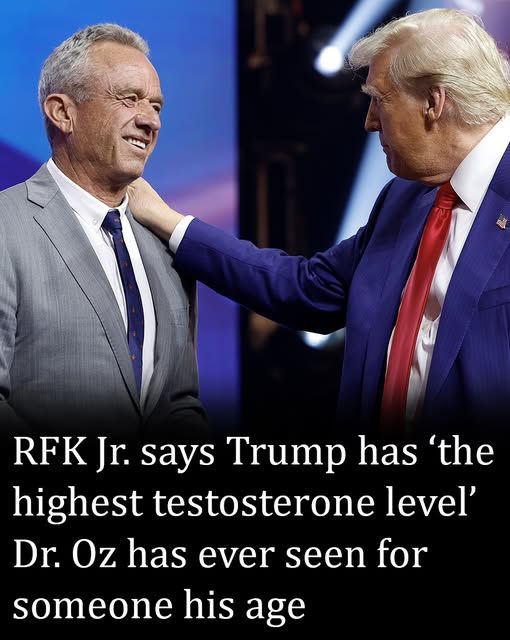
The remark attributed to Robert F. Kennedy Jr. that Donald Trump possesses “the highest testosterone level” a television doctor has ever seen for someone his age landed not as a scientific finding, but as a cultural moment. It fused politics, pop medicine, masculinity, and media performance into a single sound bite that traveled far faster than any peer-reviewed study. Spoken in a climate where political identity is increasingly shaped by imagery and implication rather than policy detail, the comment worked less as a claim to be verified and more as a symbol to be interpreted. Supporters heard vigor, dominance, and resilience; critics heard exaggeration, pseudoscience, and spectacle. The fact that the statement invoked the authority of a celebrity physician and the language of biology ensured it would resonate beyond campaign rallies, entering social media feeds, late-night monologues, and opinion columns that debate not only what leaders say, but what their bodies are assumed to represent.
At the center of the remark stands Robert F. Kennedy Jr., a figure who has built a public persona around skepticism of institutions and an emphasis on bodily autonomy, alternative health narratives, and distrust of conventional expertise. His choice of words reflected that worldview. Testosterone, in popular culture, has become shorthand for aggression, stamina, and decisiveness, qualities often mythologized in political leadership. By attributing exceptional levels of it to Trump, Kennedy was not offering lab results; he was tapping into a long tradition of equating leadership with virility. In this framing, health becomes character, hormones become destiny, and biology becomes a rhetorical weapon. The nuance that testosterone fluctuates, varies widely among individuals, and does not translate cleanly into competence was lost amid the power of the image being invoked.
Donald Trump himself has long understood the value of physical symbolism in politics. From his emphasis on energy at rallies to publicized moments of bravado, he has cultivated an image of strength that resonates with a segment of the electorate skeptical of elites and experts. For Trump, being described as exceptionally masculine, even through a questionable medical metaphor, aligns with a carefully maintained brand. It reinforces a narrative of endurance against age, adversity, and opposition. In a political culture where optics often outweigh evidence, such statements function as reinforcement rather than revelation. Whether or not the claim has any scientific basis becomes secondary to the emotional truth it signals to supporters: that their candidate embodies vigor in a world they perceive as weakened by compromise and caution.
The reference to Dr. Oz added another layer to the episode, blending entertainment medicine with political messaging. Dr. Oz occupies a unique space where medical credentials meet daytime television theatrics, a space that has drawn both massive audiences and sharp criticism. Invoking his supposed observation lends the statement a veneer of authority while sidestepping the rigor that actual medical claims require. No data was presented, no methodology explained, no consent or context provided. Instead, the idea of a doctor’s astonishment did the work. This reflects a broader trend in which medical language is used performatively, not to inform but to persuade, often blurring the line between health education and marketing. In such moments, medicine becomes metaphor, and the body becomes billboard.
Beyond the individuals involved, the controversy highlights how modern political discourse increasingly leans on simplified biological narratives. Testosterone, stripped of its complexity, is treated as a moral substance, a chemical marker of leadership worthiness. This reduction ignores decades of research showing that hormones interact with environment, psychology, and social context in intricate ways. It also sidelines other qualities voters might value: empathy, judgment, ethical reasoning, and collaborative skill. By focusing on an imagined hormonal superiority, the conversation narrows leadership to a caricature, reinforcing outdated gender norms and marginalizing those who do not fit them. The popularity of such rhetoric suggests not scientific ignorance alone, but a hunger for certainty and archetype in an uncertain political landscape.
Ultimately, the statement’s endurance says less about testosterone than about storytelling. In an era of fragmented media and shortened attention spans, a vivid claim can eclipse complex reality. The image of an aging political figure endowed with extraordinary vitality is compelling because it reassures some and provokes others, fueling engagement on all sides. Whether remembered as a throwaway line or a defining example of modern political absurdity, the remark underscores how easily science can be repurposed as symbol. It invites a broader reflection on what voters truly seek in leaders and whether the language used to describe them illuminates truth or merely amplifies myth.