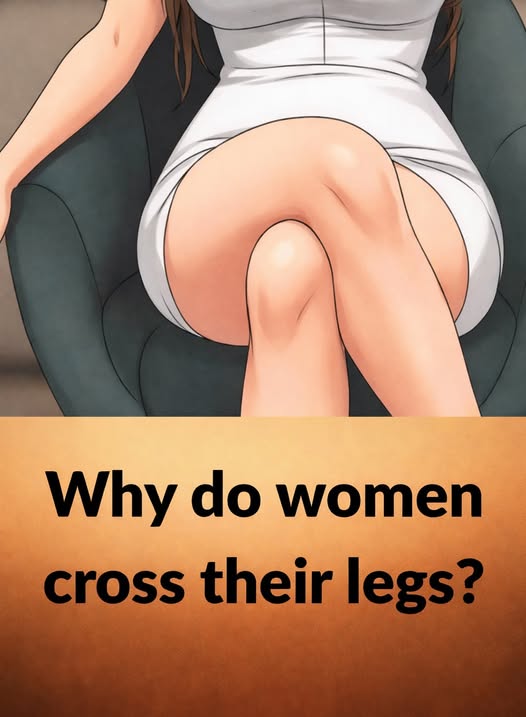
Crossing one’s legs while sitting is so common that it often disappears into the background of daily life, rarely questioned or examined. Yet for women in particular, this posture carries layers of meaning shaped by history, culture, and psychology. What looks like an effortless habit is often the result of years of observation, imitation, and subtle correction. From childhood onward, many women absorb unspoken messages about how their bodies should appear in public spaces. Sitting neatly, taking up less room, and maintaining a composed posture have long been associated with being “ladylike.” Over time, crossing the legs becomes less a conscious decision and more a default position, performed without thought but deeply rooted in social learning. The body remembers what the mind may no longer actively consider, turning cultural instruction into physical instinct.
Historically, expectations around women’s posture were closely tied to ideas of morality, modesty, and social order. In many Western societies, a woman’s body language was viewed as a reflection of her character. Sitting with legs crossed or tightly held together symbolized restraint and self-discipline, qualities prized in women for generations. Art, film, etiquette manuals, and even school environments reinforced these ideals, presenting certain ways of sitting as refined and others as improper. Women who failed to conform risked being labeled careless, unrefined, or disrespectful. These judgments were not neutral; they helped regulate how much space women were allowed to occupy, both physically and socially. Crossing the legs became a subtle way of shrinking oneself, aligning with broader expectations that women should be accommodating and unobtrusive rather than expansive or assertive.
Psychologically, leg crossing can function as a form of self-regulation. In unfamiliar or socially demanding environments, the posture may provide a sense of containment and safety. Folding the legs inward can create a physical boundary that mirrors an emotional one, offering comfort when a person feels exposed or uncertain. For some women, especially in professional or public settings, crossing the legs may help maintain a sense of composure and control. The posture can signal attentiveness, politeness, or emotional neutrality, depending on context. A tightly crossed position may reflect anxiety, discomfort, or guardedness, while a looser, more relaxed crossing can indicate ease and confidence. Importantly, these signals are not fixed rules but fluid expressions influenced by mood, environment, and social dynamics.
Cultural context further complicates the meaning of this behavior. Body language is not universal, and the interpretation of leg crossing varies widely across societies. In some cultures, crossing one’s legs is seen as respectful and appropriate, while in others it may be considered rude, dismissive, or overly casual. These differences highlight how posture is learned rather than innate. Women moving between cultures may unconsciously adjust how they sit, responding to new norms without deliberate awareness. What feels natural in one setting may feel awkward or inappropriate in another. This adaptability underscores how deeply social expectations are embedded in the body, shaping behavior long before conscious thought intervenes.
Comfort also plays a significant role, though it is often underestimated. Many women report crossing their legs simply because it feels physically comfortable, especially when chairs are designed in ways that do not naturally support diverse body types. Seating in public spaces has historically been modeled around male bodies, sometimes making alternative postures less comfortable for women. Over time, crossing the legs becomes a practical solution rather than a symbolic act. Yet even comfort is not entirely separate from conditioning. What the body perceives as comfortable can be influenced by habit, repetition, and long-term posture training. A position practiced daily from a young age eventually feels “right,” even if it originated from external expectations rather than personal preference.
Ultimately, crossing one’s legs while sitting is not a single message with a single meaning. It is a complex, layered behavior shaped by comfort, psychology, culture, and history. For some women, it is a gesture of ease; for others, a shield of privacy or a marker of professionalism. It can reflect confidence in one moment and vulnerability in the next. Recognizing this complexity allows us to move beyond simplistic interpretations of body language. Everyday gestures are rarely neutral, but they are also rarely fixed. They evolve with context, experience, and self-awareness. By understanding the forces that shape such habits, we gain insight not only into posture, but into the quiet ways society leaves its imprint on the body—often without us ever realizing it.