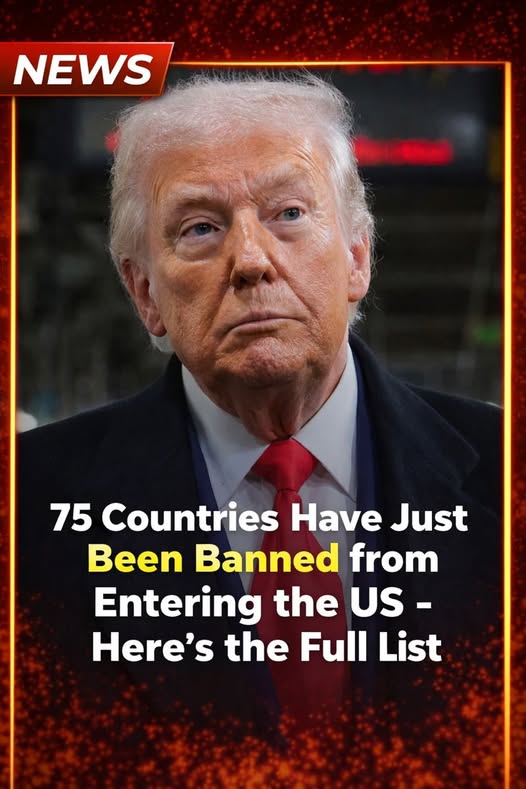
The announcement landed without ceremony, wrapped in bureaucratic phrasing and policy language that masked its human weight. The United States’ decision to suspend immigrant visas from 75 countries instantly transformed from a line in an official statement into a defining rupture in countless lives. For families who had spent years navigating paperwork, interviews, background checks, and waiting periods, the suspension felt less like a pause and more like a door slammed shut mid-step. Plans that had been carefully assembled—often at enormous emotional and financial cost—collapsed overnight. Homes were sold, jobs were resigned from, leases were terminated, and children were pulled from schools in anticipation of departure. What had been framed as a journey toward stability and opportunity suddenly became a void filled with silence and unanswered questions. The shock was not just logistical but deeply psychological, a sense that the ground beneath long-held dreams had vanished without warning.
Across continents, the policy’s reach proved indiscriminate. Doctors who had secured placements in underserved American hospitals now faced professional limbo. Students admitted to universities, some with scholarships contingent on arrival dates, watched academic futures dissolve. Skilled workers, caregivers, engineers, agricultural laborers, and entrepreneurs found themselves bound by the same invisible barrier, regardless of education or income. Grandparents who hoped to reunite with children and grandchildren they had not seen in years were reduced to watching milestones unfold through screens. The suspension did not merely delay travel; it froze lives mid-transition. In many countries, those affected were already navigating fragile economies or political instability, making the decision particularly devastating. For them, migration was not a luxury but a carefully calculated survival strategy, one now rendered uncertain by forces entirely beyond their control.
The language surrounding the suspension emphasized “limited exceptions,” a phrase that offered the appearance of flexibility while delivering little comfort in practice. Humanitarian waivers, emergency considerations, and special cases were mentioned but poorly defined, leaving applicants to grasp at vague possibilities. Legal experts warned that the majority would not qualify, and even those who might faced months or years of additional scrutiny. This ambiguity intensified anxiety, turning every day into a cycle of speculation and rumor. Immigration lawyers reported surges in desperate calls, while embassies offered few concrete answers. The system, already notorious for its complexity, became even more opaque. Applicants were forced into impossible choices: rush incomplete filings before deadlines, invest scarce savings in legal appeals with slim chances, or abandon plans entirely. Each option carried its own emotional toll.
At the heart of the crisis lies a profound sense of betrayal. Many of those affected had followed every rule, paid every fee, and complied with every requirement demanded of them. They trusted that patience and perseverance would eventually be rewarded with certainty. Instead, they encountered a reality in which compliance offered no protection against sudden political shifts. This erosion of trust extends beyond individual applicants to entire communities that had long viewed the United States as a place where process and fairness mattered. The suspension reinforced a painful lesson: immigration policy is not merely administrative but deeply political, subject to abrupt change and often indifferent to personal consequence. For families who had structured their lives around timelines provided by official channels, the realization that those timelines could evaporate overnight was particularly crushing.
The broader ripple effects are already becoming visible. Employers in the United States who relied on incoming workers are facing shortages, particularly in healthcare, technology, and agriculture. Universities risk losing diverse talent that enriches classrooms and research labs. Communities that had prepared to welcome new residents now confront gaps that cannot easily be filled. Abroad, the economic consequences are equally severe. Families who sold property or exhausted savings to finance relocation are left financially exposed, sometimes without the means to rebuild their previous lives. Children experience disrupted education and emotional distress, sensing instability even when adults try to shield them. Mental health professionals note rising levels of anxiety and depression among applicants, fueled by prolonged uncertainty and the feeling of being unwanted by a country they once idealized.
As weeks turn into months, the suspension is reshaping how people understand hope itself. Some cling to optimism, refreshing embassy websites daily and scanning news for signs of reversal. Others harden themselves against disappointment, choosing to rebuild plans in their home countries or look elsewhere entirely. A growing number quietly disengage, too exhausted to keep believing in a system that has repeatedly failed them. What unites them is the recalculation of life’s most fundamental questions: where to live, how to provide for family, whether to dream beyond immediate survival. The policy may be described as temporary, but its impact will endure far longer. Even if lifted, the memory of sudden exclusion will linger, altering perceptions of security and belonging. For millions, the suspension is not just about visas—it is about learning, painfully, how fragile the promise of a future can be when it rests on decisions made far away, without faces, without names, and without regard for the lives suspended in between.