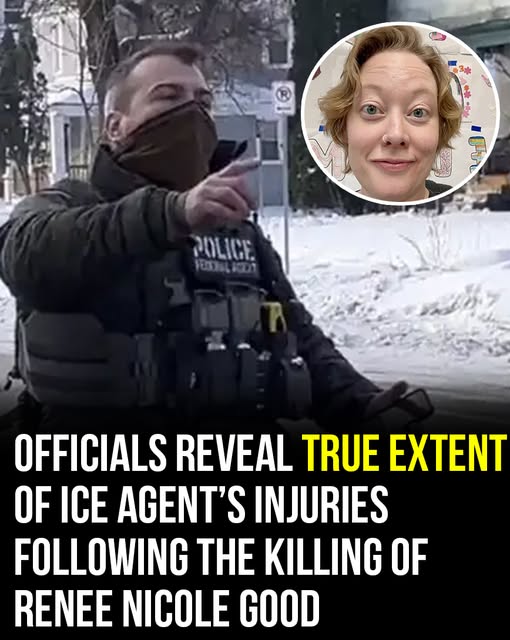
Tensions in Minneapolis intensified dramatically after the fatal shooting of Renee Good by ICE agent Jonathan Ross on January 7, an incident that has since become a flashpoint in the national debate over immigration enforcement and police accountability. As protests continued to swell across the city, new information emerged revealing that Ross himself suffered internal bleeding during the confrontation. According to multiple unnamed U.S. officials, the agent sustained injuries to his torso, though authorities have declined to specify the severity. The Department of Homeland Security confirmed that Ross was injured, adding another layer of complexity to an already volatile situation where grief, anger, and fear are colliding in public view.
The shooting occurred on a residential street as ICE officers attempted to detain Renee Good, who was seated in her Honda Pilot. Officials say Good appeared to try to drive away as officers ordered her out of the vehicle. During the encounter, Ross fired his weapon, striking Good in the head and killing her. Video footage circulating online appears to show physical contact between Ross and the vehicle in the moments before the gunshot, a detail that has fueled competing interpretations of what unfolded. Supporters of the agent argue the footage supports a claim of self-defense, while critics say it raises troubling questions about the proportionality of force used and whether alternative actions could have prevented a fatal outcome.
The Trump administration has firmly backed Ross, maintaining that he acted in self-defense and asserting that there is no basis for a criminal civil rights investigation. Deputy Attorney General Todd Blanche stated that the FBI is handling the case exclusively, effectively sidelining Minnesota state authorities from the investigation. That decision has drawn sharp criticism from state officials and civil rights advocates, who argue that excluding local oversight undermines transparency and public trust. For many in Minneapolis, a city still shaped by past encounters between law enforcement and civilians, the federal government’s posture feels less like reassurance and more like escalation.
The aftermath of the shooting has underscored how deeply polarized the response has become. Fundraising campaigns have surged on both sides, with a GoFundMe for Ross raising more than $700,000 and a separate campaign for Renee Good’s wife and son surpassing $1 million. The stark contrast between the two fundraisers reflects a nation divided not only on the facts of the case, but on its moral framing. Questions have also arisen about whether Ross can legally accept the donations, as federal ethics rules generally prohibit government employees from receiving outside compensation related to their official duties. The fundraising totals, however, have already become symbolic markers in the broader cultural battle over sympathy, accountability, and narrative control.
As Minneapolis grapples with the fallout, unrest has continued in the streets. Demonstrations against ICE enforcement have intensified, with federal agents clashing with protesters and reports of aggressive tactics during arrests. Just days after Good’s death, another shooting occurred when a federal officer fired at a suspect’s leg during an arrest, citing violent resistance. DHS described the incident as necessary to protect the officer, but for many residents, it reinforced a sense that the situation is spiraling. Minnesota Assistant Attorney General Brian Carter called for a pause, warning that the escalating confrontations risk further loss of life and deeper community trauma. “The temperature needs to be lowered,” he said, capturing a sentiment echoed by many local leaders.
The legal response is now moving alongside the public unrest. U.S. District Judge Katherine Menendez emphasized that Renee Good’s killing would remain “on the front burner,” giving the Justice Department a deadline to respond to Minnesota’s request for a restraining order against certain federal enforcement actions. Minneapolis Mayor Jacob Frey has been especially vocal, condemning what he described as discriminatory practices targeting Latino and Somali communities and even ensnaring U.S. citizens. His remarks reflect growing concern that immigration enforcement in the city is operating with insufficient safeguards, amplifying racial profiling fears and eroding already fragile trust between communities and authorities.At the center of it all remains the loss of Renee Good, a death that has become more than a single tragic incident. It now represents a convergence of unresolved questions about federal power, local autonomy, civil rights, and the human cost of aggressive enforcement strategies. The revelation that the ICE agent involved was also injured does little to ease the pain or quiet the outrage, instead complicating an already fraught narrative. As investigations continue and protests persist, Minneapolis finds itself once again confronting a familiar but deeply unsettling question: how to reconcile claims of law enforcement self-defense with a community’s demand for accountability, justice, and the assurance that no more lives will be lost in the name of policy enforcement.