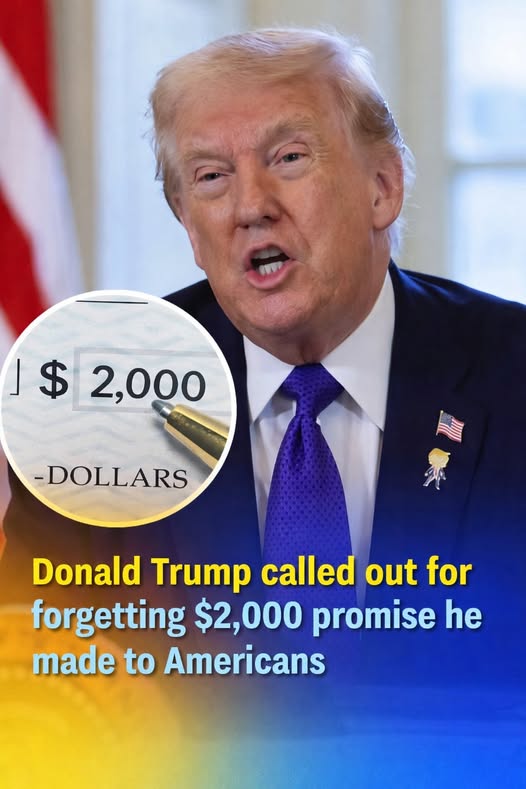
In recent weeks, President Donald Trump’s remarks about a much‑publicized promise to send Americans $2,000 “tariff dividend” checks have triggered widespread attention and considerable debate. In an Oval Office interview published in early January with The New York Times, Trump seemed momentarily uncertain when a reporter asked him to revisit the pledge — a commitment he had made publicly in late 2025 — prompting him to respond, “I did do that? When did I do that?” before later recalling the idea and suggesting the payments could still come “toward the end of the year.” The exchange quickly became fodder for news coverage, social media commentary, and political analysis, as critics pointed to it as evidence of inconsistency or lack of focus, while supporters framed it as a brief lapse during a wide‑ranging discussion on economic policy. Regardless of interpretation, the moment underscored how confusing and uncertain the plan has become in the public eye, raising questions about not only the feasibility of the proposed payments but also the way in which political leaders communicate ambitious policy ideas.
Trump’s proposal — first floated on his social media platform, Truth Social, in November 2025 — centered on a bold claim: that tariff revenues collected by the U.S. government could be so substantial that they would allow a one‑time dividend of at least $2,000 per eligible person, excluding high‑income earners, without adding to the federal deficit. In his posts, Trump touted the supposed windfall from tariffs and suggested Americans would receive direct payments funded by those import duties. Critics quickly raised concerns about the economic math behind that promise, observing that total tariff collections — including import tariffs imposed under Trump’s own policies — amounted to far less than the amount required to fund such payouts. Independent analysts highlighted that tariff receipts through fiscal year 2025 were estimated at roughly $195 billion, a figure substantially below the hundreds of billions needed to pay $2,000 to tens of millions of Americans. Moreover, any such program would almost certainly necessitate legislative approval from Congress, not unilateral executive action, given that rebates or direct payments typically require authorization and appropriation by lawmakers — a requirement underscored by senior administration officials.
Beyond the financial hurdles, the legal and political landscape around the tariff rebate idea has been exceptionally complex. The economic rationale for drawing tariff revenue as a form of dividend has itself been contentious. Some economists have described the proposal as optimistic or even speculative, pointing out that much of the cost of tariffs is often passed through to U.S. consumers in the form of higher prices on imported goods, meaning that any revenue collected represents a redistribution rather than a pure “windfall.” Likewise, the legality of using certain tariff revenues is being tested in court: the Supreme Court is currently weighing challenges to the administration’s broad use of emergency tariff powers, a development that could require repayment of billions in collected tariffs if those duties are deemed unlawful. In such a scenario, the legal foundation for the tariff revenue itself could be undermined, making the promise of $2,000 checks even more tenuous.
Within the administration, there has been at least some internal ambiguity about the structure and mechanism of the proposed payments. Treasury Secretary Scott Bessent has noted that the concept of a “dividend” might not resemble a traditional check at all, suggesting instead that it could take the form of tax relief embedded within other legislation, such as the One Big Beautiful Bill Act tax package enacted in 2025. That interpretation would align the idea more with broader fiscal policy changes rather than a direct cash distribution, though it moves the proposal further from the simple expectation that individuals would receive a straightforward, refundable check akin to the pandemic‑era stimulus payments. Analysts also point out that even if tariff revenue does continue to increase, significant legal, economic, and administrative steps would be required to translate that revenue into payments — steps that have not yet been taken as of early 2026.
Political reactions to Trump’s comments and the evolving promise have been sharply divided along partisan lines, reflecting broader tensions within U.S. political discourse. Critics, including some economists and opposition lawmakers, have seized upon the president’s momentary confusion about the pledge as emblematic of unclear leadership or unrealistic policy proposals. Republican opponents and some independent analysts have also raised concerns that promising large one‑time payments funded by tariffs could be fiscally irresponsible or inflationary, particularly without a clear legislative path and in the context of a continuing federal deficit nearing $2 trillion annually. On the other hand, supporters of the idea argue that the perceptions of inconsistency should not overshadow the underlying policy goal of returning value to American households, and that broader approval of the plan — whether as checks or alternative tax benefits — could stimulate economic activity and expand support for tariff policies. Some of these debates have played out not only in mainstream news coverage but also among various budget watchdog groups, think tanks, and economists examining the long‑term implications of tariff‑based revenue strategies.
It is also important to recognize the public confusion and misinformation that have arisen alongside the proposal. In the months after Trump’s initial announcement, a surge of websites and online groups claimed to offer early registration or application portals for the so‑called tariff dividend checks — none of which were genuine or authorized by the federal government. These scam sites attempted to exploit widespread interest in the idea, underscoring the challenges that arise when high‑profile political promises intersect with a largely unregulated online space. Meanwhile, internal administration discussions and public statements have not fully clarified how or when payments might occur, with some advisers suggesting that any dividend might be tied to broader tax changes or phased implementation, rather than direct cash disbursements. The result has been a mix of hope, skepticism, and outright disbelief among the public, with voters and commentators alike unsure whether — or even when — the proposed $2,000 payments might materialize.
As of early 2026, no federal law authorizing $2,000 tariff dividend checks has been enacted, no IRS plan for distribution has been announced, and no eligibility criteria or payment timeline has been officially established. While Trump’s statement that the checks could happen “toward the end of the year” has offered a rough timeframe, that window leaves many months before any potential implementation, and significant obstacles remain. Congress has not passed legislation to authorize the payments, economists continue to debate the fiscal implications, and legal challenges to the underpinning tariff policies could reshape the revenue base entirely. For now, the $2,000 tariff dividend remains a proposal — one rooted in political ambition and economic creativity — but not yet a realized program or guaranteed benefit. How it evolves will depend on legislative cooperation, economic realities, legal outcomes, and continued political debate, with all sides watching closely as 2026 unfolds.