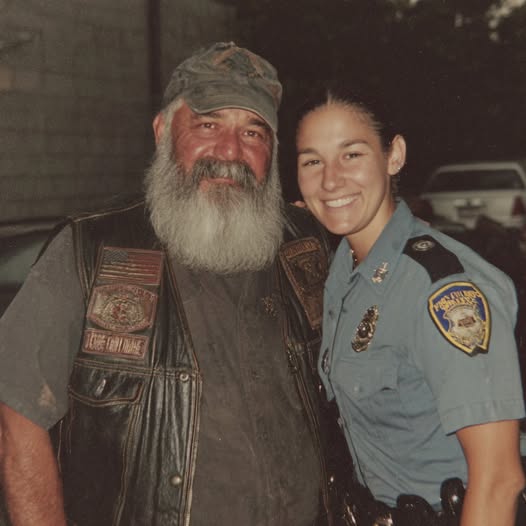
The night the patrol lights flickered against the chrome of an aging motorcycle was meant to be ordinary, just another routine traffic stop at the end of a long shift. Officer Sarah Chen had performed countless stops like this, her movements precise, her voice calm, her mind already anticipating paperwork and protocol. The rider astride the bike, leather jacket worn thin, beard threaded with gray, carried an air of quiet resilience rather than defiance. His eyes, steady and measured, suggested a lifetime of discipline honed by experience. As she approached and requested his license, there was a subtle shift, imperceptible to most. He studied her face longer than anyone dared, not with challenge, but with a disbelief that bordered on awe. Robert “Ghost” McAllister had spent decades scanning crowds, faces, and reflections in windows, always searching for a daughter who vanished before she even learned how to spell her name. In the curve of Sarah’s jaw, the tilt of her head, and a faint crescent-shaped mark just below her ear, he recognized what he had long thought lost forever. His hands trembled—not from fear of authority, but from the collision of memory and present reality. Sarah, trained to read nervousness as a warning sign, interpreted his silence as evasiveness, unaware that the man before her felt as if time itself had folded inward.
As the stop unfolded, Robert’s voice emerged hesitantly at first, then steadied, speaking not to convince but simply to endure the moment. He spoke of a daughter, long gone, taken after a divorce that had already stripped his life down to its essentials. He recounted visitation weekends cherished like sacred rituals, bedtime songs hummed over the rumble of a Harley, and promises made to a child who trusted him completely. When Sarah questioned him about sobriety, he complied without protest, submitting to tests with quiet patience. Between instructions and responses, fragments of a story he had carried for thirty-one years began to emerge. After Amy, his ex-wife, disappeared with their daughter, the trail went cold with terrifying swiftness. Addresses dissolved into empty lots, phone numbers rang into silence, names changed, and records vanished. Investigators yielded no answers, and even the favors of his motorcycle club reached limits when someone determined not to be found. Sarah listened with professional detachment, recording details while maintaining control, yet something in his tone unsettled her. It was not drama that resonated, but restraint. He spoke as someone who had learned to carry grief like a permanent companion—heavy, familiar, and quietly enduring.
At the station, procedure demanded completion, yet even the confirmation of sobriety could not contain the tension between past and present. As Sarah returned his belongings, a small, frayed photograph slipped from his wallet, landing face-up on the desk. It depicted a little girl perched proudly on a motorcycle, helmet oversized, smile fearless. Sarah froze. The child’s face was unmistakably her own. Confusion surged, followed by the instinctive denial that arises to protect a life constructed on certainty. Robert, reading the shift in her expression, realized that the fragile thread connecting past and present had tightened irrevocably. He shared details no stranger could invent: off-key songs, scars from childhood accidents, habits of counting steps when nervous. Sarah’s composure fractured—not in tears, but in stunned silence. Her adoptive parents had long told her her biological parents died in a motorcycle accident, a narrative that explained absence and closed questions. Yet here was a living contradiction, breathing and waiting, asking nothing but recognition. He did not demand belief, only that she confront the questions she had been taught never to ask.
The truth, when fully revealed, did not arrive gently. Confronted by Sarah, her adoptive parents struggled beneath decades of secrecy, confessing that Amy was, in fact, her biological mother’s sister—a desperate woman who had fled an unstable life, convinced Robert’s world was too dangerous for a child. When Amy later died in a car accident, the Chens had chosen stability over full transparency, raising Sarah with love built on carefully constructed lies. The revelation shattered her world, forcing a reevaluation of every memory, every carefully framed story. Anger surged first, followed by grief for a childhood shaped by absence and misinformation. Robert felt no triumph, only a profound relief tinged with hollowness. He had imagined this moment countless times, yet none captured the quiet devastation of seeing how thoroughly his daughter’s life had been redirected without his knowledge. Every imagined reunion fell short of the intensity of the reality, a collision of lost time and fragile hope.
Reunion did not erase thirty-one years of separation. It unfolded gradually, awkwardly, as boundaries were tested and trust painstakingly rebuilt. Sarah struggled to reconcile her uniform with his leather jacket, the warnings she had absorbed with the tenderness he displayed. Slowly, familiar gestures stirred echoes of early childhood, memories long buried but not destroyed. Her own children met their grandfather cautiously, then with joy, sensing instinctively that this connection mattered. The Sacred Riders, once a symbol of danger in Sarah’s imagination, revealed themselves as a family bound by loyalty and perseverance. Men who had scoured highways and borders for decades presented boxes of birthday gifts saved, letters never sent, and stories preserved in hope. Sarah discovered a community built not on appearances but on endurance and shared purpose. Each interaction dismantled another piece of the narrative she had been taught to fear, revealing instead a network of commitment, care, and love that had quietly endured through decades of uncertainty.
Six months later, the traffic stop that had changed everything has become a marker rather than a memory. Sarah remains in law enforcement, yet her understanding of justice has deepened, shaped by personal loss and recovered truths. Together with Robert and the Sacred Riders, she has helped establish a program dedicated to locating missing children, bridging trust between biker communities and police departments. What once seemed opposing worlds now collaborate toward a shared goal. Publicly, Sarah acknowledges the men she once feared as allies and protectors, redefining heroism through action rather than image. Her relationship with the Chens continues, complex and evolving, grounded in honesty finally spoken. Robert keeps the framed arrest paperwork on his wall, not as irony, but as reverence. It marks the moment hope triumphed over decades of uncertainty. A broken taillight became a beacon, illuminating a path back to family, identity, and a future rebuilt from truths once buried but never erased.