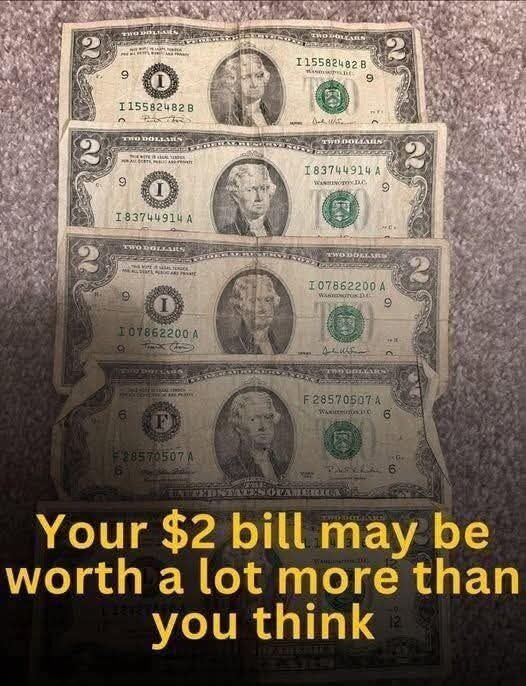
For generations, the humble $2 bill has occupied a strange place in American culture, hovering somewhere between curiosity and superstition. At various points in history, it was whispered to be unlucky, linked to gambling losses, broken traditions, and even bad fortune. Some refused to carry it, others spent it immediately to rid themselves of perceived misfortune. Yet these beliefs were never rooted in fact. In reality, the $2 bill has always been legitimate legal tender, quietly circulating through the economy while accumulating stories that gave it an air of mystery. Today, that same mystique has helped transform it from an overlooked oddity into a potentially valuable collectible, surprising many who once dismissed it as little more than an inconvenience.
One reason the $2 bill has been so misunderstood is its unusual circulation pattern. Unlike the $1, $5, or $10 bills, it is printed far less frequently, which creates the illusion of rarity. Many Americans grow up rarely seeing one, leading to the assumption that it has been discontinued or is no longer accepted. In truth, the U.S. Treasury continues to print $2 bills, though demand remains low. Because people tend to save them instead of spending them, fewer appear in everyday transactions. This self-fulfilling cycle reinforces the belief that the bill is uncommon, when in fact millions exist, tucked away in drawers, wallets, and forgotten envelopes.
The design of the $2 bill also adds to its intrigue. Featuring Thomas Jefferson on the front and an engraving of the signing of the Declaration of Independence on the reverse, it stands apart from other denominations in both appearance and symbolism. Over the years, design changes, seal colors, serial numbers, and printing errors have turned certain versions into highly sought-after items. Older red-seal notes from the 1920s and 1950s, for example, can be worth significantly more than their face value, especially if they are in pristine condition. Star notes, low serial numbers, repeating digits, and misprints can elevate a simple $2 bill into a collector’s prize worth hundreds or even thousands of dollars.
Condition plays a critical role in determining value. A crisp, uncirculated bill with sharp corners and no folds is far more desirable than one that has passed through countless hands. Collectors look closely at paper quality, ink clarity, alignment, and any signs of wear. Even modern $2 bills can command premiums if they meet specific criteria, such as being part of a limited print run or featuring unusual serial number patterns. What many people spend without a second thought could, under the right circumstances, be a small financial windfall waiting to be recognized.
Beyond monetary worth, the $2 bill carries cultural significance that adds to its appeal. It has been used as a political statement, a lucky charm, a novelty gift, and even a form of protest against conformity. Some businesses display them proudly, others refuse them out of unfamiliarity, and many people hold onto them simply because they feel special. This emotional attachment fuels demand among collectors who value the story behind the currency as much as the currency itself. Each bill becomes a tiny artifact of American history, reflecting changing attitudes toward money, superstition, and perceived value.
Ultimately, the $2 bill’s true power lies in how it challenges assumptions. Something widely dismissed as unlucky or useless may, in fact, be valuable—financially, historically, or symbolically. In a world that often equates worth with visibility and frequency, the $2 bill reminds us that rarity is sometimes a matter of perception rather than reality. Whether tucked into a wallet or framed as part of a collection, it stands as proof that even the most overlooked objects can carry unexpected significance, rewarding those curious enough to take a closer look.