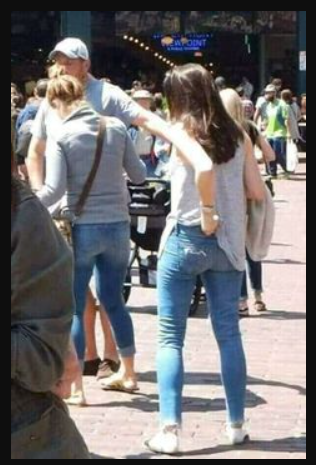
Sometimes a single photograph can quietly confuse the brain before delighting it, revealing how unreliable first impressions can be. At a glance, images like these appear completely ordinary—people walking, standing, talking, living their everyday lives. Yet with a closer look, something feels off. A missing limb, a strangely positioned body, an impossible perspective. These moments aren’t staged, edited, or manipulated. They are the result of perfect timing, overlapping movement, and the unpredictable choreography of real life. What makes such photos captivating is not just their humor, but the way they expose how quickly the human mind fills in gaps, assumes context, and constructs reality from incomplete visual information. In a split second, our brains tell us a story that isn’t quite true, and it’s only when we pause that the illusion reveals itself.
The image above is a classic example of this phenomenon. At first glance, the scene feels confusing, even slightly unsettling. A casual crowd moves through a public space, sunlight casting sharp shadows, bodies overlapping in motion. One figure seems oddly proportioned, another appears to be missing something essential, and the perspective tricks the eye into seeing something that simply isn’t there. But the longer you look, the clearer it becomes: nothing unusual is actually happening. Arms align with torsos they don’t belong to, legs overlap at just the wrong angle, and depth perception collapses into a single flat plane. The humor lies in that brief moment of misinterpretation, when your brain insists on an impossible explanation before logic gently corrects it.
These kinds of images work because human perception is not a camera—it’s a storyteller. The brain is constantly trying to make sense of the world as efficiently as possible, prioritizing speed over accuracy. When presented with a crowded scene, it doesn’t analyze every detail individually. Instead, it groups shapes, assumes continuity, and fills in missing information based on past experience. Most of the time, this works beautifully. But occasionally, reality presents a combination of angles and movements that short-circuits this process. A stranger’s arm becomes someone else’s limb. A stroller aligns perfectly with a torso. A shadow erases a boundary. The result is a visual puzzle that exists only because the brain is doing exactly what it evolved to do.
What makes these photos especially popular in the age of social media is their universality. You don’t need specialized knowledge to appreciate them. Anyone, regardless of language or culture, can experience that brief flicker of confusion followed by amusement. They invite interaction, encouraging viewers to zoom in, tilt their heads, and share the image with others accompanied by a simple phrase: “Look again.” In a digital world saturated with curated perfection and heavily edited visuals, these accidental illusions feel refreshingly authentic. They remind us that humor doesn’t always require intention and that some of the most entertaining moments are born from chance.
Beyond humor, there’s something quietly philosophical about these images. They reveal how limited perspective can distort understanding, not just visually but metaphorically. Just as a single angle can mislead the eye, a single viewpoint can mislead judgment. Only by stepping back, examining context, and allowing time for reflection does clarity emerge. In that sense, these photos become small lessons in patience and perception. They reward those who slow down, who resist the urge to react instantly, and who are willing to reconsider their initial assumptions.
In the end, funny pictures that require a second look endure because they capture something deeply human. They show us that reality is not always what it seems, that our minds are wonderfully flawed, and that laughter often lives in the space between expectation and truth. Long after the confusion fades, what remains is a shared smile—a reminder that sometimes the most ordinary moments, frozen at exactly the right second, can turn into unforgettable visual surprises simply by asking us to look again.