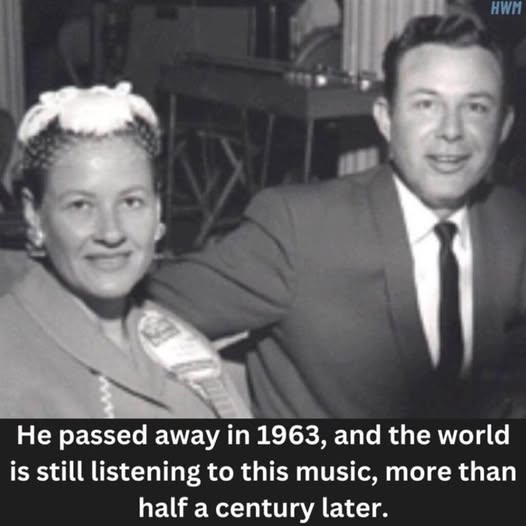
In 1960, Jim Reeves released a song that did not arrive with spectacle or bravado, yet it quietly altered the course of American music. Titled “He’ll Have to Go,” the recording stood apart from much of what dominated radio at the time. There were no dramatic flourishes, no lyrical excess, and no attempt to chase trends. Instead, the song relied on intimacy, emotional honesty, and restraint, inviting listeners into a private moment of longing and vulnerability. At a time when country music was still widely viewed as regional and rooted in tradition, Reeves offered something different: a sound that felt refined, universal, and emotionally accessible. The song crossed boundaries with ease, resonating with listeners who had never considered themselves fans of country music. Its success proved that subtlety could be powerful and that a whisper, delivered with sincerity, could travel farther than a shout.
Central to the song’s impact was Jim Reeves himself, an artist whose approach to music reflected patience, discipline, and deep emotional intelligence. Born James Travis Reeves in Galloway, Texas, in 1923, he grew up with music as a constant presence but did not rush toward stardom. Before committing fully to singing, Reeves worked as a radio announcer and disc jockey, experiences that profoundly shaped his vocal style. Behind the microphone, he learned how pacing, clarity, and tone could hold attention without force. Those lessons carried seamlessly into his singing. Unlike many of his contemporaries, Reeves avoided exaggerated emotion, trusting instead in understatement. By the late 1950s, he was already respected within country music, yet his reach remained largely within the genre. “He’ll Have to Go” became the turning point, elevating him from a successful country performer to an artist whose appeal transcended categories.
The inspiration behind the song was as understated as the recording itself. Written by husband-and-wife duo Joe and Audrey Allison, the idea emerged from a moment Joe Allison witnessed in a bar. He overheard one side of a phone conversation in which a man repeatedly asked the woman on the other end to move closer so he could hear her. The man’s words carried urgency, tenderness, and a quiet desperation that lingered long after the call ended. That fleeting, deeply human exchange became the foundation of the song. Its opening line, “Put your sweet lips a little closer to the phone,” immediately places the listener inside an intimate emotional space. There is no backstory, no explanation, only the raw realization that love may be slipping away. This simplicity allowed listeners to insert their own experiences into the song, making it feel personal rather than performative.
When Reeves brought the song into the studio, producer Chet Atkins approached it with the same philosophy of restraint. Atkins, a key architect of what would become known as the Nashville Sound, understood that accessibility did not require dilution. The arrangement avoided the rough edges traditionally associated with country music, favoring gentle instrumentation and subtle orchestration that framed Reeves’ voice rather than competing with it. Reeves sang in a low, conversational register, as if speaking directly to one person rather than addressing an audience. Every pause carried meaning, every word felt deliberate. The result was a recording that felt intimate even when played through a radio speaker, creating the illusion that the listener was overhearing a private confession rather than consuming a commercial product.
The response was immediate and transformative. “He’ll Have to Go” reached number one on the Billboard Country Chart and climbed to number two on the pop charts, a rare achievement at the time. Its success marked a pivotal moment in how country music was perceived nationally and internationally. The song demonstrated that the genre could appeal to a broad audience without sacrificing emotional authenticity. Radio stations across formats embraced it, jukeboxes carried it into diners and bars, and listeners returned to it repeatedly because of how it made them feel. Rather than fading with time, the song grew stronger, becoming a defining example of how emotional restraint can create lasting impact. It helped solidify the Nashville Sound and positioned Reeves as one of its most important ambassadors, opening doors for future artists to cross genre boundaries with confidence.
Jim Reeves’ career expanded rapidly after the song’s success, carrying him far beyond American borders. He became one of the first country artists to achieve true international stardom, performing throughout Europe, Africa, and beyond. In places like South Africa and the United Kingdom, he introduced audiences to a genre they had rarely encountered, proving that emotional truth required no translation. His life was tragically cut short in 1964 when he died in a plane crash at just forty years old, but his influence did not end with his passing. “He’ll Have to Go” continued to shape music long after it left the charts, inspiring countless covers by artists such as Elvis Presley and Ry Cooder while remaining definitive in its original form. More than sixty years later, the song endures because it speaks to universal moments of uncertainty, love, and vulnerability. Jim Reeves showed that elegance, sincerity, and quiet confidence could change music forever, and as long as listeners continue to seek honesty in song, his legacy will continue to roll on.