Dyan Cannon’s name still carries the weight of a Hollywood era when movie stars were not merely actors but living symbols of glamour, transformation, and cultural aspiration. Emerging during a period when cinema helped shape social attitudes as much as it entertained, Cannon became instantly recognizable for her radiant smile, expressive eyes, and a charisma that felt both playful and deeply intelligent. She embodied a form of screen presence that was effortless yet precise, captivating without appearing calculated. For audiences, her life seemed to unfold like a polished script filled with premieres, accolades, and iconic roles, suggesting permanence and ease. Yet behind that carefully lit image existed a woman negotiating the immense pressures of fame, beauty standards, and expectation in an industry that rarely forgave vulnerability. Decades later, her continued visibility—now stripped of Hollywood artifice—still provokes reaction, proving that cultural fascination with female icons does not end when the spotlight dims but instead follows them into every stage of life.
Her career remains a testament to artistic range, resilience, and professional longevity in an industry notorious for discarding women once they outgrow narrow definitions of desirability. Cannon was never confined to a single persona; she moved fluidly between comedy, drama, and mystery, earning respect not just from audiences but from critics and peers alike. Three Academy Award nominations, multiple Golden Globe recognitions, and a Saturn Award marked her as one of the most accomplished actresses of her generation. In 1983, her legacy was permanently etched into Hollywood history with a star on the Walk of Fame, a recognition reserved for artists whose influence transcends trends. Films such as Bob & Carol & Ted & Alice, Heaven Can Wait, The Last of Sheila, and Deathtrap showcased her ability to blend wit with emotional depth, often revealing complexity beneath charm. Her performances felt authentic because they mirrored her own evolving understanding of strength and vulnerability, qualities that would later define her life beyond the screen.
One of the most scrutinized chapters of Cannon’s life was her marriage to Cary Grant, a union that seemed destined for Hollywood legend. To the public, it appeared as a fairy tale pairing: the timeless leading man and the luminous rising star. Media fascination followed their every move, projecting romance, privilege, and perfection onto their relationship. Yet the private reality proved far more difficult. Cannon later spoke candidly about the emotional strain of the marriage, describing a dynamic that left her feeling controlled and diminished, gradually losing sight of her own identity. She has explained that she entered the relationship young and impressionable, shaped by expectations that were incompatible with her sense of self. Though the marriage lasted only three years, its psychological impact extended far beyond its end, forcing her to confront questions of autonomy, self-worth, and the high personal cost of living under relentless public observation.
Despite the pain associated with that period, Cannon has consistently resisted rewriting history with bitterness. She has spoken of her love for Grant with honesty and nuance, acknowledging both the affection they shared and the harm she endured. Their daughter, Jennifer, born in 1966, became the lasting bond that connected them beyond divorce headlines and cultural mythology. Motherhood provided Cannon with a grounding force in a life often defined by external validation, offering purpose untouched by box office numbers or public opinion. As the years passed, she continued working across film, television, writing, and directing, refusing to allow a single relationship or era to define her entire narrative. Her resilience emerged not through denial of hardship but through confronting it openly, choosing growth over silence and self-definition over imposed roles.
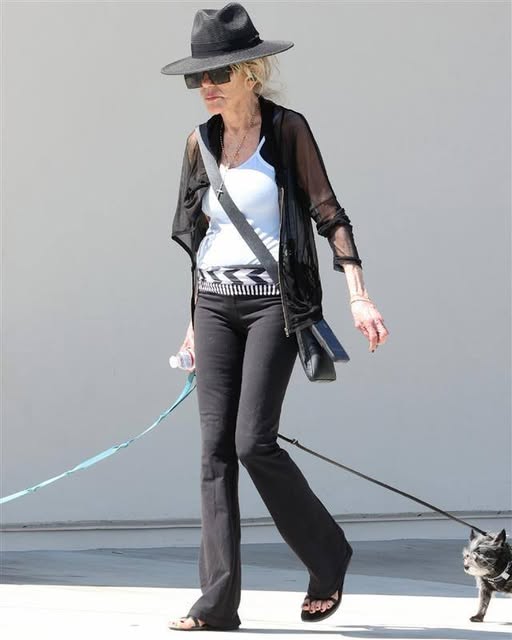
In recent years, Cannon unexpectedly reentered public discourse for something profoundly ordinary: walking her dogs near her modest home. Photographs captured her in her late eighties, dressed casually, unstyled, moving calmly through daily life. The images ignited a flood of online reactions that ranged from admiration to cruelty, exposing society’s unresolved discomfort with aging—particularly when it involves women once idealized for youth and beauty. Some praised her vitality and independence, while others responded with shock or judgment, seemingly unsettled by the contrast between memory and reality. The intensity of these reactions revealed far more about cultural anxieties than about Cannon herself. Her quiet walk became a symbol, forcing viewers to confront their own expectations of how female icons should look, age, and ultimately disappear from view.
Now in her late eighties, Dyan Cannon speaks about her life with a serenity that feels deeply earned. She credits faith, introspection, and spiritual growth for guiding her toward a form of happiness no longer dependent on applause or approval. Having lived through fame, heartbreak, reinvention, and relentless scrutiny, she describes herself with gentle humor and humility, calling herself “a happy puppy now.” In that simple phrase lies a profound victory: a woman who has stepped beyond Hollywood narratives and societal judgment to define herself on her own terms. Her story endures not as nostalgia or caution, but as a living reminder that aging is not a failure of image but an expansion of identity. Cannon’s presence—quiet, unfiltered, and unapologetically human—continues to challenge the world to rethink how it views women, legacy, and the courage it takes to remain visible long after the cameras stop rolling.