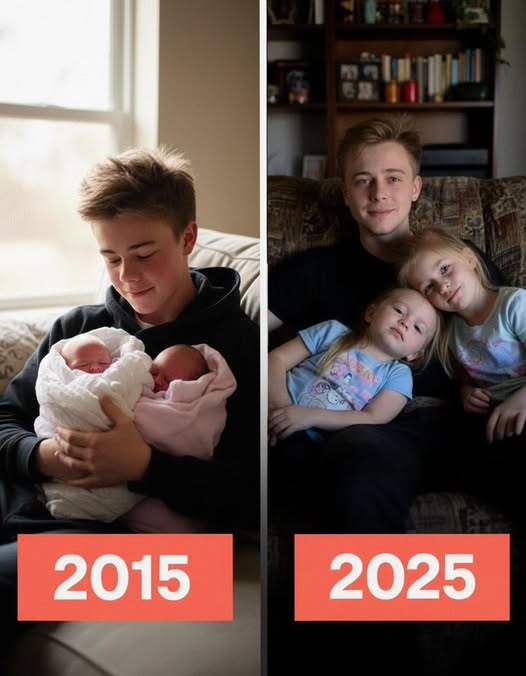
When tragedy struck, James was twenty-five years old and standing at the edge of what he believed would be the happiest chapter of his life. A wedding date had been circled on the calendar, invitations discussed over dinner, and the future imagined in comfortable, predictable shapes. Then his mother died unexpectedly, and in a matter of days, everything collapsed inward. James did not just lose a parent; he inherited a responsibility that reshaped his entire existence. His ten-year-old twin sisters, suddenly orphaned, needed a guardian, and there was no one else to step forward. James moved out of his apartment, adjusted his work schedule, and took over a household filled with echoes of loss. In the midst of this upheaval, his fiancée Jenna seemed to rise to the moment. She moved into the family home without complaint, learned the girls’ routines, packed their lunches, braided their hair, and spoke often about becoming their “big sister.” To James, drowning in grief and uncertainty, her enthusiasm felt like a lifeline. He believed he was witnessing love in action—a partner willing to sacrifice, adapt, and help him honor his mother’s legacy by keeping the family together. For a while, the idea carried them all forward.
As the weeks passed, however, grief settled into routine, and routine made room for observation. James began noticing moments that unsettled him, though he struggled at first to give them meaning. Jenna’s kindness sometimes felt performative, delivered with exaggerated warmth when others were present, then replaced by tight smiles and impatience when no one was watching. She corrected the twins sharply over minor mistakes, complained about the house feeling “too crowded,” and spoke often about how temporary everything was. When James asked if she was overwhelmed, she laughed it off, insisting she was simply tired. He wanted to believe her. He needed to believe her. Between legal paperwork, school meetings, and nights spent calming the girls after nightmares, he did not feel equipped to question the one person who claimed to be standing beside him. Still, unease lingered. Compassion, he was learning, had a texture to it, and something in Jenna’s version felt thin, rehearsed, as though she were playing a role rather than living it.
The truth arrived not in an argument or confession, but in an ordinary moment stripped of drama. One Tuesday afternoon, James came home early after a meeting was canceled. As he stepped inside, he heard Jenna’s voice from the living room and froze. Standing unseen in the hallway, he listened as she spoke to the twins in a tone that made his stomach tighten. She told them not to “get too comfortable,” warned them that once the adoption paperwork was completed they would be sent to foster care, and mocked their tears when they protested. There was no anger in her voice, no stress-induced snapping—only calm certainty. Later, still unseen, James heard her on the phone with a friend, outlining her plan with chilling clarity. She wanted James to finalize the adoption so the girls would become his sole legal responsibility, not hers. After that, she intended to push him to sign over his mother’s house and insurance benefits, free of the “extra baggage.” In that moment, the ground shifted beneath him. The woman he thought he knew had never intended to build a family; she had been managing an obstacle. Every lunch packed, every braid woven, every tender word had been strategy. James felt a new kind of pain take hold—one not rooted in loss, but in betrayal.
James did not confront her that night. Shock muted his anger, and instinct told him that reacting too quickly would put the girls at risk. Instead, he chose silence and observation. He reassured Jenna, nodded along to her plans, and even encouraged her enthusiasm for a large, elaborate wedding she suddenly became eager to organize. Behind the scenes, he began documenting everything. Nanny cameras already installed for the girls’ safety became witnesses. Conversations were recorded, patterns established, and evidence quietly gathered. It was not revenge that motivated him, but protection. James understood that if Jenna felt exposed too soon, she could twist the story, present herself as the overwhelmed caregiver, and cast him as unstable. He needed the truth to speak for itself. The wedding planning became surreal, a performance layered over a crumbling foundation. Guests admired Jenna’s devotion to the girls, unaware that James was preparing to dismantle the illusion she had so carefully constructed.
The moment of reckoning arrived at the wedding reception, a setting chosen not for spectacle, but for finality. Surrounded by family and friends, James took the microphone and thanked everyone for their support during the most difficult year of his life. Then he played the recordings. The room shifted from celebration to disbelief as Jenna’s voice filled the air, calm and calculating, describing the twins as burdens, plotting to remove them, dismissing their grief as inconvenience. Gasps rippled through the crowd. Jenna tried to interrupt, to laugh it off, to claim misunderstanding, but her own words cut through every attempt at deflection. The mask fell completely. In the days that followed, she attempted to regain control, blaming stress, grief, and misinterpretation. It did not work. James ended the relationship, secured legal protections for the girls, and ensured Jenna could no longer contact them. The wedding that never happened became irrelevant. What mattered was that the truth was no longer hidden.
Weeks later, the adoption was finalized. James stood in a quiet office and signed papers that transformed responsibility into permanence. When he told the twins they were officially staying forever, they did not cry or shout. One of them simply whispered, “We knew you’d choose us.” That night, they celebrated with a simple dinner, music playing softly in the background, and a single candle lit in memory of their mother. The house felt different—not empty, not crowded, but whole. James understood then that his life had not been ruined by tragedy or betrayal; it had been clarified. Love, he realized, is not proven by grand gestures or public declarations, but by choices made when no one is watching. What he had lost was painful, but what he had gained was unshakable. In the quiet glow of that kitchen, with two small hands gripping his, James stepped fully into a role he had never planned for—and discovered that the family built through conscious choice was stronger than any dream he had once imagined.