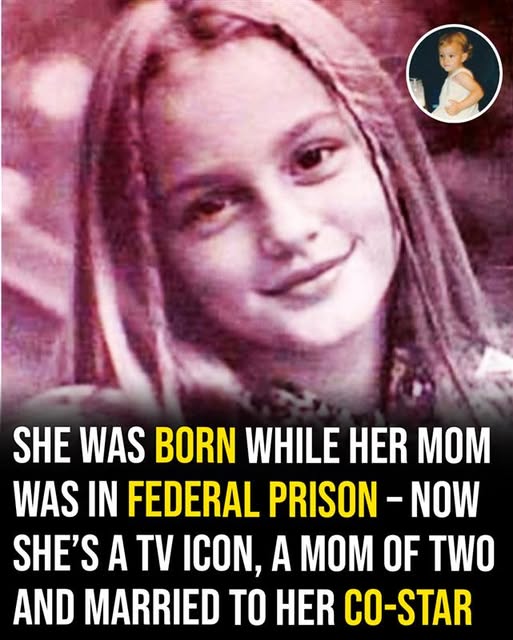
She entered the world under circumstances that could have easily confined her future to a narrow set of expectations. Born while her mother was serving time in a federal prison and with a father deeply involved in criminal activity, Leighton Meester’s earliest chapter was shaped by instability before she could even speak. Many lives that begin this way are defined by limitation rather than possibility, their narratives framed by what went wrong rather than what might still go right. Yet Meester’s story would become a powerful counterpoint to that assumption. It is not a tale of sudden rescue or overnight transformation, but one of quiet endurance and gradual self-determination. From the very beginning, her life demanded adaptability. She spent her earliest months in a halfway house, later cared for by her grandmother, moving between homes as her family situation shifted. The environment was unpredictable, but it did not strip her of warmth or memory. Looking back, she has often resisted simplifying her childhood into a single tragic label, choosing instead to acknowledge both its hardships and its moments of normalcy. That refusal to let her origins fully define her would become a defining trait.
Meester was born while her mother, Constance, was incarcerated in a Texas federal prison for drug trafficking, a fact that would later attract headlines but never quite captured the complexity of her upbringing. After her birth, her mother spent a short period with her in a facility near the prison before returning to complete her sentence. Her father, also involved in large-scale drug smuggling, was eventually imprisoned as well, and the marriage ended in divorce in the early 1990s. For a time, Meester was raised by her paternal grandparents, who provided a measure of stability amid the broader chaos. Despite her parents’ criminal histories, she has said they tried to give her as normal a childhood as possible. There were beach days, outdoor play, and simple joys that existed alongside uncertainty. “I look back now and I see it in a nice light,” she once reflected. “It wasn’t uncomplicated, but there were happy, fun times.” That ability to hold two truths at once—the difficulty and the goodness—shaped her emotional resilience long before she entered the public eye.
Her path toward entertainment began not with grand ambition but with circumstance and necessity. At the age of ten, Meester was discovered at a modeling convention in Atlanta, an opportunity that opened doors while also introducing adult responsibilities far earlier than most children face. She moved to New York City to work in commercials and modeling, balancing auditions with schoolwork and learning quickly how to navigate professional environments. By fourteen, she relocated again, this time to Los Angeles, where she began acting classes and auditioning for television roles. Unlike many child actors driven by dreams of stardom, Meester has said her motivations were more practical. Financial insecurity was a constant concern. “I was worried we didn’t have gas money or food,” she later admitted. Those realities shaped her work ethic and grounded her ambitions. Acting was not about glamour; it was about stability. Her early television appearances, including guest roles on shows like Law & Order, slowly built her résumé and introduced her to the rhythms of the industry without catapulting her prematurely into fame.
That changed dramatically in 2007, when, at just nineteen years old, Meester was cast as Blair Waldorf on Gossip Girl. The series quickly became a cultural phenomenon, and Blair—sharp-tongued, impeccably styled, and unapologetically ambitious—emerged as one of television’s most iconic characters. The role transformed Meester into a global star almost overnight. Fashion trends, dialogue, and character archetypes across teen television were influenced by Blair’s presence. Yet fame brought its own challenges. Long shooting schedules, relentless media attention, and the pressure of growing up in public tested her sense of self. “I was young when I started the show,” Meester later reflected. “If you don’t have the right perspective, you could definitely be confused by people being that nice to you or judging behavior that’s typical of a 20-year-old.” Unlike her character, whose confidence was unwavering, Meester had to learn in real time how to separate public perception from private identity, a skill not easily acquired at such a young age.
Away from the spotlight, she deliberately built a life that offered balance rather than spectacle. In 2014, she married actor Adam Brody in a private ceremony, after quietly dating following their collaboration on The Oranges. The relationship stood in contrast to the highly public romances often associated with Hollywood, marked instead by discretion and mutual respect. Together, they chose to keep their family life largely out of the public eye, shielding their children from unnecessary exposure. Motherhood further reshaped Meester’s priorities. She began choosing projects more selectively, often favoring independent films or limited television roles that allowed her to remain present at home. “There’s been a lot of stuff that I haven’t done because I want to be with them,” she said in 2025. “I don’t like being away from them.” Her choices signaled a broader redefinition of success, one that valued consistency and emotional availability over constant visibility.
Throughout her career, Meester has spoken candidly about how her upbringing influenced her worldview. She has described herself as nonjudgmental and open-minded, shaped by early exposure to complexity rather than simplicity. Even legal conflicts, such as a highly publicized dispute with her mother over financial support intended for her younger brother, were handled with restraint. She ultimately prevailed in court without seeking restitution, emphasizing her desire to protect her sibling rather than prolong conflict. Beyond acting, she explored music, releasing pop singles before stepping back to pursue a sound that felt more authentic. Her album Heartstrings reflected that shift, prioritizing sincerity over trend-chasing. Even recent hardships, including the loss of her family’s Pacific Palisades home in devastating Los Angeles fires, have reinforced her grounded perspective. Reflecting on love, loss, and uncertainty, she noted that despite everything, most days are still “pretty damn good.” From a birth marked by confinement to a life defined by choice, Leighton Meester’s journey stands as a testament to resilience, intention, and the quiet power of redefining destiny on one’s own terms.