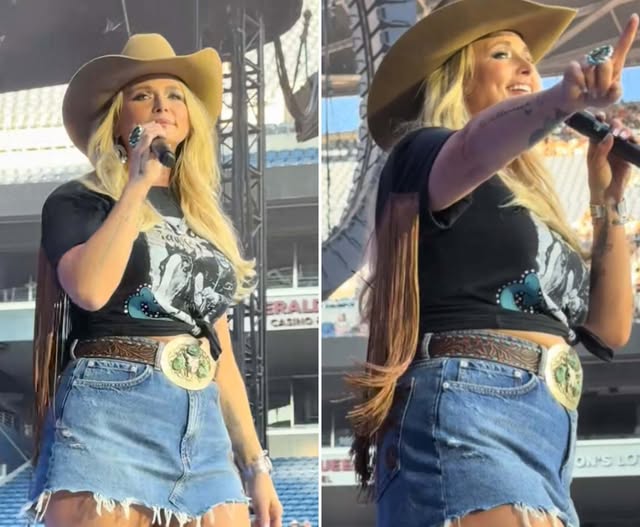
Miranda Lambert’s Las Vegas residency has been marked by sold-out crowds, sustained excitement, and the kind of audience energy that reflects her long-standing bond with fans. Yet amid the applause and celebration, one brief pause during a recent performance has again placed her at the center of a broader cultural conversation that extends far beyond country music. The moment itself was subtle, calm, and fleeting, but in the modern digital environment, even the smallest gesture from a high-profile artist can ripple outward with surprising force. Lambert’s pause echoed an earlier viral incident that had already sparked intense online debate about smartphones at concerts, artist boundaries, and audience attentiveness. In an era when live events are not only experienced in real time but also recorded, shared, and dissected across social platforms, the line between presence and documentation has grown increasingly blurred. Lambert, known for her emotional authenticity and grounded stage presence, appeared fully aware of this tension. Rather than reacting impulsively, she addressed the crowd in a manner that suggested reflection and intention, reminding audiences that live performances are shared spaces shaped equally by artists and fans.
The earlier incident, in which Lambert reacted to a fan taking a selfie during her performance, became a lightning rod for opinion almost instantly. Some viewers interpreted her response as irritation, while others viewed it as a reasonable appeal for attention during a live, emotionally driven song. The polarized reactions revealed how deeply divided modern audiences have become over what constitutes respectful behavior at concerts. For many fans today, capturing photos or videos is inseparable from the experience itself. These recordings serve as souvenirs, social currency, and proof of participation in a cultural moment. For artists, however, the constant presence of phones can feel like a barrier, turning a room filled with people into a field of glowing screens. Lambert’s music, rooted in storytelling, vulnerability, and emotional honesty, depends heavily on a sense of mutual presence. When that connection is disrupted, even briefly, it can affect not only the flow of the performance but also the emotional exchange that gives live music its power. The renewed attention sparked by her Las Vegas pause underscores how unresolved and emotionally charged this issue remains.
What made the recent interruption particularly notable was its timing and tone. Occurring during an upbeat segment of the show, it stood out without feeling confrontational. Observers noted that Lambert’s demeanor was controlled and measured, suggesting a conscious effort to avoid escalating the situation. In today’s concert landscape, performers are acutely aware that every action may be recorded and reinterpreted far beyond the venue itself. A single moment can overshadow hours of preparation, rehearsal, and artistic expression. Lambert’s approach reflected a careful balance between asserting her presence on stage and maintaining goodwill with the audience. She did not halt the show or single out individuals aggressively, instead choosing words and timing that acknowledged distraction without derailing the performance. The fact that this moment reignited widespread online discussion illustrates how sensitive audiences have become to perceived power dynamics between artists and fans, as well as how quickly narratives form in the age of instant sharing.
Fan reactions have continued to reflect a wide range of expectations about what a concert experience should be. Supporters of Lambert argue that artists have every right to define the atmosphere of their own performances. From this perspective, asking fans to stay present is not about control but about preserving the emotional integrity of live music. These supporters emphasize that concerts are not passive entertainment but collaborative experiences built on shared energy, attention, and respect. Others, however, feel that even brief interruptions can disrupt enjoyment, particularly for audience members who were not involved in the moment that prompted the pause. For them, concerts are spaces where personal expression, including taking photos or videos, should comfortably coexist with the performance. This clash of viewpoints reflects generational differences, evolving norms around technology, and deeply personal interpretations of respect, freedom, and participation.
Lambert’s response to the renewed attention suggests an artist attempting to move forward without allowing controversy to define her work. While she has not issued a formal apology regarding the earlier backlash, she has subtly acknowledged the broader issue by encouraging fans to enjoy the music and remain present. This message aligns closely with her long-established public image as an artist who prioritizes authenticity over spectacle. Rather than framing the situation as a conflict between herself and her audience, Lambert appears to be reframing it as a shared responsibility. Her continued professionalism, energy, and commitment throughout the residency signal that she remains focused on delivering meaningful performances rather than engaging in prolonged public debate. In doing so, she reinforces the idea that live music is about connection first, documentation second.
The ongoing discussion surrounding Lambert’s Las Vegas moments speaks to a larger transformation occurring across live entertainment. Smartphones have fundamentally changed not only how audiences interact with performers but also how performers experience their own art. Every pause, glance, or comment now exists within a larger digital ecosystem where meaning can be reassigned and amplified instantly. Lambert’s experience highlights the challenge artists face in preserving the emotional core of live music while adapting to modern audience behavior. As concerts continue to evolve, moments like these serve as reminders that live performances are shared rituals, dependent on mutual awareness and respect. Whether fans prioritize presence or personal freedom, the intensity of the debate itself reveals how deeply people care about live music and the connections it fosters. In that sense, Lambert’s brief pause has grown into something larger than an interruption; it has become a symbol of the ongoing negotiation between attention, technology, and human connection in the digital age.